





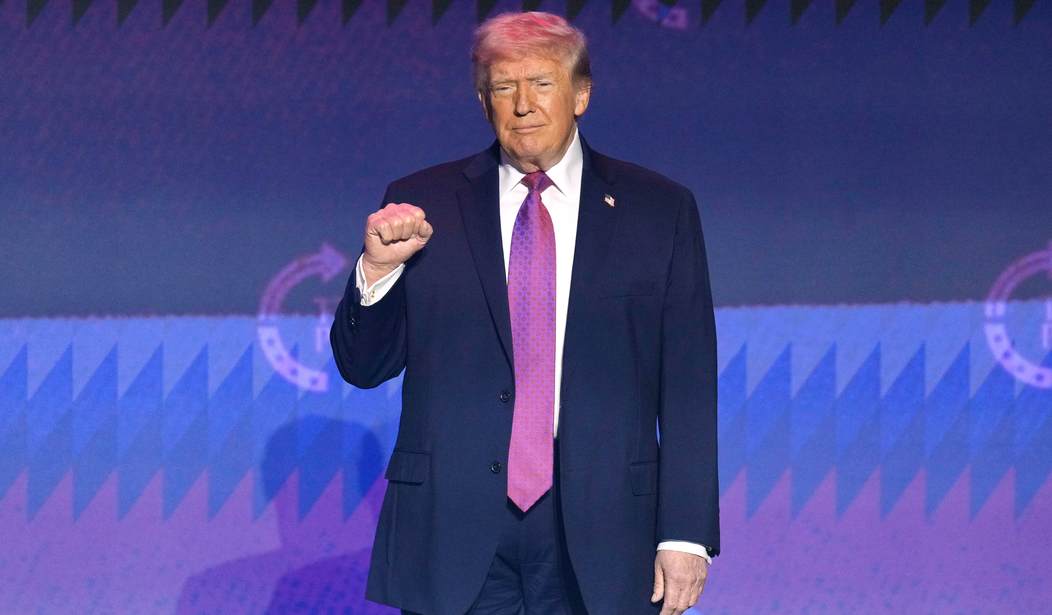
"The executive Power shall be vested in a President of the United States of America," read the very first sentence of Article II, Section 1 of the Constitution defining the executive branch of the United States government. "And it means what it says," the Supreme Court basically ruled Monday morning in a little case called Trump v. Slaughter.
Let me set the stage for today's momentous decision as briefly as possible. I might even have a little fun with it.
Early in his second term, President Donald Trump fired two Democrat commissioners of the Federal Trade Commission (FTC), Alvaro Bedoya and Rebecca Slaughter. The 1914 Progressive-era law establishing the FTC says commissioners can only be fired for "inefficiency, neglect of duty, or malfeasance in office."
Trump — much to his credit, but stick a pin in that thought — made no such claim against either Bedoya or Slaughter. He fired them because he didn't want them working for him any longer. Slaughter, whose resumé consists of legal and government positions having apparently nothing to do with trade, sued.
"The President illegally fired me from my position as a Federal Trade Commissioner, violating the plain language of a statute and clear Supreme Court precedent," she claimed.
The precedent Slaughter referred to is the 1935 case, Humphrey’s Executor v. United States, upholding Congress's authority to protect certain executive branch roles — like FTC commissioners — from getting the presidential heave-ho without cause.
So the way I see it, two things were at stake in Trump v. Slaughter. The first is the separation of powers issue concerning Article II, Section 1. Is executive power vested in the President of the United States of America, or can Congress create an executive branch position only partly within the executive power? The second was the precedent set by Humphrey’s Executor v. United States involving just the FTC almost a century ago.
And Another Thing: Sorry-not-sorry about the headline, but the decision in Trump v. Slaughter was just so gobsmackingly obvious to anyone but the most dedicated progressive that it amused me to sum it up in dated Valley Girl-speak.
By firing Bedoya and Slaughter at-will instead of for cause, Trump launched a frontal attack on Humphrey’s — and succeeded.
Today, in a six-to-three decision, the Supreme Court upheld the notion that the president is the master of his domain, and effectively obliterated Humphrey's.
You can guess which six and which three, I'm sure.
Chief Justice John Roberts wrote the majority opinion, and the last lines read, "Subordinates who exercise the President's power are subject to removal by him. Then, and only then, can they remain accountable to the President, and the President to the people."
That right there is the crux of the issue.
This is from my former colleague, Tyler O'Neil:
“Nearly 250 years ago, the Framers decided to vest ‘[t]he executive Power’ in one person—’a President of the United States of America,’” Chief Justice John Roberts wrote in the opinion. “The choice was not made lightly.”
— Tyler O'Neil (@Tyler2ONeil) June 29, 2026
🧵2/4
Well said.
The whole notion of "independent agencies" is, in this amateur's opinion, anathema to the Constitution. If there's a legal foundation propping up the progressive administrative state existing outside the will of the voters, it's the idea that there can be administrators immune to public pressure expressed by the only nationally elected official in the entire U.S. government — the President of the United States.
Today, SCOTUS potentially blew apart that foundation, which very well might have been the White House's goal from the start.
Recommended: California Dems Solve a Fictional Water Crisis by Taxing Wine
You need more alternative conservative news and analysis. We have it.
PJ Media VIP members get tons of exclusive goodies, including podcasts and video live chats with your favorite writers. You can support alternative conservative news and save 60% with promo code FIGHT.

Join the Conversation
VIP members get the ability to comment on articles.