


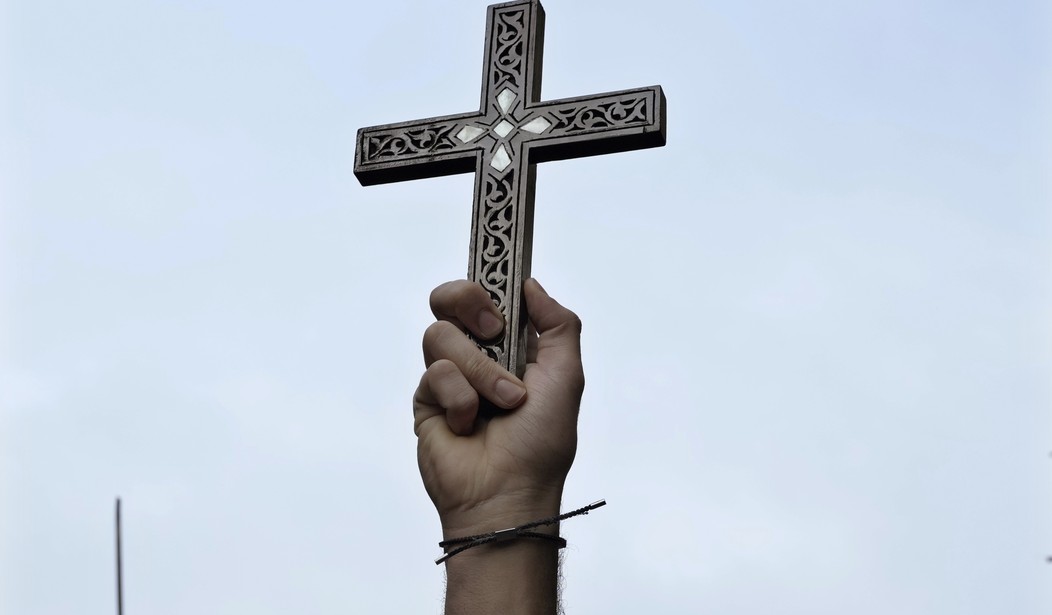
While the EU agrees to restore and improve trade ties with Syria’s new Islamist regime, a Greek member of the European Parliament (MEP) is seeking to build the European Parliament’s support for helping persecuted Christians in Syria.
Nickos Anadiotis, a member of the conservative NIKI movement in Greece, issued a motion for a European Parliament resolution on March 31.
The resolution aims to prevent the total extermination of one of the world's oldest Christian communities. It demands immediate diplomatic action and international accountability.
Anadiotis needed a minimum of 36 signatures to bring the resolution forward at the Plenary. He has gathered signatures from 51 MEPs. He now seeks support from the political groups in the European Parliament to recognize the plight of Syrian Christians as a grave violation of international law and human rights.
In his resolution, Anadiotis provides information on the urgent situation and persecutions against the Christian community in Syria:
There are alarming and consistent reports of a systematic campaign of violence, forced displacement, and illegal seizure of properties targeting the Greek Orthodox (Rum) Christian minority in various regions of Syria. These atrocities are being perpetrated by radical Islamist groups and extremist elements taking advantage of the ongoing instability in the region. The Greek Orthodox community represents one of the oldest and most historic Christian presence in the Middle East, which is now facing an immediate threat of total eradication. The destruction of religious sites and the targeting of civilians based on their faith constitute a grave violation of international law and fundamental human rights.
The resolution strongly "condemns the ongoing pogroms and atrocities committed by fanatic Islamist elements against the Greek Orthodox Christians in Syria; calls on the High Representative of the Union for Foreign Affairs and Security Policy to take immediate diplomatic steps to ensure the safety of the Christian populations; urges the European Commission to prioritize humanitarian aid and protection mechanisms for the displaced members of the Rum community; demands an international investigation into these crimes to ensure that those responsible for the religious persecution are held accountable."
For the resolution to move forward, it needs the support of the majority in the Conference of Presidents (CoP). If the resolution is supported by the CoP, then the issue of persecuted Christians in Syria will arrive on the floor in Strasbourg, where the European Parliament is located. They will debate and proceed with a formal vote on the resolution.
Within the European Parliament, Anadiotis is classified as a "Non-attached Member" (NI), or non-inscrits (French for "non-inscribed"). This means that he does not belong to any formal political group.
"The support of the EPP (European People's Party) is crucial for our resolution," Chris Molyvas, a representative of the NIKI (the Democratic Patriotic Popular Movement) in Greece, told me. "As the largest political group in the EP, their backing is the key to transforming this into a powerful European mandate. Our resolution aims to move the EU policy regarding Syria from general statements to specific actions."
"We particularly call on Manfred Weber, as the leader of the EPP, to show the statesmanship this crisis demands. Since the EPP traditionally stands as the defender of Christian values, his support is a moral necessity. We need his leadership to ensure that the European Parliament does not remain silent while an ancient community is being erased," Molyvas added.
"Our resolution calls for a shift from passive observation to active protection. It demands that the High Representative (EEAS) and the European Commission prioritize the safety of Christian populations and makes any EU engagement in the region conditional upon religious freedom. It specifically calls for increased humanitarian assistance for the displaced Christian community and the launch of an independent international investigation into the atrocities committed against Christians to ensure those responsible are held accountable."
If Anadiotis can now gain the required support from the political groups in the EP, his next step will be to ensure the resolution reaches the UN level. He wants to encourage a global response that moves beyond the borders of Europe, Molyvas said.
However, the European Council on 11 May announced that it "adopted a decision terminating the partial suspension of the Cooperation Agreement between the European Economic Community and the Syrian Arab Republic." The Council said:
By ending the partial suspension, the Council reinstates the full application of the Cooperation Agreement, marking an important step towards strengthening the bilateral relations between the EU and Syria.
Following the May 11 EU Foreign Affairs Council meeting in Brussels, Vice-President of the European Commission Kaja Kallas said that they "also agreed to lift the sanctions on Syria’s interior and defense ministers." This means that the EU has decided to restore full trade ties with Syria's new Islamist regime.
Since the fall of the Assad regime in December 2024, persecution against Christians and other religious minorities in Syria has severely escalated. The country is now mostly controlled by forces led by Hay’at Tahrir al-Sham (HTS). This is an Islamic terror group with roots in al-Qaeda and ISIS. Syria is now at its most dangerous period since the Islamic State (ISIS) occupied significant swathes of territory between 2013 and 2019. Christians in the country report unprecedented levels of persecution since the ISIS period.
The past year has seen a sharp increase in violence, including the murder of Christians and attacks on churches (such as the bombing of a Greek Orthodox church in Damascus in June 2025). Women from religious minority groups, including Christians, Alawites, and Druze, risk kidnapping and rape. Many Alawite women and girls have reportedly been taken as sex slaves by Islamic militias affiliated with the HTS regime. Under the new regime, Syrian education was reformed according to Islamic ideology: pre-Islamic history and gender equality were eliminated.
HTS, the terror group led by al-Ahmed al-Sharaa (a former al-Qaeda leader also known as Abu Mohammad al-Julani) and affiliated Islamic militias, has increasingly subjected Alawite, Druze, and Christian civilians to targeted killings, arbitrary arrests, abductions, sexual violence, destruction and seizure of property, forced displacement, and other atrocities.
The UN Security Council designates HTS as a terrorist group due to its links with al-Qaeda and ISIS. The designation has been transposed to EU law and should be followed by all 27 EU member states.
Meanwhile, during a press briefing on 11 May, Asaad Hassan al-Shaibani, the Syrian Minister of Foreign Affairs, was asked whether human rights in the country were sufficiently respected. In response, he claimed that "there are no minorities in Syria, but a single people protected by the state.”
"It is a cynical betrayal of every human rights principle the EU claims to uphold," Molyvas said, referring to the EU's decision to normalize its relations with the HTS regime. "Normalizing relations while Christians are being ethnically cleansed is beyond unacceptable.”
"When the Syrian Regime’s Foreign Minister brazenly claims that 'minorities do not exist,' it is not a mere statement—it is a clear roadmap for ethnic cleansing," he added. "By erasing the Greek Orthodox (Rum) people from the map of Syria’s identity, the regime is preparing the ground for their physical erasure. It is a moral disgrace that the EU chooses this exact moment to fund such a regime. Normalizing relations with those who deny the existence of their victims is nothing less than complicity in a silent genocide."
Molyvas called helping Syrian Christians a "non-partisan and humanitarian issue."
"There is absolutely no reason for any group in the EP to oppose our resolution," he said. "The protection of ancient communities from slaughter is not a matter of left or right-wing politics; it is a universal humanitarian imperative. This is a non-partisan issue. We call on all groups in the European Parliament to rise above party lines. To block this debate is to be complicit in the silence that allows these atrocities against innocent people to continue."
Editor's Note: Do you enjoy PJ Media's conservative reporting that takes on the radical left and woke media? Support our work so that we can continue to bring you the truth.
Join PJ Media VIP and use promo code FIGHT to receive 60% off your membership.






Join the conversation as a VIP Member