
If you’re the investor relations director of a publicly traded company, sometimes you go on “road shows.” These are usually quick tours of the big mutual funds and institutional investors who might buy your company’s stock in large amounts. The goal is to increase demand for the stock, which sends a signal to Wall Street, driving the value of the stock upward. At least that’s the plan.
In the early spring of 2001, I was engaging in one of these tours along with our company’s CEO and CFO. We were in New York along with our “sell side” analyst, who had put together a jam-packed day of meetings with some big funds. The story we were there to tell was how our company was helping to expedite the rollout of broadband technology to the world through our big customers – Verizon, Ameritech, BellSouth, and others. Dial-up was still a thing at that time.
The routine is, you all jump into a car with a driver, and then you jump from office building to office building, sitting across from portfolio managers and analysts to make your pitch. The process can give you an adrenaline rush for its intensity and sometimes its unpredictability. When you do these things, nothing else matters; you don’t even have a moment to gaze out the car window to appreciate where you are. Your mind is on the questions you just took at the last meeting and the questions you’ll face at the next meeting. The door opens, and you go. You don’t look up, you look ahead. Just be ready to shake some hands and do some talking.
So, when we went to our second meeting, I was in road-show mode, walking right into the lobby of the next building. But in this building, the security surprised and startled me. I’d never seen such fortifications in an office building lobby. Greeters behind bulletproof glass generated a photo ID on the spot, along with serious instructions on how to wear it. This was leading edge in 2001.
I looked at our CFO and made a comment about it, to which he said, “Well, it is the World Trade Center. They’re not taking any chances since 1993.” That was the first time I realized we were actually in one of those iconic towers.
Quickly, we were ushered upstairs to the 93rd floor of the World Trade Center’s North Tower. That’s where Fred Alger Management was located. It was a small but well-respected firm, and we felt lucky to have the meeting with a handful of their people.
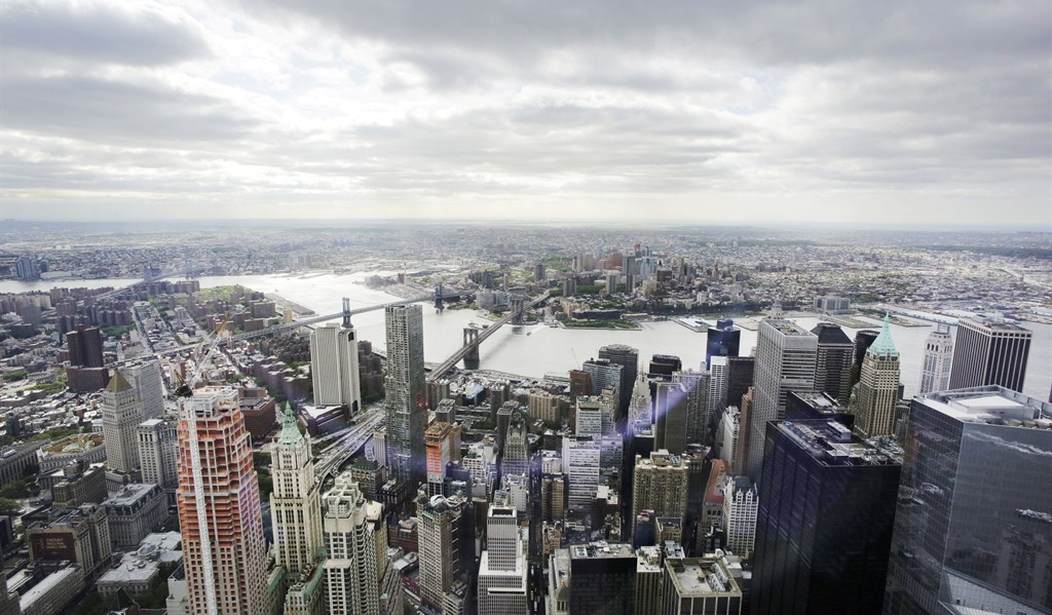
Before the meeting, while we waited for some of the Alger people to step into the conference room, I stood at the glass window overlooking Manhattan. I saw clouds at eye level, and I watched a helicopter fly below me. The scene before me reminded me of those exaggerated maps of New York, where it looks like you can see the whole city through a fisheye lens. But this was real. I was high enough to see everything and low enough to still see a lot of the detail. The experience jolted me out of business mode for a few minutes and into wonder mode. It was my favorite memory from that day, and even now, I can close my eyes and picture that view like it was yesterday.
Soon enough, the Alger team was all present, and we went ahead with our meeting. I remember the lead analyst just grilled our CEO and CFO. She had studied our financials and our company closely and asked some of the questions we wanted to hear and all of the questions we would have preferred she didn’t ask. We did OK, and I think they may have taken a position in our company after that, but 25 years later, I’m not sure.
My other memory of the very brief time I spent in those offices was the contrast between the interior of the building and that conference room. The interior lobby of those offices was more traditional, slightly darker, and it felt homey to me. The conference room was dominated by that view and all the light coming in through those floor-to-ceiling windows. Just sitting in that conference room, you felt like you were in the big time.
A few weeks after that, I left the telecom technology company where I had spent the previous four years to start my own consultancy. I got busy, and so I really didn’t think much about that World Trade Center meeting until September 11th of that year.
If your memories of that day are like mine, you remember where you were and how the day unfolded for you. For me, once again, I was in a corporate office, this time very close to the Pittsburgh airport. Air traffic was noisy that morning. An administrative assistant interrupted this one-on-one meeting to tell us that all flights were cancelled at the airport because a plane had hit the World Trade Center.
I headed to my car, turned on the radio, and heard the initial reports, before there was any confirmation of terrorism. I called my sister, whose daughter was a flight attendant for Delta, to see if she was OK. She was fine.
So, I went home and, like millions of Americans, I watched everything on TV. I couldn’t budge, in shock and transfixed by all of it. I wondered how those people at Alger were holding up.
I would later learn that the people at Alger were more punctual than most New Yorkers. They liked to get in early, so most of their 40 New York staffers were in the office when the first of those planes hit the North Tower at 8:46 a.m. It was American 11 out of Boston.
I didn’t know floor numbers at the time, but later it was reported that this first plane created a fiery opening from the 93rd to the 99th floors.
Alger lost 35 of those 40 employees that day, including David Alger, 57, the president and CEO of the firm and the younger brother of founder Fred Alger. For weeks, I tried to get through to that analyst with whom we met just to see if she was OK. Hers was the only business card I had from our meeting, and I didn’t recall the names of the others.
Still, it wasn’t like we were friends. I really didn’t know her, but since our meeting was still fresh in my mind, and this was the only connection I personally felt to 9/11, which had an unexpectedly profound impact on me, I found myself continually hoping that she and her team were OK.
There was much confusion during those days, weeks, and months, so I don’t recall Fred Alger’s losses even being mentioned much in the news coverage I saw in those first few weeks after the attacks.
About six weeks after the attacks, I got an email back from that analyst. She was one of those five employees who weren’t in the office that morning, and she survived. I never learned what happened to the three others we had met with that spring. I sensed from my email exchange with that analyst there was no point in asking. I just closed the email exchange telling her I was praying for her and her colleagues. That was the only time we connected after 9/11.
When something like 9/11 happens, Americans want to do something. They feel helpless watching something like this unfold, and they want to take some sort of action. That night, we took our kids to a Catholic church, empty save for a few other people like us who just felt the need to leave the house to pray.
As one news cycle led into the next, the country came together patriotically for a short period, and that felt comforting. To maintain some sense of normalcy in a very abnormal time, I decided that each night with my youngest, I would read aloud Mark Twain’s Adventures of Huckleberry Finn before bedtime. I did this for myself as much as for him.
With my oldest, I bought the series Band of Brothers, and we watched one episode a night, just father and son, escaping from the real world for a time. When this subject comes up, both kids, respectively, talk about these things as a positive childhood or adolescent memory.
Young people graduating from high school or college age started to enlist in the military. Many others, through their work, helped deal with the fallout of those terrorist attacks and the wars that followed.
Through happenstance, by the time George W. Bush ordered the attacks on the Taliban in Afghanistan, I had begun work for a company that made the casings for smart bombs. While nothing I did directly related to Bush’s “War on Terror,” for me, it felt like I was doing something.
The truth is, like most people, all I really did was fly the flag, and I found myself becoming much more engaged in conservative media and related causes. I was already an occasional Rush Limbaugh listener, but now I tried to catch his show, or at least a part of it, every day. He helped clarify things at a time of excessive noise and competing agendas.
Before 9/11, I was a busy young father who usually voted Republican. After 9/11, I became a conservative, with all that it entails. I wasn’t alone. It became clear to me that in an instant, the world can and did change. We could no longer limit the extent of our civic engagement to voting twice a year.
I looked for clients who fit with my conservative values or at least didn’t conflict with them. Whenever I had the opportunity, I tried to take the chance to advance patriotism and conservatism.
In 2018, I launched the Shaping Opinion podcast, which is on hiatus now, but there’s one episode I think is worth your time. I had interviewed several people who had first-hand, on-the-ground experiences on 9/11, and this podcast episode retells the events of that day in “real time” as it happened, through their eyes and through their experiences.
I talked to an NYPD cop, the photographer who captured that iconic shot of the three firefighters raising the American flag in the rubble at Ground Zero, a reporter who was aboard Air Force One, a Navy officer who was in the Pentagon, a military attaché who was in the White House Bunker, TV reporter Aaron Brown, an FBI agent who was on the scene in Somerset County where Flight 93 crashed, and the brother of a flight attendant on Flight 93.
If you want to hear it for yourself, it’s 100 minutes long, and you can find it here.
As I said, Americans tend to see something like 9/11, and they have this impulse to want to do something. I’ve come to realize that the most important thing we can do now is to remember, to never forget, and to take it upon ourselves to make sure others don’t forget.
Recommended: The Dirty Little Secret Behind Mamdani’s Attempt to Make the 9/11 Anniversary About Him