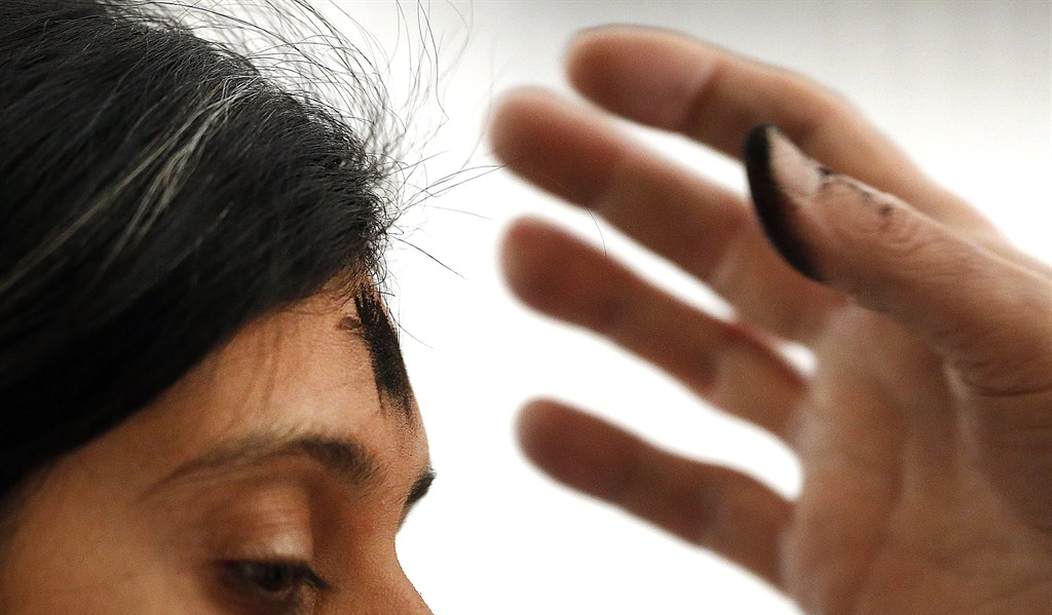

Ash Wednesday is this Wednesday, marking the official start of the Lenten season for Catholics. It’s one of the only days of the year when you can visibly distinguish a practicing Catholic from other people in public.
If the data is correct, you’re likely to see fewer people with ashes on their foreheads this week than you might have seen five years ago.
While Catholics remain one of the largest religious groups in America, their numbers are shrinking. For reference, the Catholic Church outnumbers any one Protestant denomination. And the country has more Catholics in it than each of the countries throughout the world, with only three exceptions – Brazil, Mexico, and the Philippines. This is according to the Vatican’s 2021 Statistical Yearbook of the Church.
According to Pew Research, only 20% of Americans identify as Catholic, but that number may be skewed by those who consider themselves practicing Catholics or lapsed Catholics.
The number of Hispanic Catholics in the U.S. is growing, while the share of white Catholics is shrinking. Right now, 54% of American Catholics are white. Roughly 36% are Hispanic, 4% are Asian, and 2% are black.
Pew claims, “Since 2007, the share who are white has dropped by 10 percentage points, while the share who are Hispanic has grown by 7 points.” Did you ever wonder why all those bishops are now up in arms about Trump closing America’s southern border?
Wonder no more. Pew further reports, “More than four-in-ten U.S. Catholics are immigrants (29%) or the children of immigrants (14%).” That’s a combined 43% of American Catholics who are immigrants themselves, or whose parents immigrated to the U.S.
Did you ever wonder why the Catholic Church appears to lean to the left politically? Again, wonder no more.
On the issue of abortion, Pew has found that even though the Catholic Church’s official stance is in opposition to abortion, “59% of Catholics say abortion should be legal. This includes 35% who say it should be legal in most cases and 25% who say it should be legal in all cases. Roughly four-in-ten Catholics say abortion should be illegal in most (26%) or all (13%) cases.”
Eric Sammons of Crisis Magazine, a Catholic online news magazine, looked at the Pew numbers from a year ago and put it in more practical terms. He said “that for every 100 new Catholics, more than 800 people leave the Church.”
This is not to say Christianity in general is losing in the same way. My colleague Rick Moran looked at Pew data for similar trends across all Christian denominations when Pew released the data for its Religious Landscape Study (RLS) last year. Rick reported that 78% of Americans identify as Christians and that, in the four years prior to 2025, “the number of Christians (now) hold steady, hovering between 60% and 64%.”
The view is different at ground level
You have to get closer to ground level to really get a sense of what’s happening in the Catholic Church, in particular. Where I’m from, the Pittsburgh region, two factors have dominated the political and cultural landscape for over 100 years. It’s a Democrat-run region. The city is a one-party town. And while not everyone is Catholic, it sure feels like it.
In my lifetime, I’ve witnessed the slow shift away from the Catholic Church but not the Democratic Party. Neighborhoods were once dominated by their respective immigrant group. Within those mostly Catholic neighborhoods were beautiful churches that catered to the ethnic group that lived there. That’s why you would have so many of these mini-cathedrals so close to each other. One was for the Polish. A few streets over, mass was said in Ukrainian. The Italians had their churches. The Irish had theirs.
What brought these ethnic groups to this industrialized city was steelmaking. So, when the steel industry largely left the region and packed its bags for Indiana, Illinois, and Japan, the men who worked in the mills and lived in these neighborhoods left, too. Or maybe they retired and stayed, but their kids did not stay. Once thriving blue-collar neighborhoods were hollowed out. And so were their churches.
Baptisms declined, Holy Communions declined, weddings declined — funerals did not. At least not immediately.
Catholic neighborhood schools closed, one by one. And pretty soon, by the 1990s, the Pittsburgh Catholic Diocese commenced what still seems like a never-ending downsizing.
It started with consolidating multiple church buildings into one parish, and then quietly closing all but one of the church buildings in a parish. Then it escalated to closing entire parishes.
This week, the Pittsburgh Post-Gazette reported that the latest round of closures and consolidations will involve the shuttering of seven churches in the diocese's St. Joseph the Worker Parish. That’s just one parish, which will be left with one struggling church building. The diocese blamed declining church attendance as a primary driver for the move.
But deep within that Post-Gazette story is the real story, and no one seems to be seeing it. The mayor of one of those old mill towns, Swissvale, is Deneen Swartzwelder. She told the newspaper that she attended one of the affected churches “all her life.”
She said, “They’re ripping apart our family.” She pointed out that this is more than a religious and faith issue, and that “Sunday mornings will be a ghost town.…Nobody’s meeting for coffee afterwards, or going to a local restaurant for breakfast or brunch.”
She talked about the loss of traditional community events, food drives, clothing drives, and more. But then she admitted to the newspaper that because her home Catholic church – one that’s now closing – hasn’t held services in years, she now “goes to church only occasionally at some of the smaller nondenominational churches in the area.”
“There’s no more neighborhood church,” she told the Post-Gazette. “We have to find a new home to worship and belong.”
So, when given the option to remain a practicing Catholic by driving maybe 15 minutes longer to get to mass, Swartzwelder and many like her have opted to not attend mass at all, or to choose to attend a non-Catholic Christian service that felt more convenient to them.
This dynamic tells me why, in the course of my day, I can see or hear about Catholic church closures while driving by numerous non-denominational megachurches that are growing and thriving.
Jesus is as popular as ever, but people are increasingly looking for Him beyond the walls of now deteriorating works of classic Catholic church buildings — structures that are now finding new life in secular contexts.
Religious ceiling murals are painted over with neutral tones, and below them bartenders now pour wine while wait staff serve bread, but not the spiritual kind.
Why are Catholic churches shrinking?
The challenge for the Catholic Church is to confront the question of why non-denominational churches are growing while, in many places in America, Catholic churches are in decline.
To be sure, this is not true everywhere. The decline is most noticeable in Rust Belt cities where the Catholic Church was once so ubiquitous. The Catholic Church’s visible growth is more obvious in border states where immigrants are settling, and in higher-growth cities that have started out with a very small number of Catholic churches.
We’ve all got our own ideas on how to run and market the Church. Things like how to use the Latin mass to attract followers instead of trying to ban it. Things like forcing the Church to decide if you’re here for the flock who’s contributing to your finances on Sundays and to the poor, or if you’re just here to bleed your regular congregants while directing those monies to places that feel more like social engineering than charity.
But the Church is not a democracy, and it does not do the bidding of its congregants. It exists to serve God as it should.
In practice, however, it is led by a pretty solid block of left-leaning men who increasingly cannot relate to working class people who live paycheck to paycheck, or middle-class people who still have to count every dollar.
Priests may minister to their parishioners directly, but when it comes to growing the number of parishioners and being more prudent on the finance side to ensure long-term survival and growth, Catholic leadership sees its most productive congregants as a piggybank. They then make it worse when they ask those piggybanks to pay for the oftentimes leftist-ideological programs they operate or promote.
When they can’t get the funds there, they look to the government. During the Joe Biden presidency, U.S. Conference of Catholic Bishops (USCCB)-controlled organizations took in over $100 million for “resettlement services.”
At the retail level, though – in the pews – the Catholic Church is struggling because the men in black know how to ask for money, but they don’t know how to raise it. They know how to dispense with that money, but far too often, they reject the very notion that you might invest it into your own parish or your own community so that your parish will survive and thrive, instead of decline and die.