


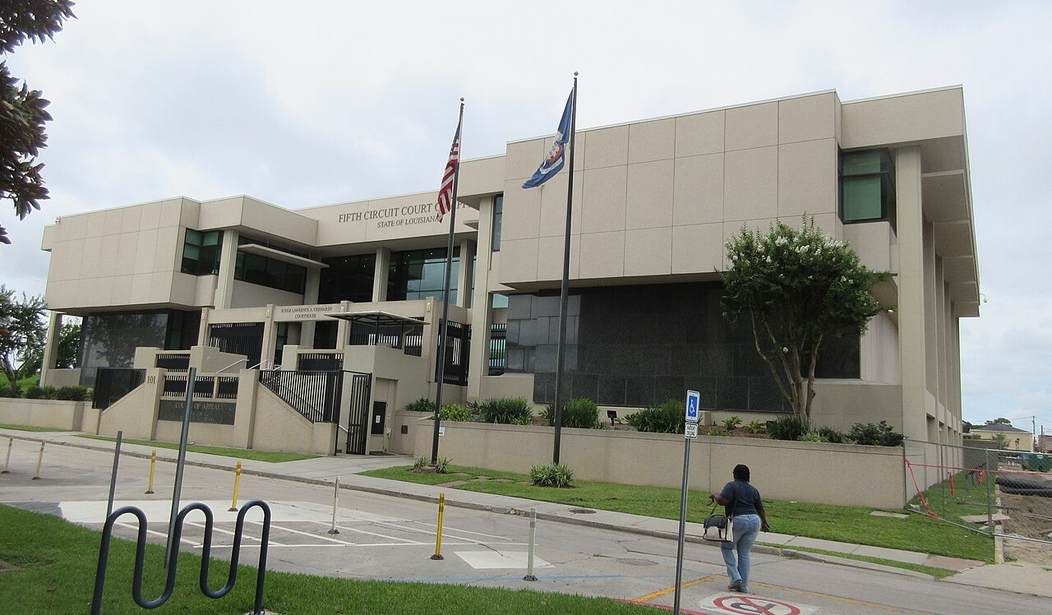
It’s taken a little work to find some of our “Dishonorable Judicial Conduct Award” winners. But the U.S. Court of Appeals for the Fifth Circuit’s removal of a judge from a case due to his misbehavior was like a billboard going up. Our award for October goes to U.S. District Judge Henry Wingate, who serves in the Southern District of Mississippi. This may be the easiest pick since we started this series in January because Wingate, in the Fifth Circuit’s words, “ignored and manipulated governing law, apparently to satisfy a policy agenda.”
The three-judge Fifth Circuit panel, led by Judge Jerry Smith, who wrote the opinion, painted a shocking picture of Wingate’s mistakes and misconduct in this case.
Here’s what happened. In Jackson Federation of Teachers v. Fitch, a “smattering of teachers, professors, students, parents, and activist organizations” sued Mississippi, claiming that the anti-DEI education law enacted in 2025 violated the First Amendment. As the Fifth Circuit outlined, the law prevents educational institutions from: 1) mandating DEI programs and training; 2) punishing students for their opinions about DEI; 3) endorsing or promoting DEI in course materials; and 4) circumventing the law. There are exceptions for “scholarly work, the activities of students and their groups, and creative engagement.”
Judicial proceedings are supposed to be based on a factual record, but this case was “a botch job, to say the least,” according to Smith. Wingate issued a temporary restraining order, or TRO, putting the law on hold “that contained several factual assertions nowhere to be found in the record, or indeed, in any proceedings of the case.” This included “mention of [eleven] plaintiffs and [two] defendants not in the complaint, supposed ‘declarations’ from [four] non-existent or never-present individuals, false quotations purporting to be taken from the text of [the law], and several erroneous claims that the law had already led to the demise of apparently fictitious [DEI] programs” at three different colleges. Wingate even falsely claimed that staff at one school “had been told not to discuss certain topics” such as “historical interpretations of systematic racism.” Unbelievable.
After Mississippi pointed out these errors, Wingate blamed his law clerk for using an AI program to draft the order. He replaced the “botched” TRO (removing it from the case file so no one could see it and denying a request to restore it to the official court docket) with a supposedly “corrected” TRO. According to the Fifth Circuit, however, this one “still contained hallucinated information,” including a citation to a decision in the Fourth Circuit “that does not exist.” In fact, the Fifth Circuit thanked the defendant, the state of Mississippi, for providing it with a copy of the original TRO “given that Judge Wingate kept it from public view.”
Undeterred, Wingate forged ahead and issued a preliminary injunction, incorporating the still wrong “corrected” TRO into the injunction “by reference.” And, according to the Fifth Circuit, he got “the entire law of injunctive relief completely backwards.”
The appellate court concluded that Wingate wanted so badly to stop the state’s anti-DEI law that he “carelessly exercised his Article III power by issuing sloppy edicts based on falsehoods and fabrications.” Once the falsehoods were exposed, “Wingate dug in his heels and claimed that the hallucinated claims had no bearing on [his] reasoning; he offered no explanation as to why he included such apparently irrelevant material in the original TRO or why the TRO nevertheless was justified in its absence.”
Wingate also got the law bearing on the plaintiffs’ First Amendment claims (including the imaginary ones) wrong. Both his TRO and his injunction, the Fifth Circuit explained, “rested on impoverished legal analysis that barely paid lip-service to the precedents of the Supreme Court or this court, seeming at times purposely to misconstrue the law by manipulating the words of statutes and cases, without regard to their texts’ meaning as a whole.” Wingate ignored or “circumvent[ed]” relevant precedent, instead focusing “on things such as what ‘[o]ne witness wondered’ and what one parent ‘thought…could be considered’” by Mississippi in enforcing the law.
This craziness would earn a first-year student a failing grade and strong encouragement to rethink his career choices. Coming from a federal judge, it is inexplicable. In fact, it was so unscrupulous that the Fifth Circuit panel did something one almost never sees in the federal judicial system.
Not only did the appeals court throw out Wingate’s injunction preventing the Mississippi law from being enforced, but “[b]ecause of the extraordinarily grave errors by the district court,” it remanded the case with instructions to the chief judge of the Southern District to “assign this case to a different district judge.” And “we instruct the new judge to conduct proceedings consistent with federal law as interpreted by the Supreme Court and this circuit.”
You would think that a federal judge would not have to be reminded to “conduct proceedings consistent with federal law” and prior court precedents. That’s sort of in the judicial job description. For throwing that job description out and making up one of his own, Judge Henry Wingate is our obvious and overwhelming pick for October’s Dishonorable Judicial Conduct Award.
Editor's Note: Unelected federal judges are obstructing President Trump's agenda and ignoring the will of the people.
Help us expose out-of-control judges determined to halt President Trump's mandate for change. Join PJ Media VIP and use promo code FIGHT to receive 60% off your membership.



Join the Conversation
VIP members get the ability to comment on articles.