


In early 1991, right at the end of the first Gulf War, President George H. W. Bush could’ve marched to Baghdad, toppled Saddam Hussein, and freed the Iraqi people from tyranny. All the military tools were in place — and long-suffering minorities like the Kurds, who died by the thousands in chemical warfare, were more than willing to wage war. All they needed was help from the U.S.-led coalition.
The help never came: 50,000 to 182,000 Kurds were slaughtered.
Up to 200,000 Iraqis died.
In the Time magazine essay “Why We Didn’t Remove Saddam,” which was cowritten by George H. W. Bush and Brent Scowcroft, the ex-president explained his reasoning:
While we hoped that popular revolt or coup would topple Saddam, neither the U.S. nor the countries of the region wished to see the breakup of the Iraqi state. We were concerned about the long-term balance of power at the head of the Gulf. Trying to eliminate Saddam, extending the ground war into an occupation of Iraq, would have violated our guideline about not changing objectives in midstream, engaging in "mission creep," and would have incurred incalculable human and political costs.
[…]
The coalition would instantly have collapsed, the Arabs deserting it in anger and other allies pulling out as well. Under those circumstances, furthermore, we had been self-consciously trying to set a pattern for handling aggression in the post-cold war world. Going in and occupying Iraq, thus unilaterally exceeding the U.N.'s mandate, would have destroyed the precedent of international response to aggression we hoped to establish.
—George H. W. Bush and Brent Scowcroft, March 2, 1998
In other words, it was purely a political calculation: Instead of getting our own hands dirty and/or risk angering our Arab allies, we heeded the United Nations’ edict to liberate Kuwait — and not press forward. After all, the UN authorized us to free Kuwait, not to overthrow the Iraqi regime.
But the hope was that Saddam Hussein was so weakened we wouldn’t have to, because the Iraqi people would depose him for us.
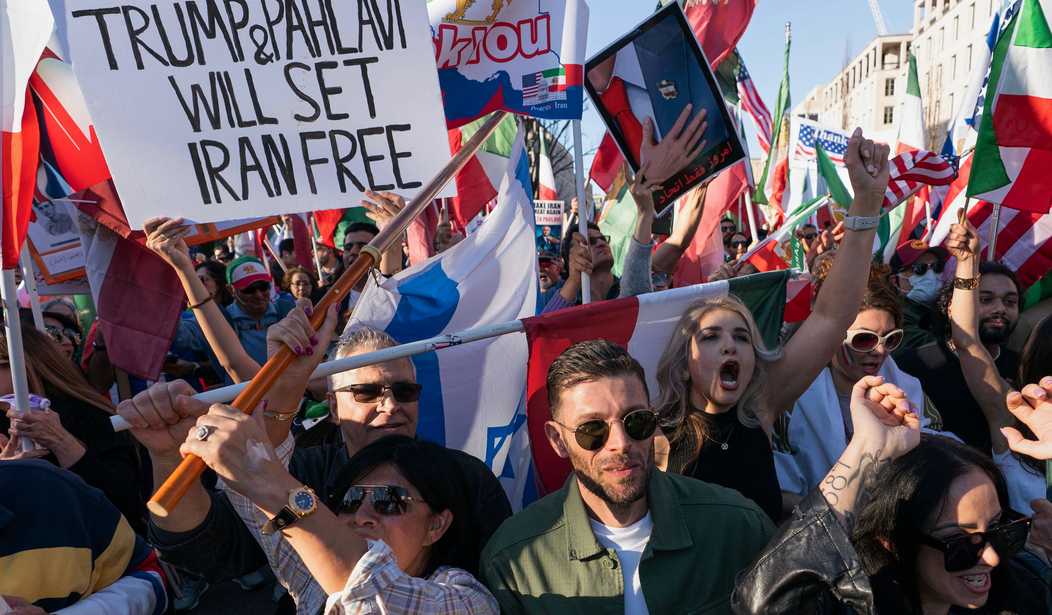
Three decades later, it’s “déjà vu all over again.” We’re yet again fighting a war in the region where our military objectives — destroying Iran’s nuclear, ballistic, and terrorist capabilities — dovetail with regime change without actually committing us to it.
Secretary of War Pete Hegseth said point-blank that this wasn’t a “so-called regime-change war.” President Donald Trump also downplayed expectations of a speedy regime change, noting the uphill battle the Iranian people face.
Speaking on Fox News Radio's The Brian Kilmeade Show, Trump said security forces loyal to the Islamic Republic routinely shoot demonstrators in the streets, making it difficult for unarmed civilians to challenge the regime despite growing pressure from the ongoing conflict.
“They literally have people in the streets with machine guns, machine-gunning people down if they want to protest,” Trump said, referring to Iran’s security forces. “That’s a pretty big hurdle to climb for people that don’t have weapons.”
Trump said that while change inside Iran will eventually happen, it is unlikely to occur quickly under such conditions.
“It’ll happen,” he said, “but it probably will be — maybe not immediately.”
[…]
More than 36,500 Iranians were killed by security forces during a two-day crackdown on nationwide protests on January 8–9.
According to the Washington Post, “Israel Urges Iranians to Revolt but Privately Assesses They’ll Be ‘Slaughtered’”:
Senior Israeli officials have told U.S. diplomats that Iranian protesters will “get slaughtered” if they take to the streets against Iran’s government even as Israel publicly calls for a popular uprising, according to a State Department cable reviewed by The Washington Post.
The cable, circulated by the U.S. Embassy in Jerusalem on Friday, relayed an Israeli assessment that Iran’s regime is “not cracking” and is willing to “fight to the end” despite the Feb. 28 killing of Supreme Leader Ali Khamenei and the ongoing U.S. and Israeli bombing campaign.
Given the historic backdrop, when the U.S.-Israeli bombing stops, it now seems inevitable: Tens of thousands — or even hundreds of thousands — of brave Iranians will be massacred in the streets, destined to share the same bloody fate as the Kurds.
It’s a fait accompli; the die is cast. When all is said and done, the mullahs will still be in charge, and the protesters’ bodies rotting in mass graves. “Abandon hope, all ye who enter here.”
But as Lee Corso used to say on ESPN’s College GameDay, “Not so fast, my friend.”
Because there are quite a few life-and-death differences between Iraq in 1991 and Iran in 2026, including air power, military strength, and political calculations. George H. W. Bush was more concerned with protecting his coalition than protecting the Kurdish people, which is why he left large swaths of Saddam’s military untouched.
The Gulf War had begun with the unanticipated resilience and aggression of Saddam Hussein, and its aftermath soon ran into another unexpected development—the yet again unanticipated resilience and aggression of Saddam Hussein. Saddam's army, seeing that Bush had declared war over with Saddam still in place and his forces largely intact, rallied to Saddam. It ruthlessly then repressed Iraqi Kurds in the north and Iraqi Shiites in the south, even using chemical weapons on Shiites near U.S. forces. In the speed of events, Bush had failed to see that calling an early end to the war to protect his coalition, and leaving many Iraqi forces intact to protect against Iran, also undercut prospects for his third hope—Saddam's removal.
[…]
Under international pressure, the U.S. introduced a no-fly zone in the north to protect the border of Turkey and to prevent the mass murder of Iraqi Kurds, but Saddam's slaughter of Shiites in the south continued largely unabated. In time, the U.S. created a no-fly zone there, too; but not before Saddam was secure and the slaughter had bred sufficient ill will among Iraqi Shiites to greatly complicate future American efforts in Iraq.
Under the terms of the Gulf War ceasefire, Iraq was barred from using fixed-wing aircrafts, but President Bush (stupidly) allowed Iraq to fly helicopters. (Bush’s logic? Since so many bridges had been destroyed, helicopters were necessary.) Unfortunately, Saddam used those helicopters to murder his people.
Photographer Richard Wayman, who was imbedded with the Kurds, recalled what happened next:
Two days after the liberation of Kuwait, the then US President, George Bush made a statement to the Iraqi population, "In my own view… the Iraqi people should put Saddam aside, and that would facilitate the resolution of all these problems that exist and certainly would facilitate the acceptance of Iraq back into the family of peace-loving nations."
Thus emboldened, in early March, the Shia in southern Iraq, and the Kurds in the north, made almost simultaneous uprisings against the regime.
Almost immediately, the Iraqis began using the helicopters to put down the uprisings. The outgunned rebels had few heavy weapons and few surface-to-air missiles, which made them almost defenceless against the gunships and artillery barrages.
Kurdish forces attempted to delay the advance of the Republican Guard to allow the evacuation of civilians from Iraqi Kurdistan to the safety of Turkey and Iranian frontiers but were inevitably crushed by superior fire-power of regime forces.
I fled with the refugees, walking to the border with Turkey on a two-day trek. The Kurds were terrified that Saddam's men would use chemical weapons against them — as they had done in 1988.
Another Kurdish dream of freedom was thwarted. More than one million Kurdish refugees swamped the borders with Turkey and Iran. Many were to die in the mountains before the setting-up of safe havens by coalition forces on the Iraqi side of the border brought some respite for their plight.
Unlike the Kurds in 1991, the Iranians of 2026 will have a genuine chance to wrest their freedom because of five key reasons:
- Iran’s army, navy, and — most importantly — air force have mostly been destroyed. (And whatever’s left will be blown to bits over the next few days.)
- We have complete air supremacy over Iran and aren’t impeded by UN regulations that would prevent us from using it to blow Iranian planes, helicopters, and drones out of the sky, should they target protesters.
- Instead of pushing Saddam’s army out of Kuwait, President Trump focused on annihilating the Iranian government, its military leaders, and its chain of command, degrading the Iranian armed forces at every level.
- Donald Trump doesn’t give a damn about protecting a political coalition of prickly foreign nations — he just wants to win. Which means, our military’s hands won’t be tied by UN legalese.
- We’ve learned from Iraq: The George H. W. Bush strategy doesn’t lead to regime change; it leads to mass deaths. It’s not sufficient just to encourage civilians to rebel and then hope for the best. The rebels also need air cover, weapons, and logistical support.
In hindsight, because of President Bush’s political calculations, the Kurds never stood a chance. They were like a lamb to the slaughter. But President Trump is no President Bush.
This time, the rebels can win.
One Last Thing: 2026 is a critical year for America First: It began with Mayor Mamdani declaring war on “rugged individualism” and will reach a crescendo with the midterm elections. Nothing less than the fate of the America First movement teeters in the balance.
Never before have the political battlelines been so clearly defined. Win or lose, 2026 will transform our country.
We need your help to succeed!
As a PJ Media VIP member, you’ll receive exclusive access to our behind-the-paywall content, commentating privileges, and an ad-free experience. VIP Gold gets you the same level of “insider access” across our entire family of sites (PJ Media, Townhall, RedState, twitchy, Hot Air, and Bearing Arms). That means: More stories, more videos, more content, more fun, more conservatism, more EVERYTHING!
And if you CLICK HERE and use the promo code FIGHT you’ll receive a Trumpian 60% discount!
Thank you for your consideration.



Join the conversation as a VIP Member