Ever watch a movie where you could tell the filmmakers wanted you to think a character was super-cool, complex, and charismatic, but he came across like a cringey dork? It’s a big problem in storytelling, because the less invested you are in the hero (anti- or otherwise), the less you’ll celebrate his victory.
I’m sure you’ve seen countless examples. And not just because of Hollywood’s cartoonishly bad casting decisions, either: More often than not, the filmmaker’s brain and the audience’s brain simply weren’t aligned. For whatever reason, their expectations were worlds apart.
Different audiences can have dramatically different visceral reactions.
Take conservatives and liberals: When news broke that Ayman Mohammad Ghazali — the Lebanese citizen/terrorist who crashed his car into a Michigan synagogue full of preschoolers last week — had just learned that his brothers were killed in an IDF airstrike targeting Hezbollah members in Lebanon, conservatives and liberals had wildly different responses.
Liberals acted like armchair psychologists: “Ah, yes, the sad cycle of religious violence continues. Can’t really blame the guy, can we? Don’t be Islamophobic: If Israel hadn’t killed his brothers, none of this would’ve happened. Curse that warmongering Netanyahu — why, he’s endangering the lives of Jews everywhere! Not that we’re condoning terrorism, but you know… [proceed to condone terrorism].”
The conservative reaction was shorter and pithier: “Holy crap, who the hell let a foreign national from the Middle East — whose relatives are members of Hezbollah! — into our country?!”
There’s no middle ground on illegal immigration, the Iran War, or public safety. No chance Republicans and Democrats can shake hands and reach an agreement. Reconciliation is an impossibility, because we see the world so differently. When we can’t even agree on the problems, there’s no chance we’ll agree on the solutions.
Which means, the only way to play the game is to play to win.
Partisan politics is binary decision-making; it’s a zero-sum game. Either our vision prevails or it doesn’t. Either we win or they do. There are no moral victories, no games of horseshoe, no substitute for the real thing.
Politics in 2026 is all or nothing.
The chaos of the Iran War is almost entirely awful, but there is an upside: When people are under pressure, they tend to reveal the truth about who they are.
When everything’s going swimmingly, facades are easy. A monster can trick you into thinking he’s a good guy when everything’s going his way.
But adversity has a nasty habit of removing the mask — and shattering the façade. It’s why relationship experts warn young couples: Until your first argument, you don’t really know who the hell your partner is.
The pressure, chaos, and uncertainty from the Iran War will remove a lot of political masks — from their side and ours. Because, when the pressure rises, tempers get shorter. And with the ubiquity of social media and smartphones, we’re going to witness the genuine, authentic, visceral reactions of Republicans and Democrats.
And the American people won’t like everything they see.
Right now, the Iran War is strictly an outcome-based endeavor: It’s less about spin and more about results. When the bullets finally stop flying, voters will ask three questions:
- Was the Iranian threat — nuclear, ballistic, and terrorism — really destroyed for good?
- Was the price we paid in blood and treasure worth it?
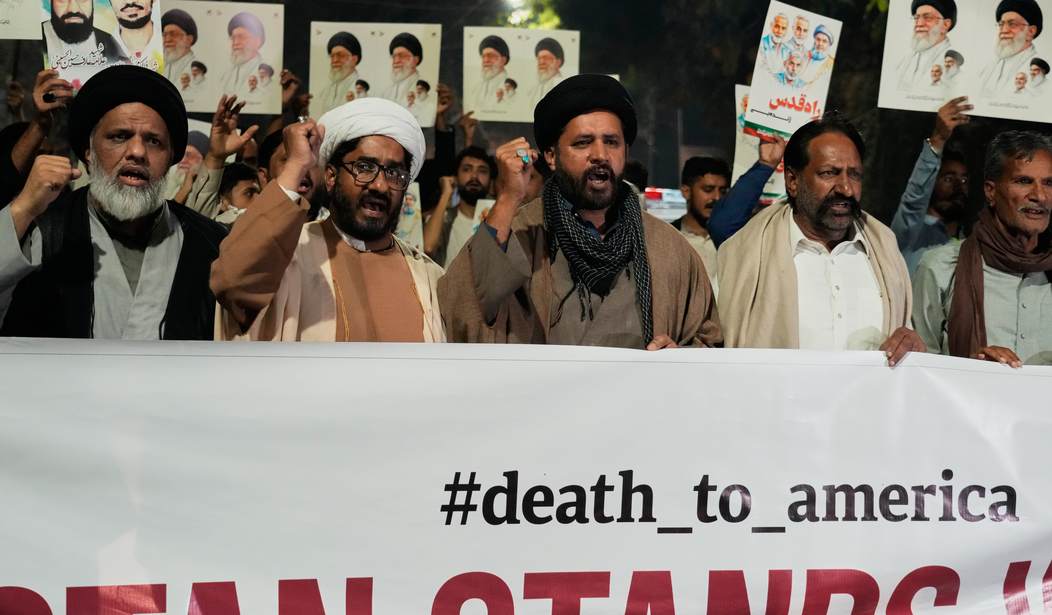
- Did we replace the “Death to America”-obsessed mullahs with a pro-American government?
For Trump to win the war dividend (and turn the Iran War into political PR gold), the answers to #1 and #2 must be a resounding yes. The more convincing the answer, the bigger the dividend.
And if Trump can tie the answer to “America First” by arguing that not only are we safer and more secure, but because the Iranian threat was neutralized, we can forget about the Middle East for a while and concentrate on America, the war will gain millions of bandwagon fans.
Everyone loves a winner.
Flipping the Iranian regime and getting a yes for #3 would further validate #1 and #2, but it’s not a required ingredient. (More like the cherry on top of our ice cream sundae.) Nonetheless, it would certainly be a visible, un-spinnable outcome.
That’s what’s so interesting: It’s still unclear if most Americans have contextualized what victory in the Iran War will ultimately mean. We’re living in the moment, not the aftermath.
Most voters, I suspect, are mostly viewing the Iran War as a proxy battle over President Trump: His supporters back it and his detractors don’t. It’s less about the mullahs and more about how we view our president.
Complicating the PR battle is the nature of the American mind: We’re an internally focused people. For the most part, we care about affordability, jobs, finances, and housing. Presidents are seldom awarded political points for foreign victories.
President George H. W. Bush’s 1991 Gulf War victory meant very little in the 1992 election.
But when the war is over and the facts are established, that’s when the PR war will begin. The Dems will try to downplay our victory and argue it was all a waste of time — and the Republicans will try to show the cause-and-effect between a defanged Iran and “Making America Great Again.”
The better we do in the actual war, the easier it’ll be for us to win the PR war.
PRediction: Mojtaba Khamenei is probably not dead. (Yet.) We’ve called him the “Flat Stanley” of supreme leaders because we’ve seen cardboard cutouts of Mojtaba, but not the real thing. No video or audio either.
The longer we go without “proof of life,” the more likely it becomes that he’s deader than a dodo.
But why would the mullahs appoint a dead (or nearly dead) guy as supreme leader? Eventually, the truth would come out — and when it does, they’re handing Israel and the U.S. another yuuuge PR victory by crediting it with the death of Supreme Leader II: Electric Boogaloo.
Q: Y’know who’d be a better choice than a dead guy?
A: Pretty much anyone alive!
So why hasn’t anyone seen Mojtaba? Why hasn’t he uploaded a video or audio file where he rallies the Iranian people?
After all, the Iranians are paranoid by nature. Been that way for a very long time. Conspiracy theories are endemic in Iranian culture and politics.
The mullahs know this — yet they still haven’t offered a proof of life of Mojtaba Khamenei.
Why? What tactical benefit is there in silence? Even if you’re paranoid that Mossad is eavesdropping, how difficult would it be for someone to record a short iPhone video of the new supreme leader and post it on X?
I don’t think it’s because he’s disfigured, either. Besides, showing the courage to battle through ghastly injuries and STILL wage war would probably elevate his standing.
If anything, it’d show he has guts (that are still mostly inside his body).
But there’s another possible explanation that hasn’t gotten much media attention…
PRojection: I think the more likely explanation is that there was already some sort of coup within the Iranian government.
There’s precedent for it: On Aug. 14, 1945, shortly before Japan surrendered to the U.S., there was the Kyūjō incident. Despite worshipping their emperor as a demigod, the Staff Office of the Minister of War of Japan — and many Imperial Guards — attempted to seize control of the Japanese government, because they didn’t want to stop fighting.
So why hasn’t “Supreme Leader” Mojtaba Khamenei shown his face, released a video, or done anything visible? He’s become the opposite of Lord Voldemort: Everyone says his name, but nobody ever sees him.
Perhaps there’s a reason for that: Maybe the mullahs have him under house arrest.
PRaise: To Danny Phillips, a 28-year veteran of the Bloomfield Hills Police Department. His courage, planning, and tactical knowhow saved the lives of 106 small children and 30 staffers when Ayman Mohamad Shazali drove his car through the front doors of Temple Israel in Michigan.
The temple’s staff and clergy had even participated in active shooter prevention and preparedness training led by an FBI official in January.
That beefed-up security is likely what saved hundreds of children who were inside Temple Israel’s preschool when Ayman Mohamad Ghazali smashed through the doors.
Phillips was the only one hit by the car and was knocked unconscious.
One of his armed, private security guards shot back after Ghazli opened fire through his windshield in a hallway of the building. [emphasis added]
Why did the Temple invest in so much security?
[Phillips’] appointment was made “in response to the evolving realities facing Jewish communities,” according to Temple Israel, and was part of a months-long process to beef up the synagogue’s overall security.
He was hired to oversee a sophisticated operation that included a combination of an in-house security team with metal detectors, guards for hire, police and even overhead drones during events like High Holiday services, according to Forward.
It’s ridiculous — and shameful — that Jews must spend so much money on outside security to protect their babies from being slaughtered, but that’s the state of our country: We can’t keep importing unstable foreigners into our country, especially ones whose family members are active in terrorist organizations(!), without expecting blowback.
Temple Israel was prepared because the attack was foreseeable. Like the rest of us, it saw the writing on the wall.
Unfortunately, future attacks are foreseeable, too.
Of course, there were also a pair of terrorist attacks in Virginia from Muslim terrorists, and Democrats responded by confiscating the rights of Virginians to own guns.
This is the absolute worst time to limit the rights of Americans to defend ourselves.
PRedators: Speaking of those two terrorist attacks in Virginia — one at Old Dominion University, in the Virginia Beach area, and the other in Fairfax County, closer to the capital — it’s not “Islamophobic” to note the multitude of similarities:
- Both terrorist attacks were committed by foreign-born Muslims.
- Both of the terrorists had the last name of Jalloh (Abdul Jalloh and Mohamed Bailor Jalloh).
- Both were from Sierra Leone.
- Both had been arrested for multiple crimes. (Abdul Jalloh had over 30 arrests, ranging from rape to malicious wounding; Mohamed Bailor Jalloh pled guilty and went to jail for supporting ISIS.)
Noticing the slew of similarities doesn’t make you Islamophobic — no matter what Mayor Zohran Mamdani might say. It’s not “racist” to recognize the obvious.
It makes you minimally observant.