Picture it: It's a random day in 2023 or 2024.
Narco-boats zip through the Caribbean Sea, largely unbothered. he United States mostly ignores or even criticizes our allies, like Nayib Bukele of El Salvador, while engaging with socialist leaders like Gustavo Petro of Colombia and dictators like Nicolás Maduro. Drug overdoses, particularly fentanyl, are at an all-time high and rising in the United States, but the administration isn't interested in going after the cartels. As a matter of fact, it's more or less opened the borders and welcomed these organized criminal groups right into our country so they can continue killing our citizens.
What a difference a year and a half makes.
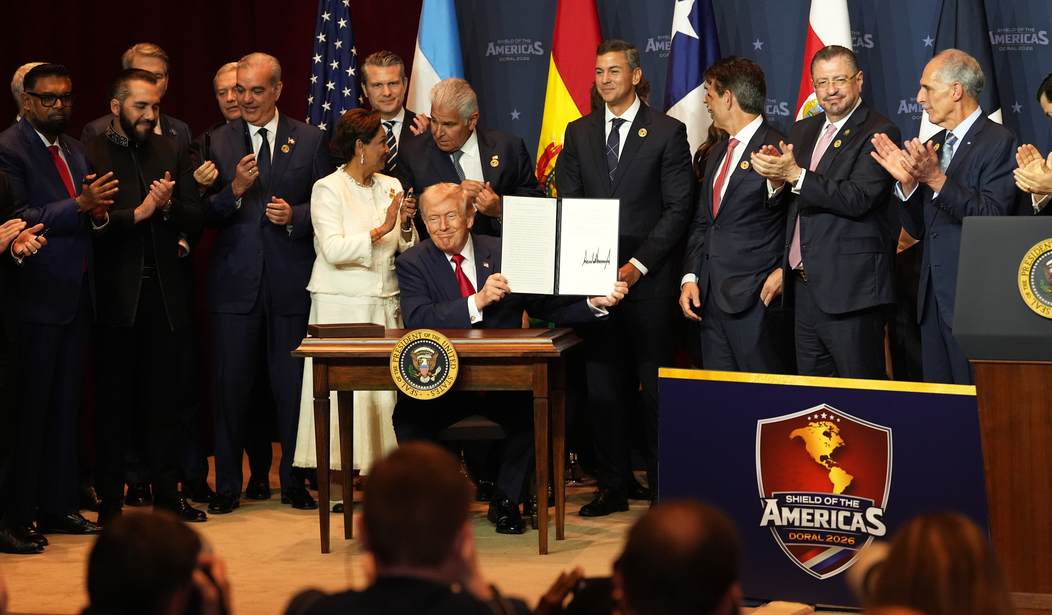
The Donald Trump administration has made it clear that narco-terrorism, drug trafficking, organized crime, and violence are no longer welcome in the Western Hemisphere. It started from day one, when Marco Rubio designated several of the main organizations responsible for a lot of this activity as foreign terrorist organizations, continued when we placed stronger pressure and sanctions on the leaders in the region who tolerate or even support this type of activity, and went even further when we began blowing up narco-boats and cartel leaders. It also helped that the Trump administration began engaging and offering support to like-minded leaders in the region who want the same things as we do: less crime, less drugs, less violence, and less mass migration, all of which go hand-in-hand.
While I sometimes fear that the situation in Iran is overshadowing the need to continue what we've started here on this side of the world, some situations arise that remind me that our efforts aren't slowing anytime soon. Here are a few notable incidents from just the past week or two.
I'll start with the most recent. United States Southern Command (SOUTHCOM) announced on Sunday that it had conducted a lethal kinetic strike on a narco-boat operated by one of those aforementioned Foreign Terrorist Organizations in the Caribbean Sea. Two narco-terrorists on board were killed, while six survived. Here's the video:
On June 21, at the direction of #SOUTHCOM commander Gen. Francis L. Donovan, Joint Task Force Southern Spear conducted a lethal kinetic strike on a vessel operated by Designated Terrorist Organizations. Intelligence confirmed the vessel was transiting along known… pic.twitter.com/34cDvvcwxe
— U.S. Southern Command (@Southcom) June 22, 2026
On June 19, El Salvador's president, Nayib Bukele, announced that the country's National Navy "intercepted an LPV-type vessel (Low Profile Vessel) 582 nautical miles (1,074 km) southwest of Bocana El Cordoncillo, in the Jaltepeque Estuary." This action led to a new national record for the amount of cocaine seized in a single operation. Here's more from Bukele:
On board were three drug traffickers: two Colombians and one Ecuadorian, who were transporting 3.425 tons of cocaine.
Six hours later, in the same operational zone, a second vessel with the same characteristics was located 633 nautical miles (1,172 km) southwest of Bocana El Cordoncillo.On this vessel were three other drug traffickers: two Colombians and one Ecuadorian, who were transporting 3.255 tons of cocaine.
In total, 6.68 tons of cocaine were seized, valued at approximately $167 million dollars.
This operation sets a new national record, surpassing the 6.606 tons seized in a single operation on February 13, 2026.
With this new blow to international drug trafficking, El Salvador has now accumulated 13.286 tons of cocaine seized so far in 2026, valued at more than $332.15 million dollars.
We continue to take the war against drug trafficking to places where they previously operated with total impunity.
He also posted some great photos of the narcos involved:
Nuestra Marina Nacional ha asestado el golpe más contundente al narcotráfico en la historia de El Salvador.
— Nayib Bukele (@nayibbukele) June 19, 2026
El 18 de junio de 2026, nuestros elementos interceptaron una embarcación tipo LPV (Low Profile Vessel) a 582 millas náuticas (1,074 km) al suroeste de la Bocana El… pic.twitter.com/09xkDEWR3d
SOUTHCOM described it as, "Another success for the Americas Counter Cartel Coalition. Together, we are combating cartels and narcoterrorists in our hemisphere."
Another success for the Americas Counter Cartel Coalition. Together, we are combating cartels and narcoterrorists in our hemisphere. https://t.co/INQ7fhKDYe
— U.S. Southern Command (@Southcom) June 20, 2026
Meanwhile, over in Costa Rica, in a joint operation with the United States, authorities intercepted a semi-submersible and seized more than three tons of cocaine and arrested four suspected traffickers (three Colombians and one Ecuadorian). The vessel was spotted by the U.S. Coast Guard about four nautical miles from the Osa Peninsula in Puntarenas Province, in the Pacific Ocean, and the operation was conducted as part of the bilateral patrol treaty with our Drug Enforcement Administration (DEA) and the Costa Rican Coast Guard/Drug Control Police support. It's all part of a growing cooperation on fighting crime and drug trafficking between our two countries.
The DEA alerted the Coast Guard, which intercepted the vessel about 4 nautical miles off the Osa Peninsula. Read more 👉https://t.co/HejGLkAgGh#AMCostaRica #CostaRica pic.twitter.com/kuN44Acvx7
— AMCostaRica (@AMCostaRicaNews) June 15, 2026
And then there's Ecuador, a country that was once quite peaceful but has pretty much become a hub for drug trafficking and organized crime. Parts of the country are literally like war zones, and President Daniel Noboa has been a hardliner, fighting against cartels and other criminal groups with the support of the United States.
On Monday, Ecuador's Minister of Defense posted on social media that in 2026 the country has, so far, "executed 207,296 military operations." The results: over 26 tons of drugs seized, over 962,968 gallons of illegally trafficked fuel seized, and 966 camps and 1,409 illegal mine shafts destroyed.
SOUTHCOM responded by stating, "Ecuador continues to combat cartels and narcoterrorists. Alongside our Americas Counter Cartel Coalition partners across the Western Hemisphere, we are disrupting narco-terrorist networks that threaten our citizens, economies, and shared security."
Ecuador continues to combat cartels and narcoterrorists. Alongside our Americas Counter Cartel Coalition partners across the Western Hemisphere, we are disrupting narcoterrorist networks that threaten our citizens, economies, and shared security. #StrongerTogether @FFAAECUADOR… https://t.co/NDynL48J3Z
— U.S. Southern Command (@Southcom) June 22, 2026
There is so much more that I could add, but these are just some samples of what's happening in our region. Make the Western Hemisphere Great Again? It sure sounds like we're heading in that direction. The election of Abelardo de la Espriella in Colombia, a country often called the Drug Capital of the World, on Sunday is another great step toward restoring safety and security across the Americas. I can't wait to see how it all plays out.