





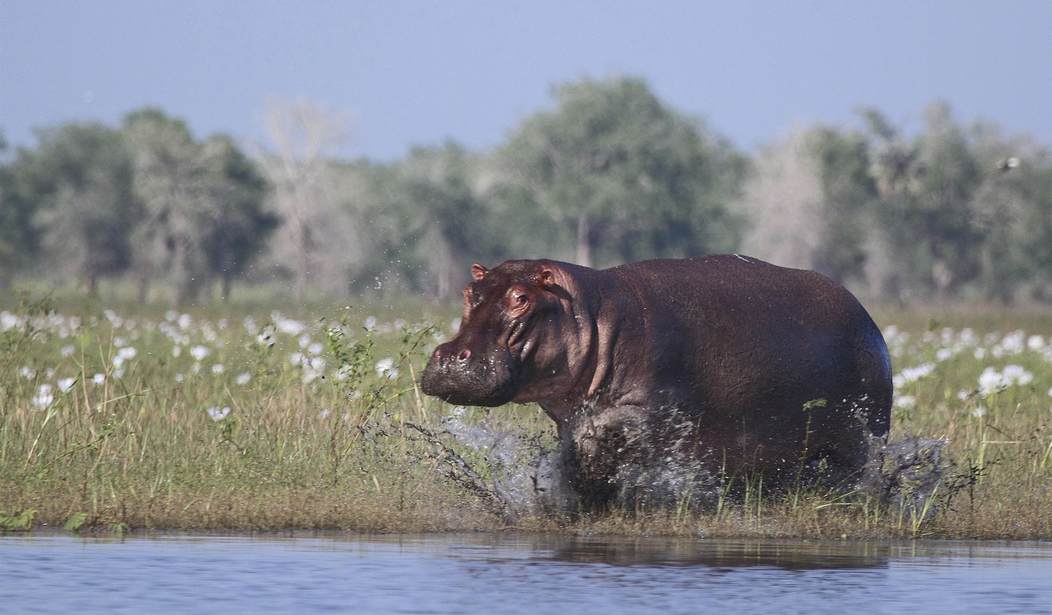
Hippos typically live exclusively in the wetlands, lakes, and rivers of sub-Saharan Africa... unless an infamous drug lord imported them to South America in the early 1980s, was fatally shot about a decade later, and the ones he kept as pets escaped, adapted to the region, and created their own colony.
You may or may not recall that at the time Pablo Escobar was killed in 1993, he owned hundreds of exotic animals, including four hippopotamuses that he reportedly imported from a wildlife center in Texas, which were kept at his Hacienda Nápoles estate. After his death, the Colombian government deemed them impossible to seize, so they were just left there, while the other animals were relocated to zoos or died in the midst of all the drama.
The hippos were fine, however, and they made themselves right at home in Colombia's Magdalena River basin. The climate, vegetation, and lack of natural predators worked out for them and they began to multiply. By 2007, there were at least 16 hippos roaming the country, and by 2014, there were at least 40. Today, it's estimated that there are about 170, and that number could reach 500 by 2030 and 1,000 by 2035.
That number is about to decline. Colombia's Environment Minister Irene Vélez says that the country has approved a plan to euthanize at least 80 of the animals. The Colombian government says they're an invasive species, a threat to humans, and damaging local ecosystems.
"If we don’t do this, we will not be able to control the population," she said of the creatures known as the "cocaine hippos" or "narco-hippos." She also noted that they have apparently resorted to inbreeding and have "visible genetic damage" due to it.
While there are no reports of the animals killing or seriously injuring people, they have threatened people in local towns. They've caused traffic and boating accidents, and they've killed crops and livestock.
According to the Miami Herald:
Scientists say the animals pose a unique ecological threat. Their size and feeding habits disrupt riverbanks and vegetation, while their waste alters water chemistry, reducing oxygen levels and increasing nutrient loads. These changes can kill fish and aquatic plants and threaten species such as manatees, otters and turtles that depend on stable ecosystems.
The Colombian government has been looking for alternative ways to stop the population boom for years, but the alternatives —sterilization and relocation — have not worked out. Sterilization is expensive, difficult, and risky, and no other country has been willing to take them, making relocation impossible. It has allotted $2 million for the new project.
Smithsonian magazine notes that the government tried culling the animals in 2009, but it stopped when a graphic photo of one's corpse caused national outage.
As you can imagine, these actions have sparked a big debate between the government and animal rights activists and even some Colombian politicians who say that the fact that the animals are in Colombia is the fault of irresponsible humans and that the hippos shouldn't have to pay the price.
I'm an animal person, so I tend to agree with those folks, but I also understand both arguments. If Escobar can have them moved from Dallas to Medellín, I would think there would be a way for the Colombian government or even some private wealthy donor to find a solution. Start a hippo sanctuary or something. Also, the Colombian government doesn't seem competent enough to handle much of anything at the moment, particularly Escobar's legacy of the drug trade — homicides are up, as are cocaine exports — so I'm not sure why they think they can do this. Gustavo Petro paints himself as a great environmentalist, but at the end of the day, he treats narcos better than he does animals.
Want to support conservative media? You can do so by becoming a PJ Media VIP member. It's less than $20 for the entire year, and you get some cool perks too. We can't wait to have you!



Join the Conversation
VIP members get the ability to comment on articles.