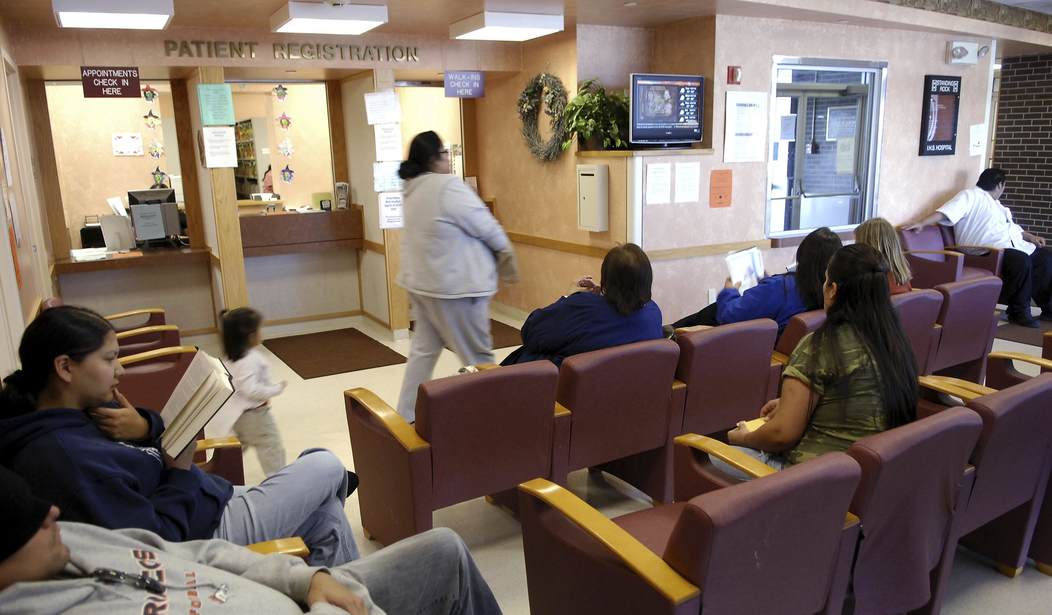
Keep the government's hands out of our healthcare. Otherwise, we'll end up like Canada.
In 2025, "physicians across Canada reported a median wait time of 28.6 weeks between a referral from a GP and receipt of treatment."
The good news is that it's down from 30 weeks in 2024. The bad news is that it's up 208% more than it was in 1993.
According to the Fraser Institute, "After seeing a specialist, Canadian patients waited 4.5 weeks longer than what physicians consider to be clinically reasonable (8.8 weeks)."
The specialities with the longest wait times are neurology, which is nearly a year at 49.9 weeks, and orthopaedic surgery, which is 48.6 weeks. When it comes to diagnostic testing, Canadians wait 8.8 weeks for CT scans, 18.1 weeks for MRI scans, and 5.4 weeks for ultrasounds.
The Fraser Institute also reports that in 2025, Canadians were waiting for 1.4 million procedures. The think tank Second Street reports that 23,746 of those people died waiting for various surgeries or diagnostic testing. Here are some of the highlights from that report:
- At least 23,746 patients died in Canada while waiting for surgeries or diagnostic scans. This figure does not include Alberta and some parts of Manitoba, while some health bodies only had data on surgeries, not diagnostic scans. Most provinces have no data on patients dying while waiting for specialist appointments;
- Comparing data from health care bodies that provided information for both [2025] and [2024] shows a 3% increase in waiting list deaths. Patients died after waiting anywhere from less than a week to nearly nine years;
- New data from Ontario Health suggests 355 patients died while waiting for cardiac surgery or a cardiac procedure. While many cases did not include target wait times for providing treatment, there were at least 90 cases where patients died after waiting past targets that were stated or after waiting more than 90 days; and
- Since April 2018, SecondStreet.org has gathered government data showing more than 100,876 cases where Canadians died while waiting for care. In previous years, large portions of data were missing, so the total is likely much higher.
While the Canadian healthcare system can't provide an ultrasound or a hip replacement surgery within a reasonable amount of time, it will be more than happy to help you end your life ASAP. Same day, no waiting.
According to Canada's Medical assistance in dying (MAID) program, for someone "whose natural death is not reasonably foreseeable," which typically means they have a mental or physical health condition that isn't terminal but is causing some form of "suffering," there's a 90-day wait period.
For those "whose natural death is reasonably foreseeable," there was once a 10-day reflection period, but that has been removed. According to a report by the Chief Coroner of Ontario’s Medical Assistance in Dying Death Review Committee (MDRC), in 2023, 65 people were provided euthanasia the same day they requested it. Another 154 people received it the day after. Members of the committee expressed concern that access to MAID is more accessible than quality palliative or end-of-life care.
As a matter of fact, one of the top so-called "dangers of assisted suicide" is that threatens the potential improvement of palliative care. I mean, who needs that? Let's just convince everyone to kill themselves and save the system the hassle.
That's a problem. The Canadian government seems to be on a slippery slope of playing God here.
For many people, assisted suicide goes against their personal, cultural, familial, moral, ethical, and/or religious beliefs. Many believe it's a gross violation of the sanctity of life. Even as they suffer from the most awful of diseases, it's simply not an option.
Another danger is that it puts vulnerable people at risk of abuse and coercion. We've seen that happen in recent years in Canada. In 2022, at least four or five Canadian veterans or active duty military members who contacted veterans affairs for care were instead offered assisted suicide by a caseworker.
The same year, Retired Corporal Christine Gauthier, who is also a paraplegic athlete who competed for Canada at the 2016 Rio de Janeiro Paralympics and the Invictus Games, claims she was offered MAID services when all she wanted was a wheelchair ramp for her home.
A 2024 MDRC report found that many requests for MAID came disproportionately from poorer communities and included people who weren't terminally ill but who were suffering from issues like addiction, mental illness, and homelessness.
"This worrisome finding suggests that MAID could be the option of least resistance and be used to end lives when social policies have failed them," said one committee member, adding, "When Canada legalized assisted suicide and euthanasia under MAID in 2016, Canadians believed it was intended to be a rare, last-resort measure, reserved for consenting adults enduring intolerable suffering at the end of life."
It's not just impacting the people who are offered the "service." A 2024 investigation from the Associated Press suggests that it's also having a negative impact on the healthcare workers involved. As doctors and nurses face requests from people who suffer from problems that could be solved financially, medically, or socially — including homelessness, obesity, injured people who can't work but can't get assistance, or even grieving widows who've recently lost their husbands — they find that they're increasingly uncomfortable with providing this type of "care." Who can blame them? It's unnatural and incompatible with our most basic human instincts.
"I don't want [euthanasia] to become the solution to every kind of suffering out there," one physician said.
Unfortunately, it looks like that's exactly the direction in which Canada is heading. The day the government stops valuing the lives of its citizens and viewing them as a burden is the day it becomes functionally worthless.