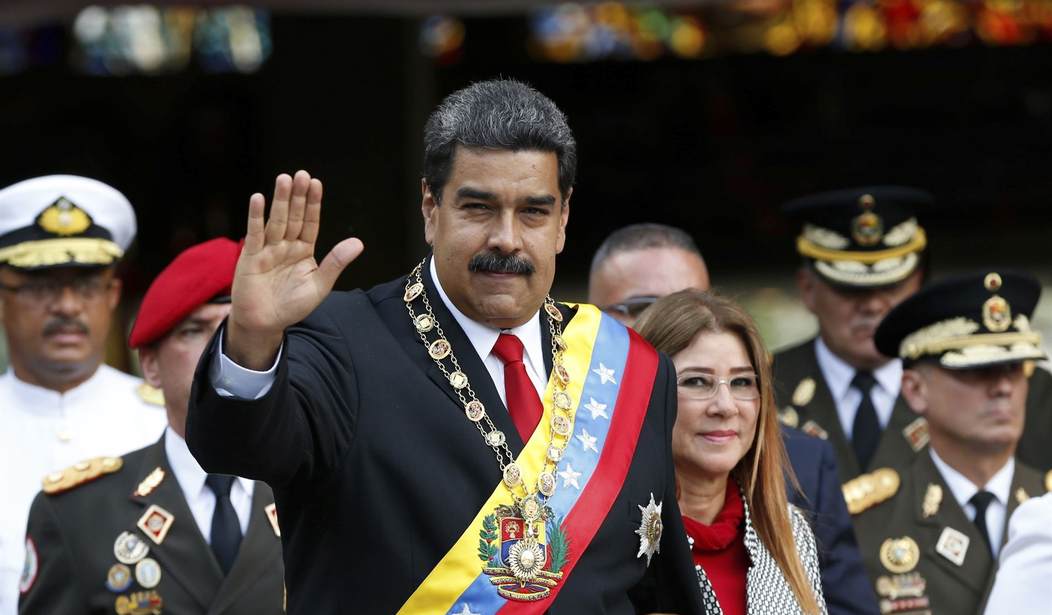

Something I've found while covering Venezuela is that most people know Hugo Chavez, but current dictator Nicolás Maduro Moros is another matter.
Whereas Chavez was charismatic, a fiery speaker with a military background who at least came across as intelligent, Maduro is, well, what's a nice way to say bumbling idiot? His background is in bus driving — nothing against bus drivers but the path from public transportation to presidential palaces isn't a common one for heads of state — and he's awkward, desperate, and constantly mocked for his gaffes. He'd make for a great sitcom character if he wasn't holding an entire nation hostage and disappearing his political opponents.
🚨🇻🇪🇺🇸 | DELIRANTE: Nicolás Maduro bailó una canción con sus frases "plis pitz forever, no crazy war", en medio del masivo despliegue militar de Estados Unidos.
— La Derecha Diario (@laderechadiario) November 22, 2025
El dictador narcoterrorista intentó que su ministro de Educación baile con él, pero se negó. pic.twitter.com/x0C8mVAk99
So, how exactly did he end up running a country (and I use that term lightly, as it's more like running it into the ground) that sits on top of the world's largest oil reserves? Let's just say he didn't necessarily get there on merit. It was more about loyalty.
Born in 1962 in Caracas in a working-class neighborhood, Maduro was the son of Nicolás Maduro García, a union leader who likely inspired his early interest in politics. In high school, he became the student body president. According to a former classmate, "He would address us during the assembly to talk about students' rights and that sort of thing. He didn't speak much and wasn't agitating people into action, but what he did say was usually poignant."
Maduro didn't graduate high school, and, rather than get into politics, he reportedly wanted to try music instead of politics. He dreamed of becoming a rock star. That didn't work out. You can probably see why here:
Venezuelan President Nicolás Maduro sings John Lennon's 'Imagine' at a rally, calling for peace amid rising tensions with the United States, November 2025. pic.twitter.com/KzHnAUjEip
— Future Adam Curtis B-Roll (@adamcurtisbroll) November 18, 2025
Instead, he found work as a bus driver, something he did for many years. He also got involved with the Socialist League, a Venezuelan political party with Marxist-Leninist-Maoist ideology, which eventually merged with Chávez's ruling United Socialist Party of Venezuela (PSUV).
Rather than make an attempt at any sort of formal post-secondary education, he did what all good little commies do and headed off to Havana for a year, where he a attended the Escuela Nacional de Cuadros Julio Antonio Mella, which was directed by the Union of Young Communists. He came home even more radicalized than he already was by Fidel Castro. By the 1990s, he was a full-blown activist. He also worked briefly as a bodyguard for presidential candidate José Vicente Rangel in 1993.
Maduro joined the Bolivarian Revolutionary Movement (MBR 200), which Chávez founded in 1982. It began as a secret movement involving Chávez and a couple of other Venezuelan military officers. They eventually brought in more members with talk of some sort of government coup that they finally attempted — and failed — in 1992. Chávez was jailed, and Maduro, who was part of the civilian sect of the movement at that point, was one of the loudest voices calling for his release.
I suppose that endeared him to the man who would, by the late 1990s, become Venezuela's president. Once Chávez was in office, Maduro's star rose, too, and he was no longer just a bus driver and commie activist. In 1998, he was elected to the Venezuelan Chamber of Deputies, to the National Constituent Assembly in 1999, and to the National Assembly in 2000.
In 2006, Chávez made him his minister of foreign affairs, where he gained respect by following "the Chavista line of openly seeking the 'construction of a multipolar world free from the hegemony of North American imperialism.'" He sought allies beyond Latin America, and ended up with China, Russia, Iran, Belarus, Syria, and, at the time, Libya on his side. With friends like that, I'd hate to see your enemies.
Impressed with his work, in 2012 Chávez made Maduro his vice president. The long-time bus driver was now one of the most trusted members of the inner circle. Sharing power was short-lived, however. Chávez found out he was dying that year, and in December, during a speech, he made it clear that he wanted Maduro to be his successor.
Chávez finally kicked the bucket on March 5, 2013, and Maduro was sworn in immediately despite outcries from the opposition, who claimed that his appointment violated the Venezuelan Constitution. An election for a new president was to be held within 30 days.
As it turns out, Chavismo without Chávez wasn't very popular. Maduro won the April 2013 election by the tiniest of margins, and many claim that he only did so through fraud, intimidation, and misuse of state resources. During his term, Venezuela faced an economic crisis, and in 2015, the opposition won the National Assembly. During the 2018 elections, Maduro claimed he had won again, even though there was evidence the vote wasn’t free or fair, turnout was extremely low, and the international community widely condemned the process.
And, of course, in July 2024, with the eyes of the world upon him, Maduro pulled a similar stunt. Despite evidence that Edmundo González won the election by an extremely solid majority, Maduro declared himself the winner and began jailing and disappearing the people who took to the streets to protest until they were too scared to do so anymore.
And that's where we find ourselves today. The man is running what was once one of the greatest democracies in the world as a drug cartel, harbor for terrorists, and socialist utopia. Meanwhile, the people starve to death, the infrastructure is crumbling, the country is billions of dollars in debt to China, and you get thrown in jail if you dare speak up.
Obviously, this is a simplified version of his ascent to power, but hopefully it gives you an idea of how a young high-school dropout turned bus driver became a head of state without ever actually facing a free and fair election. And with any luck, in the coming weeks he'll be a thing of the past for Venezuela and the entire world.
On Saturday, Donald Trump posted the following on social media.
To all Airlines, Pilots, Drug Dealers, and Human Traffickers, please consider THE AIRSPACE ABOVE AND SURROUNDING VENEZUELA TO BE CLOSED IN ITS ENTIRETY. Thank you for your attention to this matter! PRESIDENT DONALD J. TRUMP
— Donald J. Trump (@realDonaldTrump) November 29, 2025
It doesn't indicate anything aside from an increase in pressure and intimidation tactics, but there are dozens of rumors going around this weekend that the end is near for Maduro. Depending on who you believe, he's planning his escape to Iran or Turkey, sleeping — well, they say he's not getting much sleep — in a hospital to avoid military action he fears is coming, or being held hostage by Cuban security officials who will execute him if he tries to step down.
We'll see what happens.