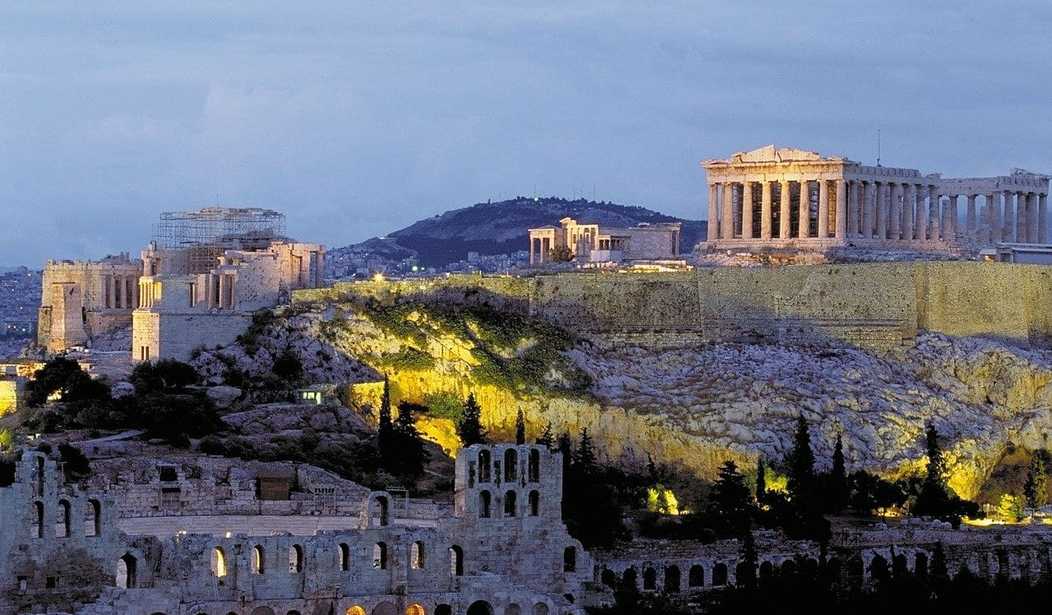

The Turks are irked, but whether they actually have good reason to be is another question altogether. They’re angry because in its tourism presentations on the Acropolis, the Greeks have slighted, in Turkish eyes, the period of the Ottoman occupation.
The Ottoman Turks occupied Greece from the fifteenth century until 1821, and for Greeks in general, this is not a happy memory. The Turks enforced Islamic rules, relegating non-Muslims to second-class status, and Greeks had to endure continuous discrimination and harassment that occasionally broke out into violence. The Greek Orthodox Church venerates a whole host of Christians whom the Turks killed for leaving Islam, or for declining to convert to Islam, as “the new martyrs of the Turkish yoke.”
It is also important to note that the Acropolis has nothing whatsoever to do with the Ottomans. It was built in the fifth century B.C., many centuries before the Turks got the idea to convert to Islam and leave Central Asia for jihad adventures in Asia Minor. In light of that, and of the fact that Greeks generally think of the time of the Turkish occupation the way the French think of the National Socialist German occupation during World War II, it’s understandable that their tourism material on the Acropolis wouldn’t exactly be singing the praises of Mehmed the Conqueror or Suleyman the Magnificent.
That is, however, precisely what the Turks think the Greeks should be doing, in this and in other contexts as well, and so they’re irked. Greek City Times reported Sunday that “the Greek Ministry of Culture’s new infrastructure and cultural route projects around the Acropolis aim to highlight overlooked ancient monuments. However, the initiative has sparked sharp criticism from Turkish ‘experts’ and pro-government media, who accuse Athens of deliberately sidelining the city’s Ottoman-era cultural layers.
The Turkish government is reportedly fuming because the “enhanced cultural paths near the Acropolis focus almost exclusively on classical ancient heritage while treating Ottoman remains as ‘neglected or marginalized.’” The Turks accuse the Greeks of “abandonment or secular repurposing of Ottoman buildings in Athens,” along with “inadequate maintenance of Ottoman tombstones, cannons, and other artifacts around the Acropolis.”
The Turks also complain that the Greeks have closed “historic” mosques in Greece, an accusation that is particularly rich in light of Turkish President Recep Erdogan’s conversion of Hagia Sophia, the grandest cathedral in the entire Christian world for nearly a thousand years, into a mosque in 2020. Hagia Sophia is, in fact, just one of innumerable Byzantine-era churches throughout Turkey that have been converted into mosques, but consistency has always been the hobgoblin of jihadis (and their leftist allies).
Add to that Turkish complaints that the Greeks present an “overall ‘hierarchy of history’ that downgrades the Ottoman period as secondary or unwanted,” which is exactly what it was, and there is a new source of tension between the putative NATO allies. The Turks want the Greeks to “equally integrate the ‘multi-layered’ history of Athens, including nearly 400 years of Ottoman rule (1458–1821), during which the Acropolis and city saw mosques, fortifications, and other additions.”
As one X user commented, “Take note people, when you conquer a country and enslave the population, if the natives ever manage to free themselves they are required to cherish that period as part of their heritage.”
Meanwhile, in Turkey, the Turks routinely tout ancient Greek Christian sites as if they were part of the Turkish national heritage, despite the fact that these sites flourished many hundreds of years before there were any Turks in Asia Minor at all.
Related: ‘Without Muslims, Europe Would Be Centuries Behind’
GoTürkiye, the Turkish government’s official tourism website, touts numerous Christian sites as destinations for visitors to the country: the Seven Churches of Revelation, the Shrine of the Virgin Mary in Ephesus, and even the Phanar, the headquarters of the Ecumenical Patriarchate in Constantinople, the first see of the Orthodox Christian Church.
The tragic irony of this is that many of these sites are ruins today, and the Christian population of Turkey is vanishingly small and steadily diminishing because of Turkish genocides of Christians that the Turkish government steadfastly refuses to acknowledge. But they’re ready to skewer the Greeks for not paying due attention to the fact that they once invaded and occupied Greece, including the site of the Acropolis.
As my PJ Media colleague Catherine Salgado remarked, “Hasn’t Turkey stirred up enough bad blood with Greece over the years?” Apparently, as far as the Turks are concerned, no amount is ever enough.