





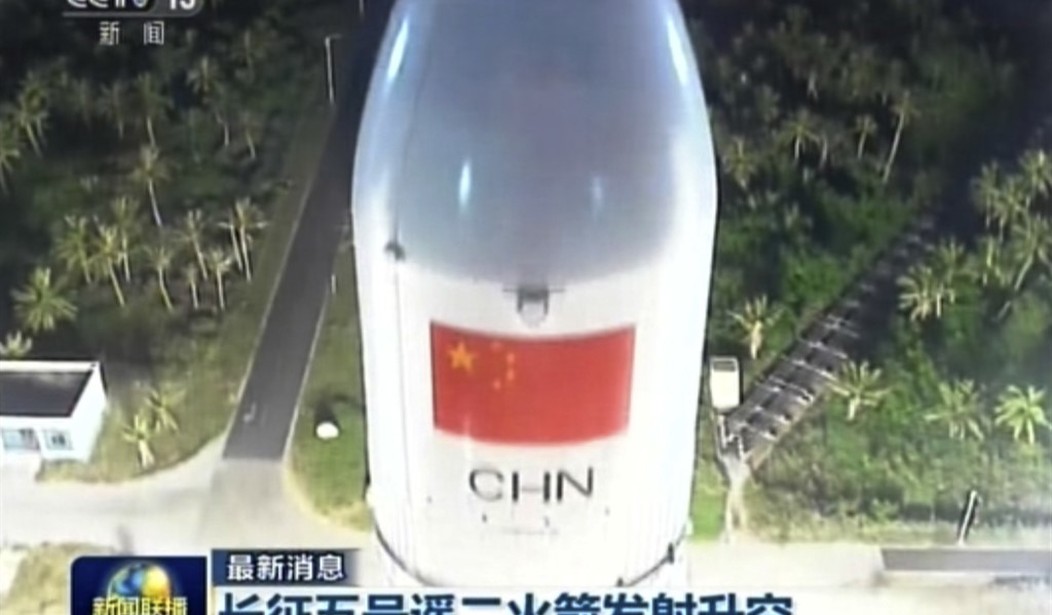
China's manned space program issued an announcement on Sunday.
“In keeping with the principle of proceeding prudently and reliably, and ensuring absolute success, after a comprehensive assessment it has been determined that the Chang’e 7 mission does not meet the conditions for launch and therefore cannot be carried out during the planned launch window this year."
Chang’e 7 mission is groundbreaking. The unmanned probe was expected to lift off on Sunday and land near the South Pole of the Moon, close to Shackleton Crater.
Shackleton Crater is Sutter's Mill, the Klondike, and the Witwatersrand Gold strike all rolled into one. Scientists confirmed the existence of water ice hidden in the Permanently Shadowed Regions, or PSRs, of the Moon in 2012. How much water ice on the Moon is the number-one question for any nation wanting to establish a permanent base on our satellite. Being able to use water found on the Moon means not having to lug water from the Earth, thus saving untold billions of dollars in transport costs.
Water (H2O) can also be broken into hydrogen and oxygen to make breathable air and fuel to power rockets and other vehicles. In short, finding and using water ice from the South Pole will be a game-changer.
And the first nation to stake a claim will be in the catbird's seat.
The government hasn't said why the Chinese Moon mission was scrubbed. Social media speculation centered on a typhoon lingering in the area of Hainan Island, where China launches all of its missions. Whatever the reason, the delay means that a "launch window" won't open for a trip to the South Pole from Earth until late February or March. Because of the Moon's very small axial tilt (1.2 degrees vs. 23 degrees for Earth) and the South Pole being in shadow most of the year, a solar-powered mission must land during a narrow window when Shackleton is in continuous sunlight.
The delay comes amid a tight contest between China and the United States to establish a meaningful presence at the South Pole of the Moon. Robotic missions such as Chang’e 7 are precursor flights for human missions that could follow in the next two to four years.
Chang’e 7 is planned to land near one of the most compelling regions of the Moon, Shackleton Crater, very nearly at the South Pole. Much of the lunar surface is pretty barren, but the South Pole, and Shackleton Crater in particular, offers some of the most coveted real estate there. This is because the high rims of the crater create permanently shadowed regions known as “cold traps,” where it’s thought that water (in the form of ice, of course) and other useful materials may have accumulated over billions of years. In all of NASA’s and China’s plans for long-term settlement on the Moon, relatively few square miles at the South Pole of the Moon matter the most.
No country has softly landed a spacecraft at the lunar poles, which are more difficult to reach than equatorial regions of the Moon. The delay of Chang’e 7 opens up the possibility that NASA could reach this terrain first, with the initial launch of Blue Origin’s Blue Moon Mark 1 vehicle. This large lander will carry two NASA probes to the South Pole.
Is it really a "race" to the South Pole? Perhaps it's not as consequential as the first space race between the Soviets and the U.S., but it's a race nonetheless. That's because at present, there is no agreement with China or any other spacefaring nation about how to divvy up lunar resources. In addition to water ice, there is also an abundance of Helium-3, which is considered the "Holy Grail" of nuclear fusion. Fusing H-3 with deuterium (or with itself) could produce massive amounts of clean energy without creating dangerous radioactive waste products. The isotope is all over the moon, found in the regolith on and near the surface.
In 1967, all the major spacefaring nations signed the Outer Space Treaty, which serves as the core framework for international space law and bans national appropriation of celestial bodies under Article II. The real debate under the treaty is not over land ownership (which is outright banned), but over resource extraction (e.g., harvesting water ice or mining Helium-3). The treaty prohibits claiming the terrain itself, but it leaves a legal gray area as to whether a nation or private entity can own the raw materials extracted from that terrain once harvested.
The current "framework" is known as the Artemis Accords. This is a non-binding framework that states the Moon and its resources are the "common heritage of mankind" and seeks to establish an international regime to govern and distribute benefits from space mining. It explicitly says that extracting and using lunar resources (such as harvesting water ice at the lunar South Pole for fuel or life support) does not violate Article II of the Outer Space Treaty. It also introduces "safety zones" around lunar operations to prevent harmful interference between competing landers.
Frankly, I think any legal framework is likely to unravel where China is concerned. They will interpret treaties as they see fit and brook no disagreement.
An accident blew up Blue Origin's launch pad at Cape Canaveral, Fla., during a static fire test in May, setting back the launch of probes also headed for the South Pole. The Chinese and Blue Origin missions may launch within days of each other, with the Chinese mission spending 90 days in polar orbit studying the terrain before setting down. This could give the Blue Origin mission a head start in looking for water.
Like the original space race, there are no "participation trophies" for second place.
Editor's Note: President Trump is leading America into the "Golden Age" as Democrats desperately try to stop it.
Help us continue to report on President Trump's successes and combat Democrats' lies. Join PJ Media VIP and use promo code FIGHT to receive 60% off your membership.



Join the Conversation
VIP members get the ability to comment on articles.