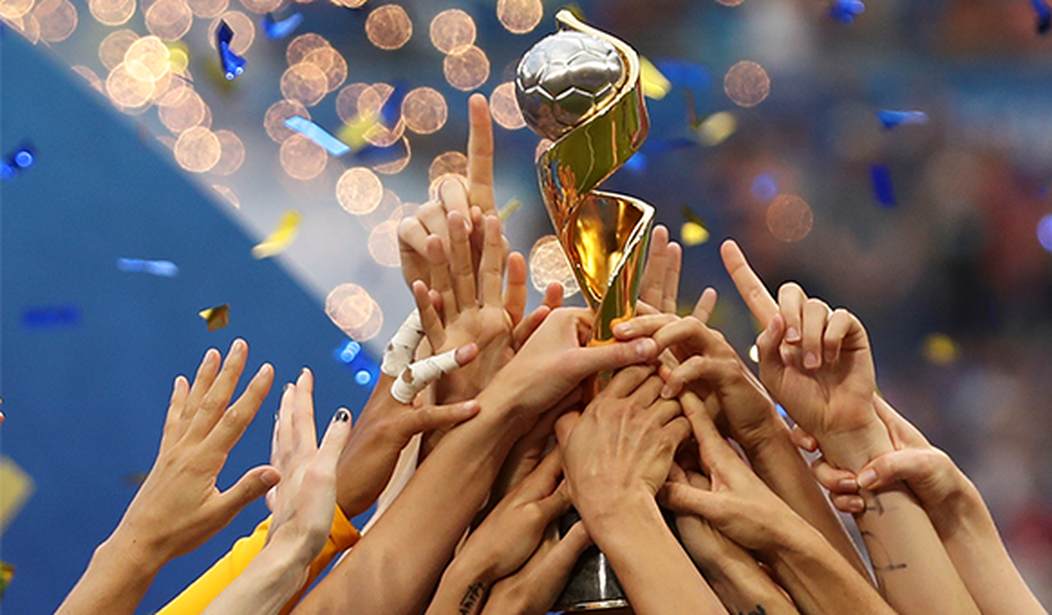
It may be the greatest bait-and-switch scam in history. And it virtually guarantees that the World Cup soccer tournament, which begins in the U.S., Mexico, and Canada on June 12 and will run through July 19, will be the last held in the U.S for quite some time.
When the U.S., Canada, and Mexico submitted their bid to host the 2026 World Cup soccer tournament in 2018, they made certain assurances. The "proposed face value of tickets ranged between $21 to $323 (not including suites) for group-stage games." according to ESPN. "The final, again excluding suites, ranged from $128 to $1,550."
But something funny happened on the way to reality.
The $60 "entry point" for tickets is a sham. Only a few hundred tickets were priced at that rate, according to the Associated Press.
The reality hit home for people looking for that $60 ticket from FIFA, the sport's international governing body.
Average prices for the cheapest tickets available for group-stage games two months before the tournament's start were much higher. For example, in Los Angeles, where the U.S. men's national team will play twice, the average cheapest ticket for group-stage games 60 days out was $1,040.52 on FIFA's resale market. In Dallas, where global icon Lionel Messi will play two matches, the average cheapest ticket for group-stage games was $1,028.
For context, that's roughly double what the average American spends on food in a month.
"A main insight from my work on ticket reselling is that modern resale markets change the economics of ticketing," said Pnina Feldman, an associate professor from the Darden School of Business at the University of Virginia. "Historically, sellers disliked resale because uncontrolled resale created competition against them, but with electronic tickets, identity verification, and an official exchange, the seller can control the exchange and collect fees on every transaction.
"An authorized resale market [like FIFA's marketplace] enables the seller to control the exchange and charge commissions and is the seller's best revenue-maximizing mechanism," Professor Feldman said. "That is the core economic logic behind FIFA's resale platform."
The official U.S. proposal also claimed that public transportation would be offered free to ticket holders on game day. "Spectators will have complimentary public transportation to and from the stadiums on match days," but the AP reported that 'agreements with host cities were altered to allow them to provide public transportation 'at cost.'"
Naturally, greedy Democrats took that alteration and ran with it.
Standard fares will apply to the rail systems in Atlanta, Houston and Seattle, while Kansas City has $15 shuttles to and from Arrowhead Stadium. Miami-Dade County is offering free shuttle service, and fans in Philadelphia can get free postgame subway rides funded by Airbnb.
Meanwhile, NJ Transit will charge $98 to get to MetLife Stadium, and in Boston, an express bus will cost $95.
Donald Trump said, "I wouldn't pay it either, to be honest with you," when discussing World Cup tickets that could go for more than $1,000.
"I think they're high," said Andrew Giuliani, the executive director of the White House Task Force for the World Cup. "I think I'm with the president on this one. These prices are high, and I think in some ways FIFA's a bit of a victim of their own success."
Pure, unadulterated greed and a stereotypical view of Americans all being rich sports fanatics have contributed to FIFA's ludicrous ticket prices.
"There is a point at which revenue maximization can undermine the cultural value of the event," Feldman said. "The World Cup is not perceived by fans as just another luxury product. It has a public, cultural and national meaning. When prices move too far out of reach, the event may still be economically successful, but it risks becoming less representative of the communities that give soccer its value."
FIFA refuses to give out any information on ticket sales or prices. But we know that the U.S.vs. Paraguay match on June 12 is far from being sold out due to the steep drop in ticket prices the closer we get to the match.
"FIFA, as a private organization, they said, 'Hey, we're going to use dynamic pricing and we're going to see where these land,'" Giuliani said. "They're either going to land at thousands of dollars of tickets or they're going to end up coming down. I know right now ... there are plenty of tickets that are available around the country for less than $200 for the World Cup. So I do think there will be some affordable options, but I'm certainly not denying that these prices are expensive."
ESPN reports, "According to a May report from the Athletic, the USMNT's opener on June 12 in Los Angeles is not on pace to sell out at current prices and purchasing rates. Empty seats in a World Cup played in a market of nearly 350 million people would've once been unthinkable, but at the current prices, could some of the tournament's 104 games be played in front of less-than-sellout crowds?"
Probably not. FIFA will give any extra tickets out for next to nothing if it comes to that. But who wants to buy a soccer ticket for $1,000 to $4,000 a pop?
Fewer than if the tournament had been held in Western Europe or South America.