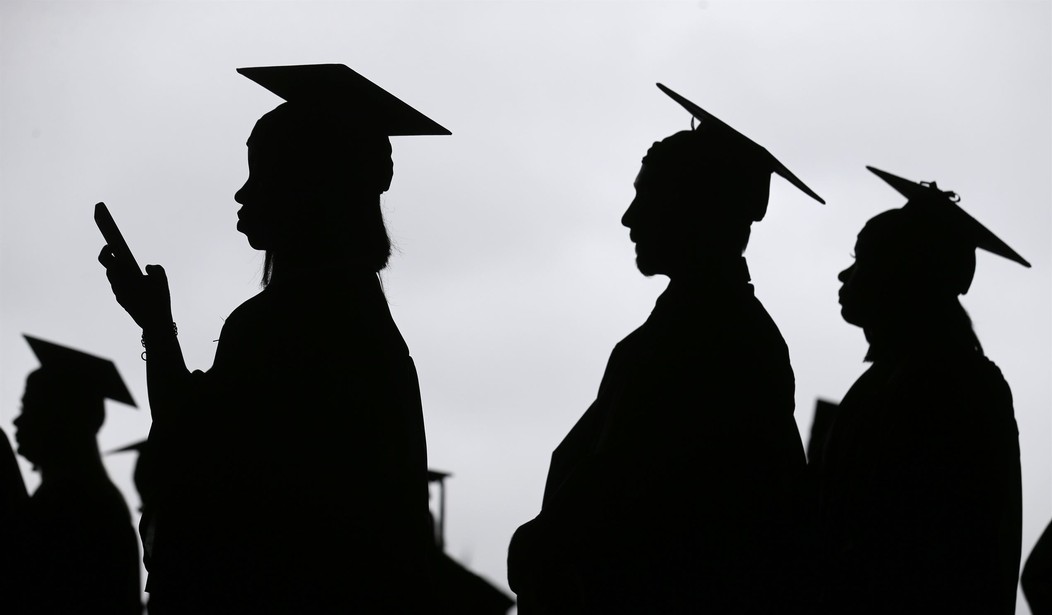
ChatGPT and other AI tools are making grades at colleges and universities largely irrelevant in many subjects.
Even prior to ChatGPT's arrival in 2022, there was growing concern in elite schools that professors weren't challenging students enough. "Solid A's account for nearly two-thirds of all undergraduate letter grades," according to Axios. "That's up from roughly a quarter 20 years ago."
Harvard's faculty recently voted on limiting the number of top grades students can receive. Pre-vote polls showed 60% of professors in favor of limiting "A" grades. Fifty students in the 2025 graduating class had perfect 4.0 grade point averages.
The upshot of this grade inflation is that it cheapened a college degree and reduced a university's GPA as a tool for employers and graduate admissions offices to screen for the best candidates.
Some critics complain that limiting the number of "A's" undermines academic freedom. Also, capping the number of "A" grades puts students at a disadvantage against other schools without the cap.
"Princeton and Wellesley previously adopted anti-grade-inflation policies and later rolled them back amid concerns about student stress, perceptions of quotas and other unintended consequences," reports Axios.
ChatGPT has further clouded the issue. The grade inflation isn't just from a "B" to an "A." "We have a C student who is now an A student," says Igor Chirikov, a UC Berkeley professor who authored a study on AI and grade inflation.
"Since the release of ChatGPT in 2022, 'excellent' grades rose by 30% in classes where AI is useful, such as English composition and coding," Axios reports. "In classes where it's not — like sculpture and lab-based courses — grades remained flat."
Excellent grades have been on the rise since the early 2000s, but Chirikov found that classes that place more weight on homework assignments than on in-class exams see higher rates of grade inflation.
That pattern suggested that unsupervised work is getting an AI-assisted boost, he says.
Another issue with the grading scale is that faculty are sometimes incentivized to "grade more leniently" as student evaluations of their work are often tied to a professor being promoted, Chirikov says.
There is no "silver bullet" to stop AI from inflating GPAs, nor is it a new concept that students have inflated GPAs, he says.
"There are many cases when students can select easier courses and get easier A's, and their GPA will be higher. And I think AI just exacerbates the existing trends," Chirikov says.
To combat ChatGPT's influence, some professors are going old-school. They're bringing back the ubiquitous "blue book" to facilitate written exams. No cutting and pasting possible. There has also been a return to oral exams, although too many students today are incapable of stringing together coherent thoughts, and other students who are multilingual or handicapped are at a disadvantage.
Professor Dan Melzer, at the University of California, Davis, says educators won't be able to completely "outsmart ChatGPT" use because students will find workarounds. Besides, as Steven Krause, a professor at Eastern Michigan University, says, it's a myth that most students cheat using ChatGPT. In his experience, most cheaters are "desperate" for solutions
He says he reads about 1,500 pages of student writing each semester, and that "AI writing just sounds off." Krause thinks that "experienced professors should be able to detect it, especially if they know their students."
Indeed, the poor writing skills of most students would make any ChatGPT additions stand out like a sore thumb.
It's worth noting that influencers and startups are creating programs and prompts to "humanize" AI writing, making it harder to recognize to an untrained eye.
Critics say blue-book exams are a misguided solution.
More than half of students now take at least one online course and asynchronous, self-paced classes make in-person assignments impractical.
Multilingual writers and students with disabilities who need accommodations are at a massive disadvantage in timed, handwritten scenarios. Plus, deciphering students' poor handwriting is a headache, Krause says.
Writing is meant to be a revision process. Forcing students to write a timed, single-draft response, means professors are evaluating a students' rushed thoughts, not their skills.
As college education becomes more expensive and parents are less likely to foot the bill (and students are less willing to take on deep debt), the generosity of professors in handing out top grades becomes an issue at schools that purport to be elite. What makes them “elite” if they aren’t highly competitive and don’t have a reputation for challenging students to the utmost degree?
That's a question parents and students want answered before they shell out $100,000 for an education they can get at a state school for $10,000.