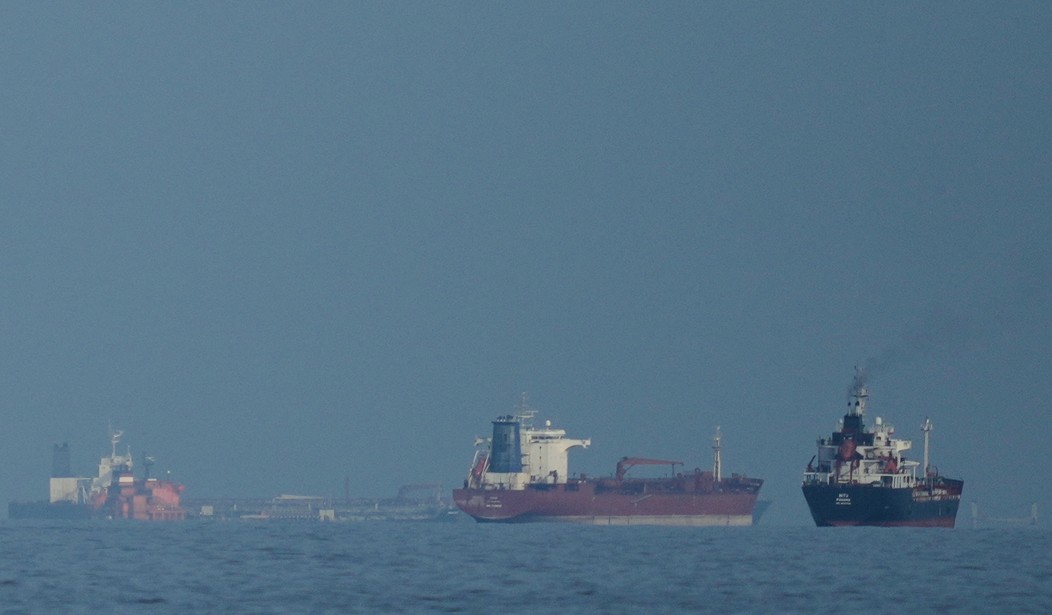
The standoff in the Strait of Hormuz is not between Iran and the U.S. It's between the world and Iran.
Why then, is the world, as one, not on the side of the U.S? Iran, a terrorist state run by a terrorist organization (Islamic Revolutionary Guard Corps or IRGC), has unilaterally decided to close the Strait of Hormuz to vital shipping, a brazen, unprecedented act of lawlessness. More than 20% of the world's energy moves through the Strait.
Now, Iran is demanding that the U.S. grant it sovereignty over the Strait. This would "fundamentally remake regional and global maritime norms in a manner extremely detrimental to US interests," according to the Institute for the Study of War (ISW). It would be a catastrophe for the U.S. and the developed and developing world.
"Long-term control of the Strait would require Iran to secure U.S. recognition of its claims to the Strait of Hormuz through a negotiated agreement so that Iran could order ships to comply with its rules legitimately and then intercept those ships that fail to comply," according to ISW. "Iranian negotiators increasingly prioritized securing its control over the Strait in negotiations, likely because it believes Iranian control over the Strait would act as a safeguard against future wars between Iran and Israel and the United States."
Iran has demanded formal recognition of its sovereignty over the Strait and an end to the U.S. naval blockade of Iranian ports as a condition for a permanent ceasefire. The United States cannot even consider it. The U.S. continues to cite the UN Convention on the Law of the Sea (UNCLOS) — specifically the right of "nonsuspendable transit passage" — to argue that Iran has no legal authority to restrict or tax international shipping.
Iran, which has not ratified UNCLOS, argues it only recognizes "innocent passage," which it believes allows it to bar "hostile" vessels.
The U.S. will be pressured by allies and the UN to agree to some compromise of this stunningly brazen demand. Instead of standing with the U.S. against this kind of aggression, most of Europe and Asia (with notable exceptions), the rest of the world only wants an end to the tension so that everyone can get back to making money and politicians can keep their voting publics quiet about energy prices.
The Strait of Hormuz is not the only critical waterway that an unfriendly power could hold hostage.
For decades, the free passage of global trade through key maritime routes was treated as a given. Not because the world was peaceful, but because there were limits — lines that, once crossed, would trigger a response strong enough to restore them.
That assumption is now being tested. The United States has acted. A naval effort is underway to reopen safe passage, guiding stranded ships and attempting to break the chokehold that has paralyzed the strait.
But this is not, and cannot be, an American problem alone.
Because what’s at stake is not just access to a single waterway. It is the principle that global trade cannot be dictated by force.
If that principle collapses here, it will not hold anywhere.
From the Red Sea to the Indo-Pacific, the modern economy depends on narrow corridors like this one. If the Strait of Hormuz can effectively be closed by a rogue nation — and the world hesitates, fragments, or looks away — then every choke point becomes a potential weapon. Every supply chain becomes contingent. Every market becomes more volatile.
What would Iranian sovereignty over the Strait look like? "Iran’s 'Persian Gulf Strait Authority' also sent an email on May 6 to shipping companies with vessels in the Persian Gulf stipulating that for safe passage through, crews must pay the body in Iranian rials and gain issuances of guarantees from Iranian banks, which would force everyone who wants to use the Strait to violate U.S. sanctions," reports the ISW. The communique also makes clear "that countries whose ships want to go through the Strait have to lift sanctions."
"Critics, including the United Kingdom, Germany, France, Spain, and even Italy, nations that depend on free navigation through the strait far more than the U.S., claim they did not start this war and are not required to act," writes Elizabeth Stauffer in the Examiner. Like the famous crocodile in Churchill's analogy of appeasement, each of those European nations hopes that the croc will eat them last.
This is the dilemma facing Europe and Asia right now: is it better to resist the "crocodile" today or hope to be the last one eaten?