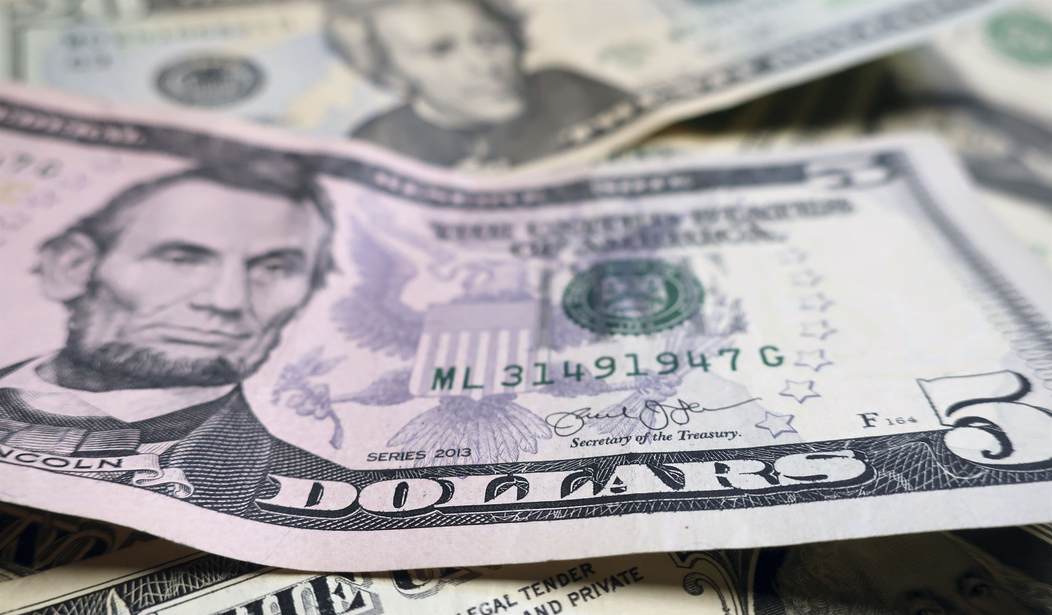
We rarely stop and think of the world that the U.S. dollar has created for America. Our interest rates are comparatively low compared to the rest of the world because of the dollar's position as the world's reserve currency. This gives the U.S., in Charles de Gaulle's words, "Exorbitant Privilege."
We're able to run massive budget and trade deficits because the rest of the world uses the dollar for trade and for international finance. Because the rest of the world pays for goods in dollars, our imports are relatively cheap. The strong dollar gives us a higher standard of living as well.
Now imagine a world where the dollar wasn't king. That's what the BRICS nations (Brazil, Russia, India, China, and South Africa) are talking of doing at a meeting later this year.
The meeting may be "the start of what might be termed the 'plot against the dollar,'" writes The Spectator's Matthew Lynn. "America’s currency is likely to face its most serious challenge of the post-World War Two era.
Indeed, the dollar has had several rough patches since the 1944 Bretton Woods agreement established the greenback as the world's reserve currency. By linking their currencies to the dollar, other countries essentially agreed that the dollar was "as good as gold." This made the dollar the essential medium for international trade.
Even after Richard Nixon took the U.S. off the gold standard in 1971, the world continued to recognize the U.S. currency's dominance, largely because there was no alternative that wouldn't have led to chaos and worldwide disruptions.
We're living in a different era now. And the disruptions would be worth it, China thinks, because replacing SWIFT and the greenback would mean that the Chinese yuan would gain in prominence. And the BRICS would begin to use each other's currencies to pay for goods and services.
Thus endeth the dollar's "Exorbitant Privilege."
The BRICS nations want to launch their own multilateral payment platform to rival the current SWIFT (Society for Worldwide Interbank Financial Telecommunication) protocol. The network connects over 11,000 financial institutions across more than 200 countries and territories. As a standardized messaging system, it is considered the backbone of international finance due to its high level of security and reliability. "BRICS Pay" would be "a new type of financial mechanism that will allow some of the largest economies in the world to trade with each other without involving the American dollar anywhere along the way: not so much a single currency, but a single payment platform," writes Lynn.
America’s share of the global bond market, a key financial asset, has steadily declined, and so has the percentage of commodity trade priced in dollars. “Fundamentally, de-dollarization could shift the balance of power among countries, and this could, in turn, reshape the global economy and markets,” the report said.
There is little question that the American currency has reached the stage where it is weak enough to be vulnerable. There are two reasons, however, why 2026 is proving to be the perfect year to launch the “plot.” First, last year’s “Liberation Day” saw President Trump tear up the rules-based trading system that had been in place for the past 50 years. You can argue about the rights and wrongs of the tariffs. The important point is this: Liberation Day was specifically designed to bring money and manufacturing jobs back to the United States, and that meant for the rest of the world there was far less incentive to remain locked into the dollar system. Next, the military adventurism in Venezuela and more dramatically in Iran, as well as the casual abandonment of traditional alliances, means loyalty to Washington has declined.
What would happen if the world went off the dollar as a reserve currency? Without guaranteed global buyers, the U.S. would have to offer much higher interest rates to attract investors to its debt. This could lead to a fiscal crisis, as a larger portion of the federal budget would go toward just paying interest. We're already paying close to a trillion dollars in debt servicing payments. Those payments may double if our debt instruments have to compete in the open market.
For ordinary consumers, much higher interest rates would price many people out of the housing market as borrowing costs would go through the roof. Costs for imported goods would go through the roof, leading to a serious rise in inflation. This would decrease our standard of living and the real wealth of everyone.
With the high cost of borrowing and lack of enthusiasm for American debt instruments, Congress would have to get serious about the budget. That means deep spending cuts even in social programs. It would mean getting control of entitlements. And it would mean tax increases.
Globally, it wouldn't all be a bed of roses for the BRICS nations. The world might split into regional "currency blocs" (e.g., a euro-dominated Europe, a yuan-dominated Asia, and a dollar-dominated Americas). This would make global business more complex and expensive due to increased hedging costs. Investors would scramble for alternatives, potentially leading to massive spikes in the value of gold, Bitcoin, or other currencies like the euro or yuan, depending on which is viewed as more stable.
Some of the BRICS have been eying the Chinese "Digital Yuan," which has begun to offer interest on its currency. Bitcoin is prevented from offering interest by law, although if the world decides it has had enough of the dollar, Congress may be forced to act.
Some prognosticators predict doom for the U.S. economy if the world moves away from the dollar. It will no doubt be rough, and there will be pain involved. But we still have a $32 trillion GDP, and the world will need the U.S. to keep nations' economies healthy and growing.