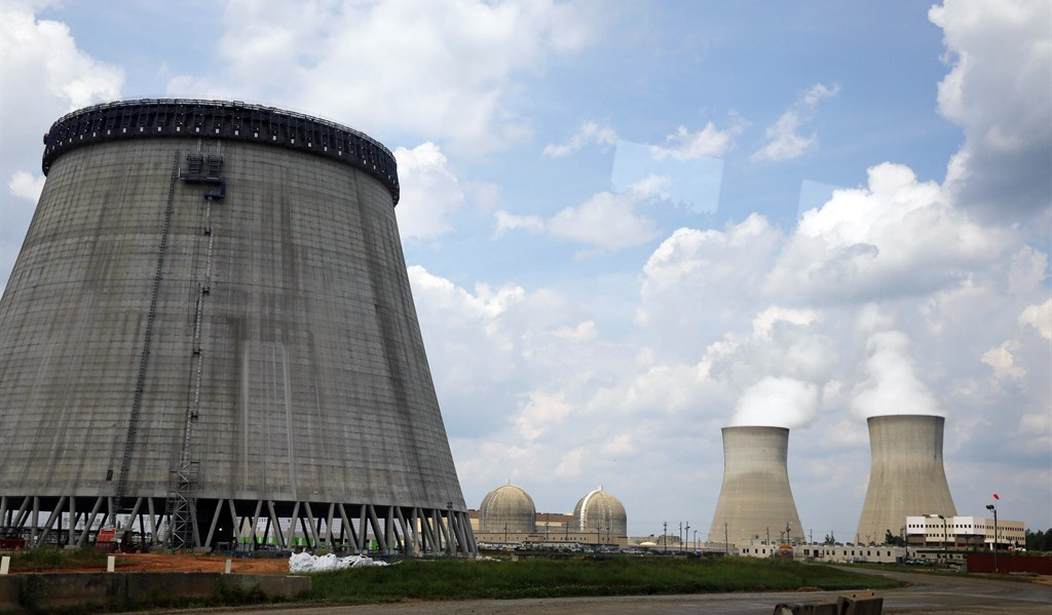

The Nuclear Regulatory Commission (NRC) was considered one of the more hidebound agencies of the federal government. The NRC had approved construction of just two nuclear plants (both in Georgia) since the 1990s.
Now, the NRC is about to receive a long-overdue wake-up call.
The voracious appetite of artificial intelligence data centers for power, and the experiment of trying to cut CO2 emissions by starving Americans of electricity, have necessitated the urgent need to build nuclear reactors.
However, the permitting process to build a new reactor has, in the past, meant decades of red tape before any power is generated. That is about to change.
"The U.S. Department of Energy (DOE), in collaboration with Idaho National Laboratory (INL), Argonne National Lab (ANL), Microsoft and Everstar, said it has successfully demonstrated the use of artificial intelligence (AI) tools to streamline the nuclear regulatory process," according to Power Engineering.
"The team used AI mapping to convert a safety analysis document required under DOE’s authorization pathway for advanced reactor demonstrations into U.S. Nuclear Regulatory Commission (NRC) licensing documents for commercial deployment," according to the site.
The 208-page document took one day to generate, when the process normally takes a team of people four to six weeks to complete. DOE argues that Everstar’s Gordian AI has the ability to “understand and integrate data through semantic ontology mapping,” to ensure that the final output is “computed and verified, not inferred.”
Thousands of documents go into the licensing process for a nuclear power plant. If you include everything before construction begins — environmental reviews, licensing, design, financing — the full timeline can stretch to 15 years or more. If AI can help shave years off that timeline, the nuclear industry will be able to give us all the electricity we can use, and then some.
They held a ceremony in Wyoming recently when Dr. Rian Bahran, DOE deputy assistant secretary for nuclear reactors, signed off on a construction permit for a new reactor in Kemmerer.
“For years I’ve been saying we’re at a tipping point,” said Bahran. “And it feels like we’re finally tipping.”
Tara Righetti is co-director of the University of Wyoming's Nuclear Energy Research Center and a professor of law and energy policy.
"I believe when Dr. Bahran said we are at a tipping point, he was referencing the fact that this is the first commercial advanced reactor licensed by the NRC," Righetti told Cowboy State Daily. "At various points over the past several decades, politicians have announced that nuclear energy would have a renaissance, but those promises have not come to bear.
"Authorizing construction for a non-light water reactor is a tangible milestone potentially heralding a new era of nuclear construction."
The greens will object, of course. They will throw as many roadblocks in the way as possible. But if this is a "tipping point" — and given the revolution in smaller reactors and other kinds of reactors — the greens better get out of the way, or they'll be steamrolled by progress.
Global electricity demand is projected to increase 4.5% in 2025 and grow at least 2.8% annually through 2030, according to the World Resources Institute, citing BloombergNEF analysis.
The jump is driven by expansion of electric vehicles, industrialization, greater demand for cooling in developing countries — and the rapid growth of U.S. data centers, which has upended years of flat demand. Executive orders from the Trump administration have set a target of 400 gigawatts of nuclear power by 2050, quadrupling current capacity.
“Things certainly are moving along really well now, but that’s the result of over a decade or more of positioning for this moment in time,” he said. “Nuclear has been one of the few things that has enjoyed really pretty strong bipartisan support.
Virginia Sen. John Warner (R) is a big booster of small modular reactors (SMRs). Major components — sometimes entire reactor modules — are built in controlled factory environments, improving quality and reducing on‑site construction time. Several companies are working to bring SMRs online as early as 2029.
One problem that's currently slowing the industry down is finding enough skilled workers to construct the plants.
Getting a qualified workforce fully up to speed to build many plants will take time, said Ross Ridenoure, Hadron Energy's chief nuclear officer.
"There will be, I think, a shortage initially, until the training programs catch up with the demand," he told Axios.
The Nuclear Energy Institute's Kotek, however, isn't fazed by any potential workforce shortages.
"What I've heard, particularly from labor, is, you show them the nuclear jobs, they'll find you the people," he said. "Because nuclear pays well, it's safe, it's long-term."
The bottom line: Hyperscalers are bringing more than just a demand for electricity to the nuclear field — they're bringing a much-needed sense of urgency, said TerraPower president and CEO Chris Levesque.
The Trump administration has lit a fire under the nuclear industry and transformed a moribund, sleepy agency and companies into a dynamic, "can-do" entity ready to lead a revolution.
Also for our VIPs: JD Vance's Comments About Aliens Are Exactly Why the Government Shouldn't Reveal What it Knows About ET