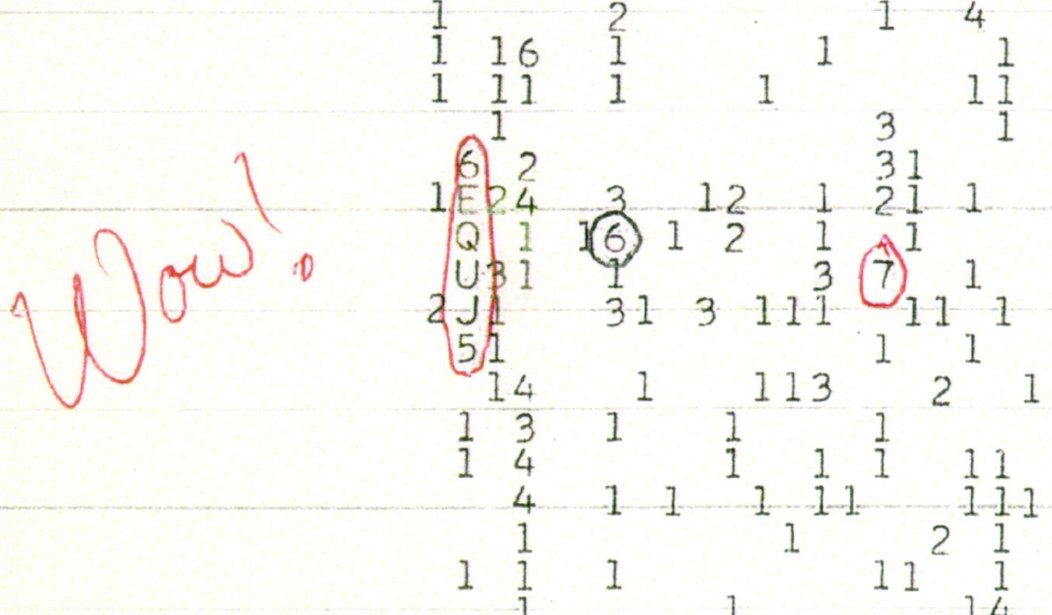

On Aug. 15, 1977, the radio telescope on the campus of Ohio State University, nicknamed "The Big Ear," recorded the weirdest signals in radio astronomical history.
That recorded signal was viewed a few days later by Astronomer Jerry R. Ehman, who had volunteered to view data collected by "The Big Ear" telescope as part of the Search for Extraterrestrial Intelligence (SETI) program on campus. What he saw probably made his heart leap in his chest. The signal was detected in the hydrogen band, which is just where many early SETI scientists believed aliens would try to send a message.
Hydrogen is, by far, the most common element in the universe, and this particular signal was not only unusual, but it also exhibited characteristics that scientists would expect from an artificial transmission.
The signal lasted exactly 72 seconds, matching the telescope’s scan window. It was strong, precise, and unlike anything detected before or since.
What was it?
"Since all of the possibilities of a terrestrial origin have been either ruled out or seem improbable, and since the possibility of an extraterrestrial origin has not been able to be ruled out, I must conclude that an ETI (ExtraTerrestrial Intelligence) might have sent the signal that we received as the Wow! source," Ehman wrote on the 30th anniversary of his discovery.
Over the next 50 years, theory after theory was shot down. Ehman himself believed it might have been a signal that got reflected off space junk. The idea that it was an alien civilization sending us greetings was fanciful, but improbable. The signal was never repeated and has appeared nowhere else. The alien hypothesis hasn't been dismissed entirely, but another, more likely explanation has been put forth by several scientists as the best explanation yet.
"The team of scientists behind a study recently uploaded to the preprint server arXiv believes that they’ve finally cracked the case," reports Popular Mechanics.
“Our latest observations,” Abel Méndez, who led the project that produced this paper, “made between February and May 2020, have revealed similar narrowband signals near the hydrogen line, though less intense than the original Wow! Signal.”
This paper represents the first results of the Arecibo Wow! project, which aimed to do exactly what this paper claims to have done: dig through data captured by the tragically collapsed Arecibo Telescope in order to find other signals that resemble (and thus, potentially explain) the Wow! signal.
Specifically, the team was looking at signals around what’s called, unimaginatively, the 1420 megahertz (MHz) hydrogen emission line—frequencies right around where the Wow! signal was detected. And while they didn’t find any signals that were as strong as the Wow! signal (which was, at its peak, an astonishing 30-31 time stronger than all background noise detected around it), they did find signals that behaved in the same manner.
"According to the paper, the Wow! signal and others like it can be attributed to cold clouds of hydrogen flaring up with energy when hit by some kind of huge radiation flare—a phenomenon known as stimulated emission," says Popular Mechanics. What makes this theory so compelling is that it checks almost all the boxes of what the Wow! Signal should be: it's rare, it's powerful, it appears in the right place on the radio spectrum, and the stimulated emissions explain several of the characteristics found in the 1977 message.
“We hypothesize,” the team wrote in their paper, “that the Wow! Signal was caused by sudden brightening from stimulated emission of the hydrogen line due to a strong transient radiation source, such as a magnetar flare or a soft gamma repeater (SGR). These are very rare events that depend on special conditions and alignments, where these clouds might become much brighter for seconds to minutes.”
Now that our telescopes have gotten much more sensitive, it looks like we may have finally been able to flesh out the category that was dominated by the Wow! signal for decades. If this team is right, the mystery of the source of this signal is solved—it was just an exceptionally large hydrogen cloud energy flare-up that we happened to be lucky enough to catch.
“Our hypothesis” the team wrote, “explains all observed properties of the Wow! Signal, proposes a new source of false positives in technosignature searches, and suggests that the Wow! Signal could be the first recorded event of an astronomical maser flare [a source of energy produced by stimulated emission] in the hydrogen line.”
Whether the explanation of "stimulated emissions" of cold hydrogen clouds holds up to scientific scrutiny remains to be seen. Meanwhile, perhaps if some alien civilization is monitoring us, they'll resend the original signal because they might think that after 50 years, we're too dumb to translate it.