At its height of popularity in the late 1970s, the United Farm Workers (UFW) counted more than 80,000 members. Today, that number is less than 5,000.
What happened?
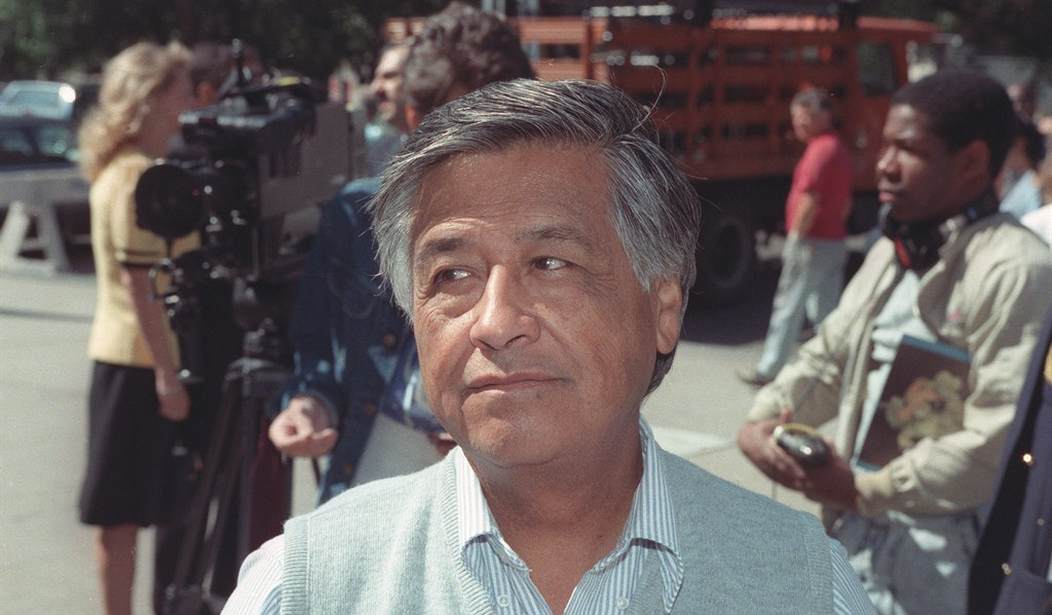
Cesar Chavez, the Democratic Party golden boy and civil rights icon, died in 1993. But for 20 years prior to that, he worked the system as thoroughly as any Somali fraudster, stealing millions of dollars from the state and federal government, union members, and well-meaning do-gooders. What's worse, other UFW leaders and friends joined him in his grift, making a mockery of the heroic efforts of rank-and-file farm workers to win basic labor rights.
Not only that, but over the years, the "union" did a poor job of negotiating, sometimes walking away from the bargaining table. Meanwhile, workers were still paying 3% of their wages in dues.
In 2014, workers at a California farm tried to decertify the UFW. The workers had first won recognition for the UFW in 1990, but the union never negotiated a completed contract. A decertification vote was held, but the votes were never counted.
"A group of Gerawan employees, less than eager to relinquish 3 percent of wages to an absent union, began petitioning for an election to decertify the union," explained Reason's Zach Weissmueller. After a campaign that included intimidation of the workers, the California Supreme Court ordered the Agricultural Labor Relations Board (ALRB) to count the votes. The vote was 197 in favor of the union and 1,100 against it.
The UFW has become a haven for union corruption. And Chavez benefited the most.
The recent revelations about his sexual abuse of underage girls and women in the New York Times only add to Chavez's tarnished legacy. His financial crimes were first reported by Reason Magazine in a 1979 exposé by Patty Newman: "Who's Bankrolling the UFW?"
Reason investigated a "network of nonprofit, tax-exempt organizations set up and run by Chavez and other UFW officials" that was given millions of taxpayer dollars with no transparency. Traditional accounting procedures were absent. Chavez's standing as a Democratic Party powerbroker (and personal friend of California's Gov. Jerry Brown) gave him an immunity akin to that of Jesse Jackson in Chicago or Al Sharpton in New York.
No one wanted to know where the money was going and who was getting it.
But a big part of the decline in membership is surely attributable to Chavez's imperious management style, which included more than financial impropriety and the newly revealed sexual improprieties. In a scorching 2009 review for the defunct Left Business Observer of a book called Beyond the Fields: César Chávez, the UFW, and Struggle for Justice in the 21st Century, economist Michael D. Yates writes that, "with the union's successes, Chávez began to think of himself as a holy person, Christ-like and above reproach." By the end of the 1970s, Chavez had become friendly with Charles Dederich, the controversial creator of the disreputable drug-rehab program Synanon, infamous for its use of a practice called "The Game," where members were subjected to constant psychological abuse.
"The UFW effectively became a cult of personality rather than an organization lobbying for better wages and conditions," writes Reason.com's Nick Gillespie.
Michael D. Yates, radical leftist labor activist, writes that, "with the union's successes, Chávez began to think of himself as a holy person, Christ-like and above reproach." A longtime editor at the socialist Monthly Review and the author of Why Unions Matter, Yates supplies the most scathing analysis of Chavez from either friend or foe.
Under Chávez's autocratic leadership, the union dissolved the boycott staff, firing its leader and accusing him of being a communist; purged its staff, using the most disgusting means imaginable; refused to entertain any local union autonomy and democracy; denied the election of actual farm workers to the union board; ruined the careers, and in some cases, the jobs, of rank-and-file union dissidents; lost almost all of its collective bargaining agreements, and began a long and ugly descent into corruption.
Today, farm workers in California are no better off than they were before the union came on the scene.
No, Chavez does not deserve the hagiography from his admirers. But if he's only remembered for raising awareness of the plight of farm workers (who are better off today than they were before the uinon despite what Yates thinks), it would be enough to give him his due.