
About two hours west of Chicago is the small town of Amboy, Ill. Like a thousand other small towns in the Midwest, it was a railroad town that grew up around a spur of the old Illinois Central Railroad.
The U.S. Army saw a great place to put an ammunition factory in World War II. The Green River Ordnance Plant was built in 1942 and, at its peak, employed 4,500 people.
Among them was Vesta Stoudt, a 44-year old mother of eight who got a job inspecting and packing cartridges used to launch rifle grenades that were used by soldiers in the Army and Navy.
Vesta was bothered by the tape that was used to seal the boxes containing the cartridges. “The paper tape was very thin, and the tabs often tore off, leaving soldiers frantically trying to open the box while under fire,” said Margaret Gurowitz, chief historian at the healthcare company Johnson & Johnson, in an article from 2018. The entire box was sealed in wax, making it even more difficult to open. Vesta had two sons in the Navy, and, like all mothers with sons serving, she could imagine something terrible happening to them, wrestling with the box of cartridges, trying to get it open before it was too late, and an enemy sniper picked them off.
Instead of worrying herself to a frazzle, Vesta did something about it. She thought that waterproof tape made of cloth would be a much better way to seal the box and would make it much easier to open. She took her idea to her supervisors, who dismissed the idea out of hand.
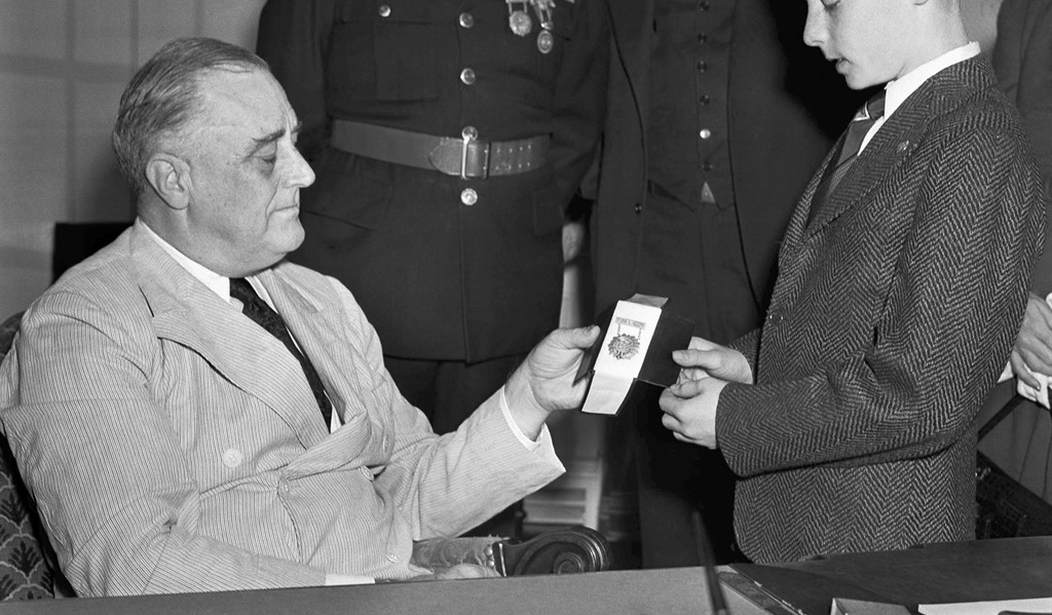
Vesta wasn't giving up. She took her idea for the cloth tape right to the top; she wrote a letter to President Franklin Roosevelt.
Stoudt sent a letter to President Franklin D. Roosevelt and described her idea, including diagrams in her correspondence. She mentioned her sons in the service, as well as Roosevelt’s, and noted that “we can’t let them down by giving them a box of cartridges that takes a minute or more to open, the enemy taking their lives, that could have been saved … I didn’t know who to write to Mr. President, so have written you hoping for your boys, my boys, and every man that uses the rifle grenade, that this package of rifle cartridges may be taped with the correct tape.”
The rest is history. FDR immediately realized the merits of the idea and passed it along to the War Production Board (WPB). The Board sought manufacturers to produce the tape and settled on Industrial Tape Corporation (now Permacel) to do so.
The tape was a smash hit with the soldiers.
“The military called the waterproof, cloth-backed, green tape 100-mile-per-hour tape,” says Gurowitz, “because they could use it to fix anything, from fenders on jeeps to boots.”
We know it today as "duct tape."
After the war, the tape wound up in hardware stores for home use. That’s when people realized that this nifty product works well in linking together parts of heating and air conductioning ducts, so it took on the duct tape nickname. The tape also got a silver makeover with aluminum powder to match the color of these tin ducts.
Today, soldiers continue to use duct tape for all sorts of purposes, like covering holes in shoes and fixing up equipment, not to mention the many civilian uses—including as a prom dress material. Duct tape even played a key role in uncovering the Watergate scandal, alerting a security guard to the infamous burglary at the D.C. complex in 1972.
The plant in Amboy shut for good on VJ Day. The town quickly returned to normal, now with a population of 2,200.
Vesta remained a devoted mother and grandmother. By the time of her passing in 1966, she was survived by five of her eight children, 20 grandchildren, and eight great-grandchildren.
While she did not become wealthy from her invention (as the companies that manufactured it, such as Johnson & Johnson's Industrial Tape Corporation, held the rights), she did receive the Chicago Tribune’s War Worker Award for her contribution to the war effort.
She lived to see her "waterproof cloth tape" transition from a specialized military tool to a civilian product. In the 1950s, it gained its silver color and the name "duct tape" as it became popular for wrapping heating and air conditioning ducts.
Credit to FDR for recognizing a good idea and passing it on to someone who could make the idea a reality. And, of course, credit to Vesta Stoudt and the love for her sons and all sons who fought for America in World War II.