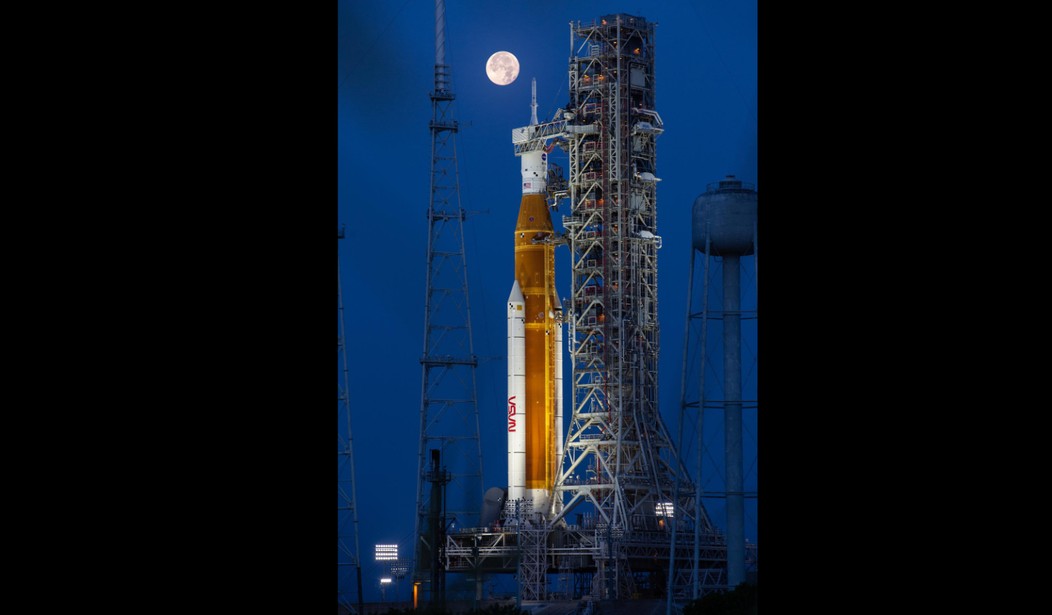

The launch of NASA's Artemis II rocket, which will take four astronauts on a trip to orbit the moon, will have to wait another month. During a fueling test in which engineers pressurized the booster rocket with the fuel required for takeoff, several hydrogen leaks occurred at the connection between the rocket and the launch pad.
That was apparently just one of the problems.
“Engineers pushed through several challenges during the two-day test and met many of the planned objectives,” NASA said in a statement following the conclusion of the practice countdown, also known as a "wet dress rehearsal" (WDR), early Tuesday morning.
Meeting objectives was not the object of the test. The goal was to see if the bird could fly. The test was a failure, but the "F" word isn't in NASA's vocabulary.
“To allow teams to review data and conduct a second Wet Dress Rehearsal, NASA now will target March as the earliest possible launch opportunity for the flight test.”
"Our rockets always blow up, and our boys always botch it," wrote Tom Wolf in The Right Stuff, his history of the Mercury program, the first U.S. attempts to launch humans into space. Wolf wasn't quoting anyone directly, only what he perceived the American people were thinking.
It was true, to a point. The Atlas rocket that took John Glenn and other Mercury astronauts into space had a failure rate of approximately 40% to 50% in the years leading up to Glenn’s flight. (The first two astronauts, Alan Shepard and Gus Grissom, were shot into space for a suborbital flight using the old nuclear missile, the Redstone rocket.)
Several of those spectacular failures of the Atlas rocket were broadcast on live television. When they weren't blowing up, the rockets were afflicted with constant delays, leading Wolf to sum up the American people's attitude toward the entire program with the phrase, "Our rockets always blow up, and our boys always botch it."
What did the astronauts think? The eight Mercury astronauts were all test pilots. They were used to failure. They knew that failures were part of the engineering process and, most importantly, it was much better from their point of view for the failures to occur now, before they were on board for a trip into space.
In the case of Artemis II, there is some reason for concern. The uncrewed Artemis I, which flew in November 2022, was also plagued by hydrogen leaks. But this is a new process in loading the fuel, and liquid hydrogen is extremely tricky to work with. It's not surprising, nor is it especially worrying, that they haven't been able to lock down the problem yet.
Now, the second Space Launch System (SLS) rocket is on the cusp of launching a crew for the first time. The Artemis II mission will send four astronauts inside NASA’s Orion spacecraft on a loop around the far side of the Moon on the first crewed lunar flight since 1972, paving the way for future expeditions to land humans at the Moon’s south pole.
Going into the countdown rehearsal, NASA officials hoped a smooth test would clear the way to launch the Artemis II mission as soon as Sunday, February 8. NASA has only a handful of launch opportunities for Artemis II each month, when the Moon is in the right location in its orbit to allow the Orion spacecraft to fly a so-called free return trajectory and come back to Earth for a safe reentry and splashdown.
The first launch opportunity for Artemis II next month is March 6, with a two-hour launch window opening at 8:29 pm EST (01:26 UTC on March 7).
The hydrogen leaks on Artemis II are occurring in the same place they happened on Artemis I. This is not unusual, as it's not like plugging a leak in your tire.
The leak appeared in the same location it did during the Artemis I launch campaign nearly three years ago. Liquid hydrogen and liquid oxygen flow from ground storage tanks into the SLS core stage through so-called Tail Service Mast Umbilicals (TSMUs), two roughly 30-foot-tall gray pods rising from the base of the rocket’s mobile launch platform. The TSMUs route propellant lines through connections near the bottom of the core stage, where umbilical plates on the rocket side and ground side meet. At liftoff, the umbilical plates disconnect as the rocket begins its climb off the launch pad.
Hydrogen is one of the most efficient rocket fuels, but it is notoriously difficult to handle. Liquified hydrogen must be stored at minus 423° Fahrenheit (minus 253° Celsius), cold enough to change the shape and size of seals and other soft goods in the fueling line. This can create leak paths not readily detectable at ambient temperatures. Hydrogen molecules are the smallest and lightest in the Universe, with the ability to find their way through the tiniest of breaches.
Because hydrogen leaks easily, NASA engineers have set a safe limit of 4% hydrogen concentration in the housing around the fueling connector. That level was exceeded "several times" according to Ars Technica.
“Attempts to resolve the issue involved stopping the flow of liquid hydrogen into the core stage, allowing the interface to warm up for the seals to reseat, and adjusting the flow of the propellant,” NASA said in a statement. It didn't work. NASA executives pulled the plug on the test early Tuesday morning.
“As always, safety remains our top priority, for our astronauts, our workforce, our systems, and the public,” NASA Administrator Jared Isaacman said in a social media post. “We will only launch when we believe we are ready to undertake this historic mission.”
I certainly hope so. The Challenger disaster was preventable for many reasons, but one of the major ones was the pressure on NASA engineers to get the mission off the ground. In the days of the Mercury program, delays were expected, and President Kennedy was wise enough not to put additional pressure on NASA to launch.
The Space Launch System (SLS) is a new booster using the most powerful rocket ever built. As always, there isn't a lot of room for error when four human beings are sitting on top of 765,000 gallons of highly volatile liquid propellant.
Getting it right is literally a matter of life and death.