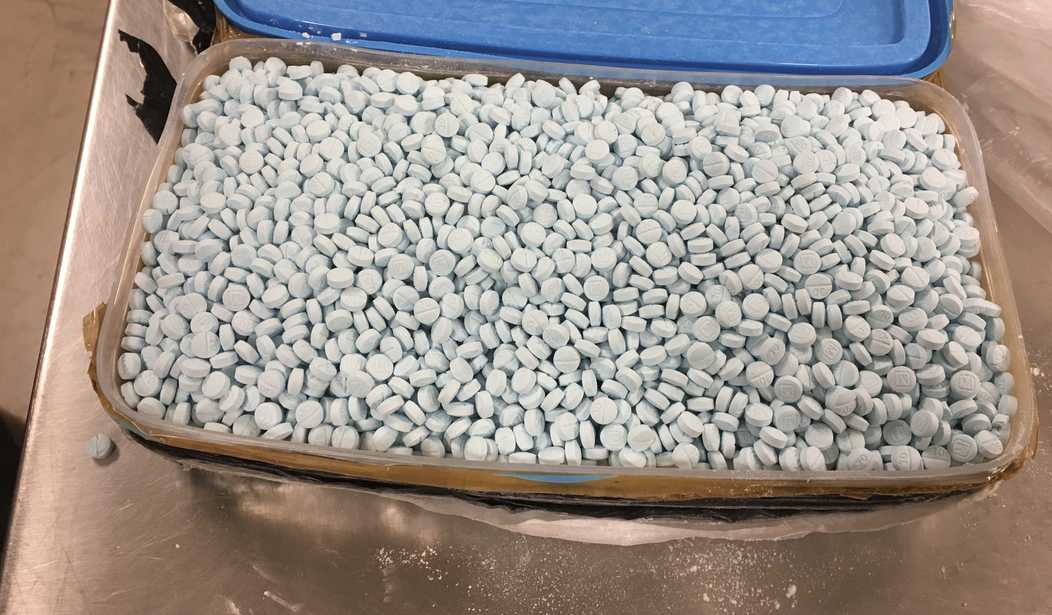

The synthetic opioid fentanyl came to the United States in the early 2010s. Drug dealers issued no press release or announcement that they were mixing the incredibly potent drug with heroin.
Users found out soon enough. They started to overdose and die in astonishing numbers.
"No illicit drug in history has claimed so many fatalities," writes Sally Satel, a psychiatrist and Senior Fellow, American Enterprise Institute, in The Free Press. The Congressional Joint Economic Committee reported that the overdose rate was 0.9 people per 100,000 in 1968.
Kaiser Family Foundation (KFF) claims the overdose rate climbed to 1.8 per 100,000 in 1988, jumping to 3.6 per 100,000 in 1998, and by 2015, it had jumped to 13.8 per 100,000.
It was 32 per 100,000 by 2023, according to KFF.
About 1,000,000 Americans have OD'd since 1999. But in the last few years, the number of Americans who died as a result of overdosing on Fentanyl has dropped considerably. "Last week, the CDC estimated that nearly 73,000 people died of a drug overdose during the 12 months that ended last August, down 21 percent from a year earlier," writes Satel. Why?
It seems certain that the widespread use and availability of the opioid counteracting agent naloxone, or Narcan, has saved tens of thousands of lives.
Naloxone has existed as an injectable since 1971, but hospitals and paramedics were almost exclusively those who used it. It became widely available to the layperson only after the FDA approved the Narcan nasal spray in Nov. 2015. This user-friendly design meant that family members and bystanders — not just medical professionals — could easily administer the life-saving drug.
Since then, states have conducted outreach to addicts, making sure they knew the benefits of this life-saving drug, and giving out free Narcan kits that have dramatically impacted the fentanyl death toll.
In 2023, the FDA allowed users to get the drug over the counter. The easy availability of this drug, more than interdiction, more than any other factor, has led to a significant drop in overdose deaths.
But even the availability of Narcan can't explain the tremendous fall in deaths. There are several other factors, some deliberate and some accidental, that have contributed to the dramatic drop in ODs.
Second, the purity of the fentanyl supply has changed. By the end of 2024, fentanyl purity fell by half from its peak in early 2023, when fentanyl overdose deaths were near their highest, according to a report this month in Science. In parallel, the number and weight of fentanyl seizures by U.S. law enforcement decreased during the same time frame.
This “supply shock,” as the researchers called it, probably emanated from China, the world’s primary manufacturer of the chemical precursors to fentanyl. U.S. officials have long alleged that Chinese chemical makers ship precursor chemicals to Mexico, where U.S.-bound fentanyl is synthesized in secret laboratories. The researchers in Science inferred that Chinese companies sent less to Mexico to comply with international counternarcotics law.
As a result, individual fentanyl users in Washington and all across America are getting less of the drug in any specific purchase—and are therefore less likely to overdose.
The addition of adulterants such as xylazine and Medetomidine, which is "a very inexpensive drug that is related to xylazine but is far more potent and fast acting," according to Satel, prolong the high for fentanyl users, but Narcan cannot reverse the effects.
Another reason for the drop in opioid deaths is that education has prevented a lot of kids from using fentanyl. Fewer users means fewer deaths from overdosing.
Many communities on the East Coast and in the Midwest also have attained “fentanyl saturation,” researchers wrote in The Lancet in November, with most opioid users having already adapted to fentanyl. That is, these users are both physiologically tolerant and experienced. They don’t use fentanyl alone, they keep Narcan handy, and they even use fentanyl test strips.
There is one more grim reason why overdose deaths are going in the right direction. The people who still use fentanyl are the survivors. The vulnerable and the unlucky have, by now, died off.
Experts such as Satel tell us not to rest on our laurels. There is certain to be another drug, such as the "class of synthetic opioids called nitazenes, or carfentanil, a fentanyl analog," writes Satel. "Nitazenes and carfentanil are both far more potent than fentanyl," she says.
The Chinese, who ship fentanyl "precursors" to Mexico to be turned into fentanyl, have cut back under international pressure. Those chemicals are available everywhere, including the U.S., so the cartels aren't worrying about the supply.
The decline in overdose deaths may be ending. It's certainly slowing, according to the CDC. Whether that presages another epidemic is unclear, but it's certain we're not prepared for whatever is coming.