In a speech to the nation in November, Iranian President Masoud Pezeshkian floated the notion of evacuating the capital itself if rain does not arrive soon in needed quantities.
“When we said we must move the capital, we did not even have enough budget. If we had, maybe it would have been done. The reality is that we no longer have a choice; it is an obligation,” he said in a speech in Qazvin.
The water crisis has exposed the regime's corruption and mismanagement of resources to a criminal degree. Meanwhile, the regime is so busy trying to save itself that the revolution is proceeding apace, unencumbered now by the morality police and other state weapons of oppression.
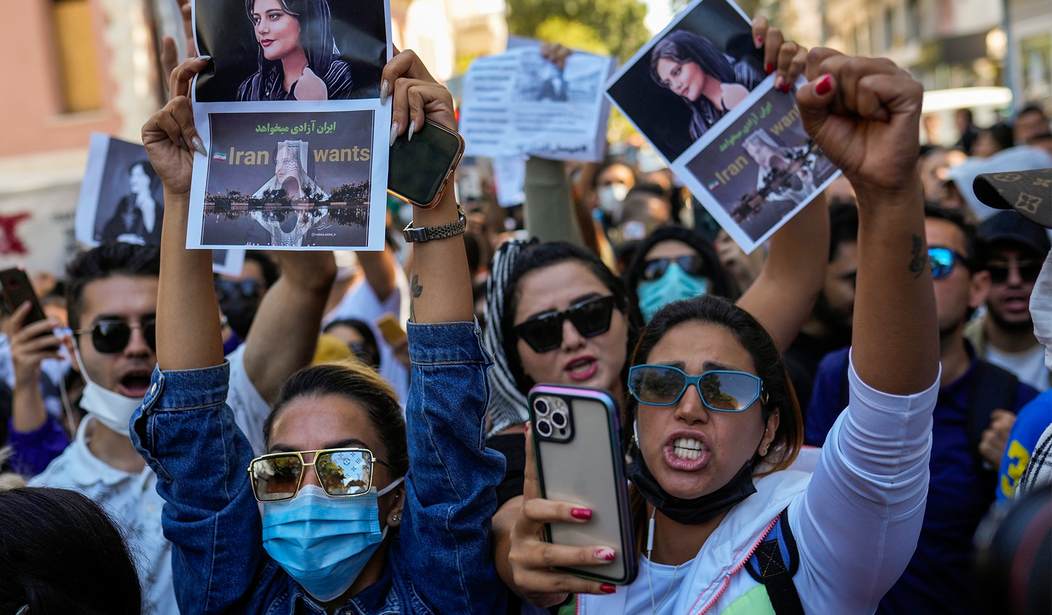
In 2022, the nation took to the streets to protest the death of a Kurdish woman, Mahsa Amini, while in the custody of the morality police. Amini's "crime" was that she wasn't wearing her hijab "properly."
Millions of Iranian women took off their hijab and dared the authorities to arrest them. Girls as young as 10 were taken into custody, and 20,000 women were jailed.
"The mandatory veil was never merely a dress code; it was intended to be the public signature of the state’s authority over private life, the imposed symbol of faith upon a people who had rebelled against state imposition," writes Roya Hakakian in The Free Press.
But lately, the authorities have other pressing concerns to attend to, and the protests against the hijab have taken a back seat. Israel's destruction of its nuclear weapons program and an economy in freefall, with inflation at nearly 50% and unemployment at more than 10%, much higher among those under 30.
Corruption is out of control as the Revolutionary Guards and the clergy, recognizing Iran's imminent collapse, are robbing the nation blind, taking whatever isn't nailed down.
"The Akkadians. The Maya. The Tang Dynasty of China. The Chaco. The Indus Civilization. These diverse societies, separated by oceans and continents, each persisted for hundreds of years," writes Hakakian. "They had large cities, transcendent architecture, organized agriculture, and regional power. Yet each ultimately collapsed."
The ways each ended up in the dustbin of history all looked a little different, but they shared one simple attribute: a lack of water. And now, it's the turn of Iran, as mismanagement and corruption, more than anything, are responsible for its downfall.
Considering Iran's present drought conditions have persisted for six years now, it's highly unlikely that the nation will get the precipitation that many of its inhabitants, encouraged by the country's ruling clerics, are praying for.
Appeals to God will not save Iran. What's needed are radical reforms to the country's inept water management practices. CSIS highlighted a few of them: overbuilding dams, inefficient agriculture, free-for-all well-drilling, reducing vegetation cover due to uncontrolled expansion in Tehran, subsidizing consumption, and leaking pipes.
Also for our VIPs: Poland Is a Huge Capitalist Success Story
Meanwhile, Iranian women continue their "silent revolution."
"The political cost of upholding their archaic rules, which has brought the regime face-to-face with women, has proven too steep," writes Hakakian. "As domestic crises increasingly mount, and the military licks its wounds after the short direct war with Israel earlier this year, perhaps the political leadership seem to have chosen not to die on this hill."
If so, Iran will never be the same. As Ronald Reagan reportedly told Mikhail Gorbachev in Moscow in 1988, you can't give people a "little bit of freedom." Once the bird is untethered, you must allow it to fly free.
"The fact that this token of control has slipped is not reform, but concession," writes Hakakian. "By choosing to look away rather than enforce its own laws, the regime is confessing, silently but unmistakably, what it cannot admit aloud: that it is losing its ideological hold over the people of Iran."
The ayatollahs are juggling too many balls at present and are bound to drop a few before the system comes crashing down. I've been saying for years that a revolution in Iran is extremely unlikely because the Revolutionary Guards have the guns.
But even the fanatical guards need water. Without it, the regime will wither and die.