





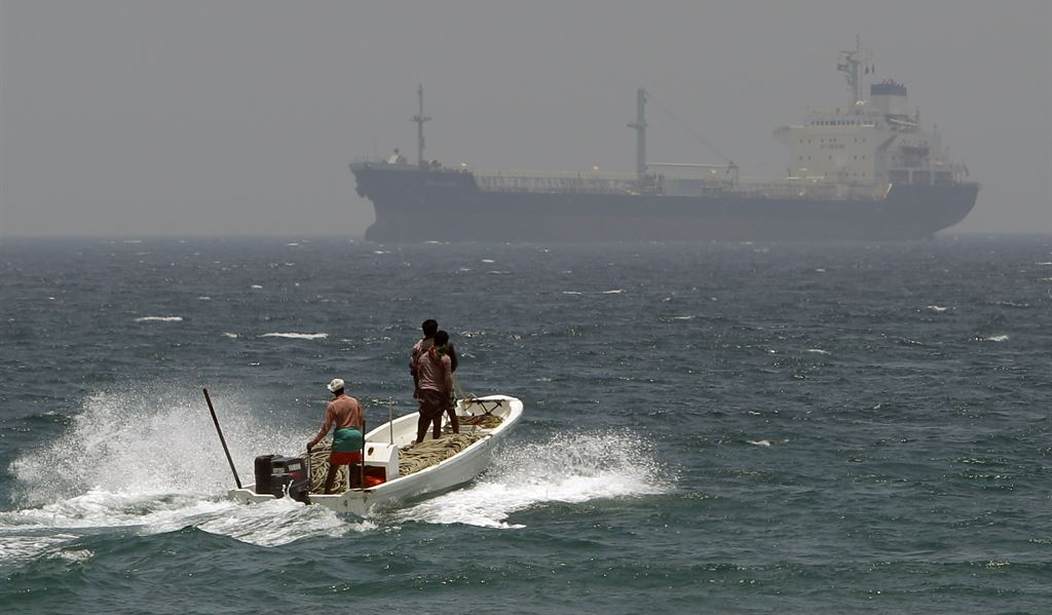
The bombshell dropped. Donald Trump announced that Operation Freedom, an effort to guide ships out of the Strait of Hormuz, will begin on Monday morning, Middle East time. According to Trump, the operation will be centered on helping the vessels leave the Persian Gulf, in response to countries asking "the United States if we could help free up their Ships, which are locked up in the Strait."
It sounds innocuous enough. In fact, Trump cast it as a “humanitarian operation,” but one that is obviously protected by sharp teeth. In a subsequent social media post on X, CENTCOM elaborated on the mission, which has obviously been studied and prepared for by military staff.
U.S. Central Command (CENTCOM) forces will begin supporting Project Freedom, May 4, to restore freedom of navigation for commercial shipping through the Strait of Hormuz. …“Our support for this defensive mission is essential to regional security and the global economy as we also maintain the naval blockade,” said Adm. Brad Cooper, CENTCOM commander.
Last week, the U.S. Department of State announced a new initiative, in partnership with the Department of War, to enhance coordination and information sharing among international partners in support of maritime security in the strait. The Maritime Freedom Construct aims to combine diplomatic action with military coordination, which will be critical during Project Freedom.
U.S. military support to Project Freedom will include guided-missile destroyers, over 100 land and sea-based aircraft, multi-domain unmanned platforms, and 15,000 service members.
But it’s only the tip of a strategic iceberg. Although considerable resources will be dedicated to protecting ships transiting the Strait, CENTCOM makes it clear that Project Freedom is part of a larger operation, involving the Department of State, to coordinate movement through the narrow waters. This contextually implicit larger operation, for which we have been given no name as yet, is more interesting than Project Freedom itself. For one thing, it implies that not only will the U.S. deny passage to Iranian and other hostile ships, it will also secure the passage of neutral and friendly ships through Hormuz. Project Freedom is the flip side of the naval blockade of Iran, the "open" setting on the valve as contrast to the "close."
If Project Freedom succeeds, the Strait will essentially be controlled not by Iran, but the United States.The USN will essentially turn Iran’s ultimate weapon, a blockade of the Strait of Hormuz, against it. This is a feat that both Britain and France have long declared as physically impossible. Recently the respected British think tank Chatham House wrote that both countries “will not be seeking to reopen the Strait of Hormuz in a conventional military sense. Indeed, the Strait cannot be opened by force and requires more than ad hoc security measures in the long term.”
But the conclusion that the Strait of Hormuz cannot be “opened by force” necessarily implies that Iran will oppose the escorted merchant convoys by force as they did in the tanker war of 1981-1988. “The tanker war, part of the larger Iran–Iraq War, was a series of military attacks by Iran and Iraq against merchant vessels in the Persian Gulf and Strait of Hormuz from 1981 to 1988. Iraq was responsible for 283 attacks. Iran accounted for 168.” Chatham House did not unpack the implications enough. Attacking the convoys would mean reopening hostilities with the U.S. and dissolving the constraints of the War Powers Resolution. “The War Powers Resolution requires the president to notify Congress within 48 hours of committing armed forces to military action and forbids armed forces from remaining for more than 60 days, with a further 30-day withdrawal period, without congressional authorization for use of military force (AUMF) or a declaration of war by the United States.”
Iran would be caught on the horns of a dilemma – the Horns of Hormuz as it were: to let the ships pass or by opposing them, give Donald Trump a 60-day renewable permit to pound the Islamic Republic into dust. Accepting either course would likely be fatal to the Islamic Republic. If Tehran lets the ships pass unmolested, the Strait will be closed only to them and open to everyone else. They would have blockaded themselves!
Given an uninterrupted blockade, the Islamic Republic would be slowly starved into submission, if not this month then the next, while the rest of the world does business without them. But if they attack the merchant ships “guided by the USN,” even if they succeed in scoring hits (which is by no means certain), then they will only have succeeded in repeatedly unleashing a force camped outside its borders free to resupply itself, while they must make do with salvaged weapons and improvised defenses.
It’s interesting to speculate whether this was the endgame envisioned by Operation Enduring Freedom’s planners all along. Certainly blockade is one of the things taught in naval academies. One of the enduring lessons of the Navy’s institutional memory was its post-WW2 realization that the naval blockade of Japan, much more than the bombing of cities by B-29s, was responsible for the surrender of Japan. Critics of the administration assumed it was too ignorant to remember this, but perhaps not. It is probably safe to say that the concept of making the Strait of Hormuz the center of CENTCOM’s gravity was present in principle from the moment the decision was made to move the Marine MEUs into the theater. These units would be completely useless for a ground campaign against Iran, but they would be logical assets in any maritime strategy. Thus, far from neglecting the Iranian response to close Hormuz in initial planning, there is evidence to suggst that the Pentagon planners were counting on it. Once the ayatollahs decided to use their ultimate weapon of interdicting Hormuz they had trapped themselves
By frontloading the explicitly offensive aspects of the campaign against the Islamic Republic in the opening days of OEF the administration set the stage for the decisive conduct of operations, including regime change, on a potentially “defensive” political basis. Can Tehran still wriggle out of the chokehold they find themselves in? There is no military exit for the regime from their present predicament. Only by submitting to terms and becoming a normal country is there a clear exit from the regime in Tehran.
Editor's Note: Do you enjoy PJ Media's conservative reporting that takes on the radical left and woke media? Support our work so that we can continue to bring you the truth.
Join PJ Media VIP and use promo code FIGHT to receive 60% off your membership.


Join the Conversation
VIP members get the ability to comment on articles.