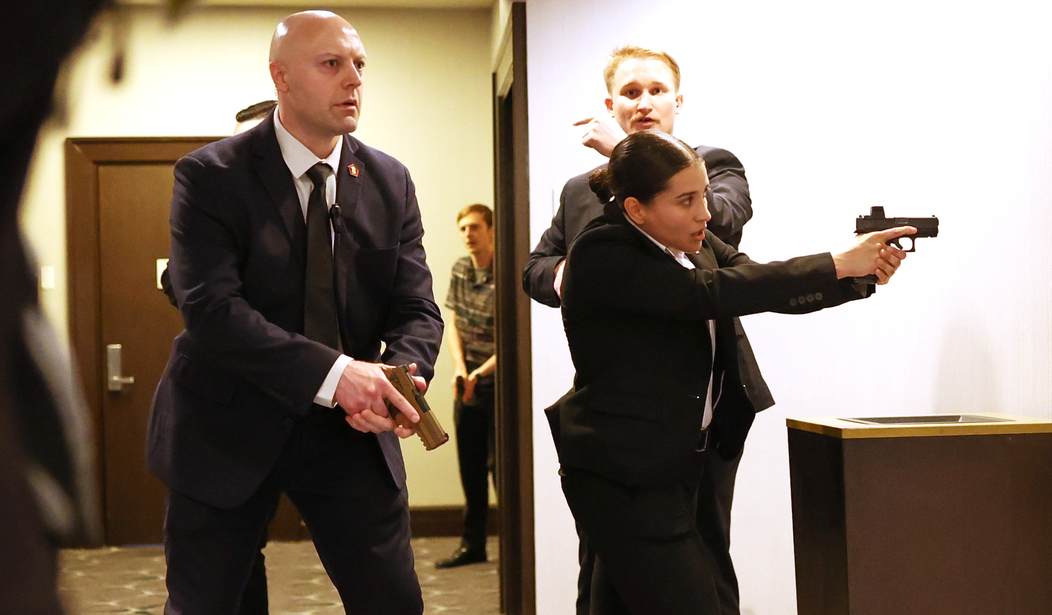
There's a story developing around the man accused of trying to kill President Trump at the White House Correspondents' Dinner — and it's bigger than the usual narrative about a lone, radicalized leftist. The digital trail Cole Allen left behind points to something most people aren’t looking for. And when you follow it, a familiar foreign player shows up right in the middle of it all. So the question worth asking is: who, exactly, was shaping his mind?
Like so many before him, he wasn’t radicalized in a vacuum. He had help, but not just from Democrats in Washington with their violent rhetoric. There’s a whole online ecosystem specifically engineered to turn Trump-hatred into an all-consuming identity.
Miranda Devine at the New York Post dug into Allen's activity on Blue Sky, the left-wing platform that functions essentially as a support group for the Trump-deranged. Blue Sky isn't a marketplace of ideas. It's an echo chamber where anti-Trump lawyers, liberal activists, and far-left firebrands amplify each other in a constant feedback loop of outrage.
ICYMI: Florida Democrat Has UNHINGED Meltdown on House Floor After New Map Passes
According to Devine, an analysis of Allen's most-liked accounts in the month before the Correspondents' Dinner tells a story. He thrived on the kind of content that actively feeds contempt, grievance, and, apparently, violence.
But, the thing that really sticks out is that among the accounts he regularly engaged with was that of James Palmer — deputy editor at Foreign Policy — who posts under the Blue Sky handle "beijingpalmer." Palmer has earned a reputation as a China apologist, someone whose content consistently casts China in a favorable light while finding fault with the United States. He's written that there is "more hope for gay rights in China than the US." He's solicited input from Asian-American followers who "have been through the US security clearance process — particularly those who have had problems with it because of ethnicity."
Now, liking a bunch of pro-China content doesn’t make Allen a Chinese agent or a witting participant in anything. But that's not really the point. The point is that China doesn't need witting participants. Beijing's influence operations work precisely because they don't require cooperation — only consumption. According to Devine, China is actively working to magnify social, political, and racial divisions inside the United States, and it does so by seeding psychologically manipulative narratives across social media platforms. Rutgers University’s peer-reviewed research on Chinese manipulation campaigns on TikTok documents just how sophisticated and determined these operations have become.
If you’ve never been to Blue Sky, it’s the worst of the worst left-wing social media, which is what makes it a target-rich environment for exactly this kind of operation. Pro-China narratives don't stand out there — they blend right in with content that already frames America as corrupt, authoritarian, and irredeemable. A radical already primed to hate Trump wouldn't need much of a push to absorb content painting China as the more enlightened alternative.
Devine makes a critical point: when we try to understand why young left-wing men become would-be assassins, we cannot ignore the potential role of foreign manipulation. The same hostile actors who run influence operations on mainstream platforms also target gaming networks and other spaces where young men spend their time. These aren't random channels — they're carefully selected pipelines for delivering destabilizing narratives to susceptible audiences.
And we can’t continue to look the other way at what’s happening.