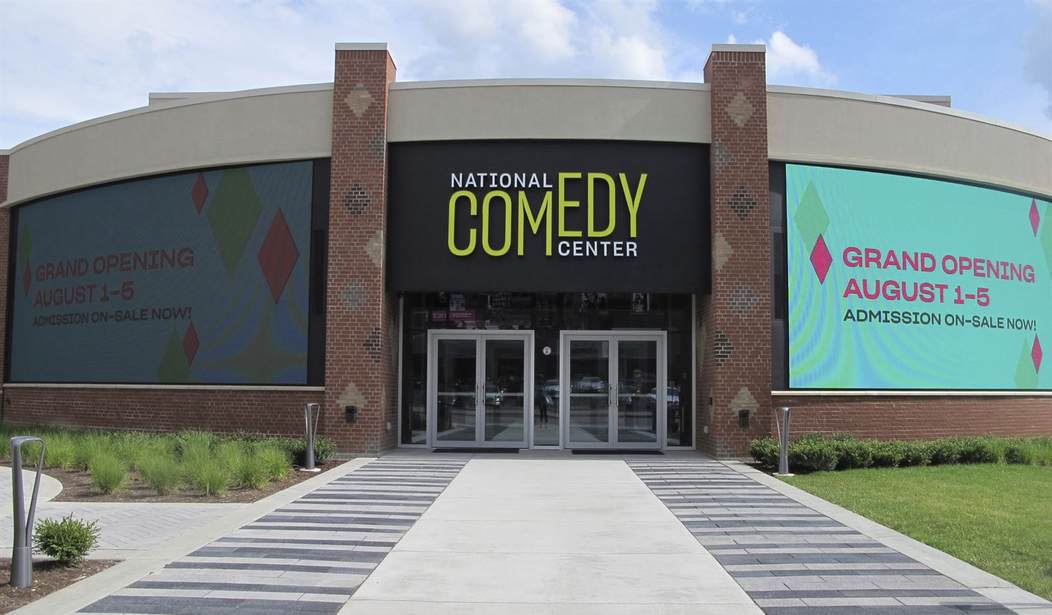
I took a break from my writing desk on Thursday and took the family to the National Comedy Center in Jamestown, New York. It's a genuinely fun place with a lot of amusing exhibits. You can look through George Carlin’s archives, see the puffy shirt from Seinfeld, and enjoy a state-of-the-art experience tailored to your own comedy preferences. I've been there a few times, but something caught my eye this visit that I couldn't shake.
One display early in the visit on late-night comedy caught my eye. Covering the early history of late night through the present, it covered everything from the Johnny Carson era to the Letterman/Leno feud and, finally, to the present.
The final board is what caught my attention. The heading read “POLITICS TAKES CENTER STAGE," as if that were a triumph worth celebrating.
"Thanks to the major influence of Jon Stewart and The Daily Show, late night shifted its focus from straightforward interviews to comedic political commentary,” it read. “Although the satirical programs helmed by former Daily Show correspondents Samantha Bee and John Oliver couldn't be defined as talk shows, they were among the most important programs in the modern late-night landscape."
Most important to whom, exactly?
Stephen Colbert got his own glowing write-up for finding "his groove during the 2016 presidential campaign" through "relentless mockery of the White House."
Here's what really gave the game away, though. The exhibit mentioned Jimmy Fallon as the lone exception — a host known for "delivering lighthearted fare to viewers of all political persuasions."
Read that again.
If Fallon is the exception because he didn't target only one side, then the others are defined precisely by the fact that they do. The exhibit said the quiet part out loud and kept right on moving.
Anyone who watched late-night TV through the ‘90s knows what it used to look like. Leno and Letterman threw jabs at everybody. Republicans, Democrats, left, right, Washington in general — nobody got a pass, and nobody felt left out. It was fun for everyone because back then, it was understood that the audience wasn’t politically homogeneous. That's how comedy builds an audience rather than shrinking it.
ICYMI: White Liberal Lectures Black Conservative About Race on CNN. It Does Not Go Well.
The display also had one glaring omission: Greg Gutfeld. His show consistently outdraws Colbert, Fallon, Kimmel, and the rest of the left-wing programs. He doesn't exist anywhere in that exhibit. Not a mention. For a museum dedicated to celebrating comedy history, it’s hard to see that as an oversight. Sure, the display was probably made before Gutfeld’s rise to king of late night, but exhibits do get updated.
Ironically, the same board that celebrated the political turn of late night quietly acknowledged that "the era of late-night talk shows on network television may be coming to a close, as post-network television has been bolstered by streamers."
No self-reflection. No connecting of dots. Just a bizarre attempt to blame streaming for changing how we view content, as if that’s why the era of late night on network television is ending. The real story about the dying late-night format was literally on the same board: politics takes center stage.
And they have no idea.
Colbert is already on the chopping block. Kimmel looks like he could be next. And yet the Comedy Center doesn’t realize the truth: these shows spent years deliberately alienating half their potential audience. Instead of acknowledging that the hateful political jokes drove their audiences away, they want to blame streaming. Give me a break. Streaming expands reach. It opens new revenue streams. It allows clips to go viral and audiences to grow far beyond the old late-night time slot. Streaming didn’t kill the format. The problem is that viewers who felt mocked or lectured simply stopped tuning in, and no distribution model can fix that.
So, @NtlComedyCenter, it's curious that @greggutfeld isn't included here when he has the best ratings of them all.
— Matt Margolis (@mattmargolis) February 19, 2026
cc:@FoxNews pic.twitter.com/gY1kFvs8Hp
I'm not against political comedy. But, if I’m going to sit through a show and it’s one-sided, I’m gonna watch my side. Who wouldn’t?
And that’s why institutions like The Tonight Show and the Late Show are dying.