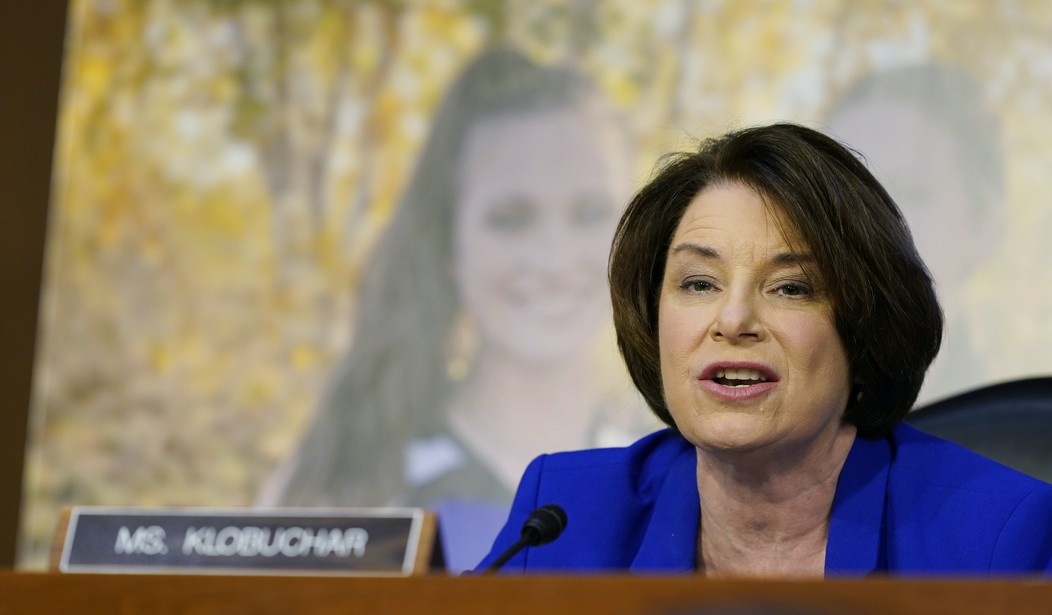

When Sen. Amy Klobuchar announced her run for Minnesota governor this week, I couldn’t help but ask, “Why?”
Sure, it had been telegraphed for weeks after Tim Walz dropped his reelection bid earlier this month, but something still didn’t quite make sense to me. Does she really want to leave Washington, D.C.? I think there’s something more going on here.
I think her gubernatorial bid is a sign that Democrats are scared about Minnesota.
Now, obviously, Klobuchar has presidential ambitions — she ran for president in 2020 — and being governor of a battleground state would definitely make her attractive to the Democratic Party donor class. But I don’t think that's what's really happening here. This is about Democrats circling the wagons around a state that's slipping through their fingers.
Minnesota hasn't had a Republican governor since Tim Pawlenty, who left office in 2011, and hasn't backed a Republican presidential candidate since 1972. But make no mistake about it, Minnesota is trending red. Klobuchar won reelection to the Senate in 2024 by nearly 16 points, her slimmest victory ever after years of landslides. The Harris-Walz ticket barely squeaked by Trump by just five points. That's not the sign of a safe blue state. That's a state Democrats are slowly losing their grip on.
And the fraud scandal that took down Walz made things worse.
The University of Virginia's Center for Politics let the cat out of the bag earlier this month:
On the other hand, even if Walz could have won, the overriding mission of a party’s gubernatorial candidate is to lead their ticket. If Walz skated by on the state’s partisanship alone—or if he did just a little better than Harris—Democrats down the ballot might not be as well positioned. Both chambers of the state legislature will be up this year, and each are closely-divided: Democrats hold a 34-33 edge in the state Senate while the state House will be tied at 67-67, assuming Democrats hold two currently vacant blue seats in upcoming special elections. If Democrats regained a trifecta, there could be potential mid-decade redistricting implications. The state’s current map, divided 4-4 between the parties, is court-drawn, as the state was operating under divided government in the 2021-2022 period.
Fortunately for Democrats, their strongest statewide performer may soon enter the race. Before his exit, Walz consulted Sen. Amy Klobuchar (D), who herself seems likely to run, per recent reporting. Klobuchar’s seat is not up until 2030, which would give her a “free shot” at the race. Last year, Klobuchar won a fourth term in the Senate by a 56%-41% vote against a poor-quality Republican challenger. Though that margin was the weakest of Klobuchar’s senatorial career, she ran about a dozen points ahead of Harris. With that, Klobuchar was the second-best performing nominal Democrat relative to the presidential result, as only Sen. Jon Tester (D-MT) did better (independents Angus King and Dan Osborn each outran Harris by a little more).
In short, with Klobuchar in the race, Minnesota's gubernatorial contest remains "Likely Democratic." Without her, it would have shifted to "Leans Democratic." Bill E. Gates Jr., a centrist Democrat, was already running for governor before Klobuchar jumped in. Clearly, he wasn't who the party wanted. Democrats needed their biggest name, a proven statewide winner, to lock this down.
The timing works perfectly for Klobuchar. If she loses the governor's race, she still keeps her Senate seat. But if she wins, she’ll get to appoint her own replacement, helping Democrats hold onto that seat too. So, it's a low-risk, high-reward play to protect Democratic power in a state that's becoming less reliable.
So, in the end, Klobuchar's candidacy is an acknowledgment by the Democrats that Minnesota is no longer a sure thing, and they're trying to hold onto power as long as they can.