





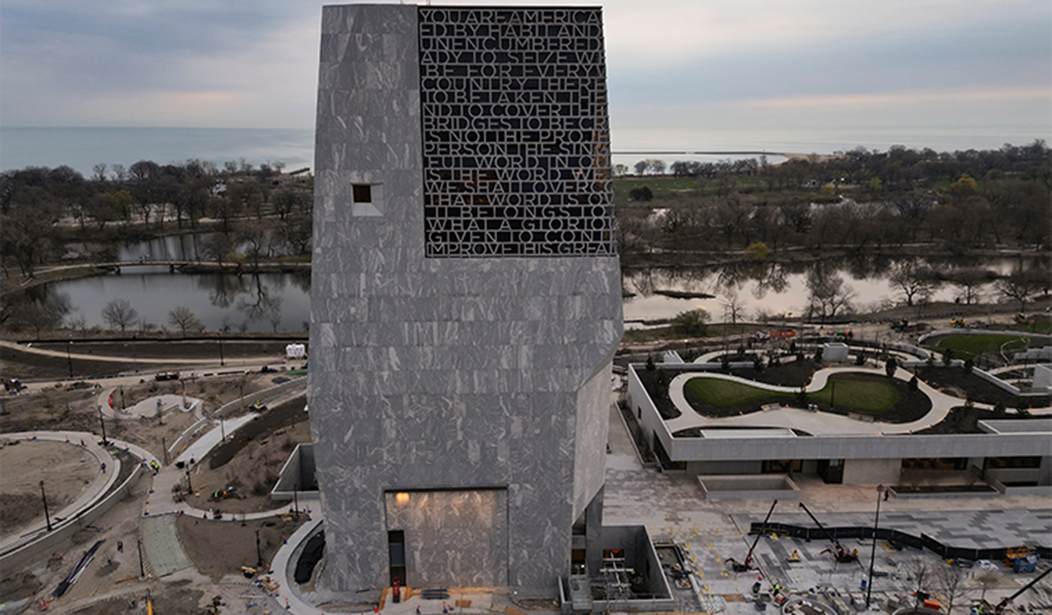
On June 18, 2026, a photograph of a massive, gray institutional building went viral. The caption was blunt: “Truly just a disgusting monstrosity of a building.” The image showed the newly opened Obama Presidential Center in Chicago — a 225-foot granite tower, blocky, nearly windowless, engraved with hard-to-read text.
The replies were fairly predictable. One, from @avidseries (i/o), who presents himself as a reasonable centrist:
Bottom line is that when it comes to art and design the American right are hicks. They have either bad or retrograde taste in almost everything.
— i/o (@avidseries) June 18, 2026
Anything new or challenging or innovative or relevant to the zeitgeist terrifies them.
It's the curse of low Big 5 openness. https://t.co/0k3Tj7kkaV
A sigh is the only honest response.
Here is someone who claims the middle ground, in one casual stroke writing off the aesthetic judgment of millions of ordinary people as a personality defect. No real engagement with the building itself — its cold scale, its alienating heaviness, its failure to invite the eye or comfort the body. Instead, a tidy diagnosis: conservatives are simply too closed-minded, too low in “openness,” to appreciate what the sophisticated see. What looks to normal human perception like an ugly, soul-crushing structure becomes evidence of the viewer’s own backwardness.
The response, instead of arguing on the basis of logic, delivers dismissal dressed up as psychological insight. It assumes that any rejection of certain modern forms must come from ignorance rather than from a healthy, instinctive response to proportion, material, and human scale. The arrogance is breathtaking: a public building meant to serve and represent a shared civic inheritance is turned into a litmus test that conveniently flatters the defender’s enlightenment while condemning everyone else as hicks.
The pattern is wearily familiar. When the eyes and the gut say one thing and the manifesto says another, the observer is told to distrust their own faculties and trust the expert. Beauty, however, rarely needs this sleight of hand. As @Architectolder put it so cleanly, “Beauty is obvious. Ugliness always comes with a lecture.”
Classical Beauty: What Makes Something Beautiful?
What makes something beautiful? Not a matter of fleeting fashion or expert decree, but qualities that have spoken to human beings across cultures and centuries. The classical tradition — drawing from Aristotle, Aquinas, and the long witness of lived experience — points to several interlocking elements that produce an instinctive, pre-verbal response.
- Proportion and harmony: The parts relate to the whole in balanced, pleasing ways. A building, a face, a piece of music feels right when nothing jars or overwhelms.
- Clarity and integrity: The thing is what it appears to be, without pretense or hidden contradiction.
- Wholeness and radiance: A kind of inner fitness that draws the eye and mind without needing explanation.
- Fitness to human nature: We are wired for patterns that signal life, safety, and care — natural forms, prospect and refuge, organic variation, human scale.
This is why beauty so often feels obvious. A well-proportioned classical facade, the quiet light in a Vermeer, or the movement of water in a fountain needs no manifesto. It simply works on the eye, the ear, and the nervous system. It resolves rather than creates friction. We recognize it the way we recognize a face we love or a story that rings true.
Brutalist and many modernist projects deliberately turn away from these anchors. They prioritize raw materiality, monumental scale, and ideological statement over harmony and human warmth. The result often feels like an assault on the very faculties that make beauty possible. When people recoil, they are not displaying low openness. They are displaying normal human perception.
Brutalist Architecture as Visual Gaslighting
Brutalism offers a near-perfect case study of how ugliness demands a lecture, and how that lecture often functions as visual gaslighting.
This architectural form emerged in the 1950s, primarily in Britain and famously adopted swiftly by the Soviet Union, as part of postwar reconstruction. The name comes from the French béton brut — raw concrete. Architects such as Alison and Peter Smithson and the critic Reyner Banham championed the style, building on earlier modernist ideas from Le Corbusier. The approach favored exposed concrete, monumental scale, bold geometric forms, and the deliberate display of structure and materials with little or no ornament.
What does brutalism actually say? At its root, it speaks the language of power, austerity, and industrial honesty. The building presents itself as a blunt engineering fact rather than a welcoming or delightful presence. It was invented in the context of massive postwar rebuilding: a desire to house people efficiently, express “honest” materials after the decorative excesses of earlier eras (in nature and civilization alike, decorations consume vital resources), and pursue social-engineering ambitions through architecture. Concrete was cheap, fast, and modern. The style promised democratic, forward-looking solutions to urgent problems, with little wasted on unnecessary frills during a period of scarce resources.
Its defenders claim something more elevated. They speak of “material honesty,” “social purpose,” “challenging bourgeois taste,” and “relevance to the modern age.” When ordinary people look at the resulting hulking concrete boxes and feel alienation, coldness, or oppression, the response is rarely to reconsider the design. Instead, observers are told they are looking at it incorrectly — that they lack sophistication, that they are closed to innovation, or that they simply don’t understand the deeper meaning.
This is visual gaslighting. The eyes and the body register one reality. The manifesto insists on another. The burden shifts from the building to the viewer: Ignore what you see and feel. Trust the theory. Material honesty itself is not the villain — concrete and synthetic materials can be used with integrity. The deeper problem is that brutalism often treats the antithesis of nature as an aesthetic virtue. Humans crave natural beauty: organic forms, variation, refuge, the play of light on water. We are wired for it. A reflecting pool in Washington, or almost any successful fountain, works because it celebrates the inherent beauty of water — its movement, reflections, music, and calmness. No lecture required. The element itself suffices.
When a style turns its back on these deep human preferences and then scolds people for noticing, the lecture is doing the heavy lifting that the building itself cannot. Do we still need brutalism today? Is this really a deliberate aesthetic choice, or has it simply become a habit? We no longer live in a resource-scarce, war-ravaged world that demanded buildings fast and cheap. We have the wealth, the technology, and the time to return to the beautiful forms that developed over centuries — the grace of Victorian detail, the organic curves of Art Nouveau, the elegant streamlining of Art Deco. Why cling to an aesthetic born of scarcity and ideology when abundance allows us to build what actually delights the human spirit?
The Parallel in Truth and Language
The same asymmetry we see in architecture runs straight through truth and language. Genuine truth, like genuine beauty, can sit quietly, unadorned. It does not need constant reinforcement, repetition, or institutional defense because observable reality keeps confirming it. Over time, it endures. If lost, it is rediscovered. Lies, distortions, and ideological constructs require ongoing expenditure of energy — explanation, redefinition, social pressure, and insulation from scrutiny — precisely because they clash with reality.
In language, this pattern shows up with painful clarity. Plain words carry a certain lightness when they stay anchored to observable reality. When they are stretched, inverted, or loaded with new connotative freight until ordinary meaning is pathologized, they demand the same heavy scaffolding as an ugly building. Disagreement is reframed not as a legitimate response to distortion, but as moral or intellectual failure. The word still looks the same on the outside, but inside it has been hijacked for a different purpose. The lecture — or the style guide, the training manual, the carefully worded press release — does the work the altered meaning cannot do on its own. The human brain has to convolute itself to accommodate the new meaning of the word, even though it knows there is something wrong. This is, naturally, stressful.
The best art and the clearest truth feel restorative. They do not tax the psyche. They resolve dissonance rather than create it. A story that rings true, a statement that corresponds to reality, a building that honors human proportion — these things can simply be. They do not require us to distrust our own eyes or our language.
Brutalist structures, like the ideological claims that once justified them, are already decaying or quietly being reconsidered in many places. The beauty of flowers, trees, moving water, and well-proportioned human environments will outlast them because these things align with enduring human nature rather than fighting it.
Truth and beauty both scale with simplicity. The counterfeit demands ever more complexity just to keep standing.
Reenchantment
The pattern we have been tracing connects naturally to Occam’s razor: the simplest explanation that fits the facts is usually the right one. Genuine beauty and genuine truth are simple and clean. They do not require elaborate theoretical scaffolding, auxiliary hypotheses, or constant psychic overhead to sustain themselves. They resolve cleanly and feel restorative.
Reenchantment is the recovery of that wonder. It is the deliberate turn away from the flattened, deconstructed, lecture-heavy world back toward meaning, beauty, proportion, and the living inheritance of language and culture. It is not nostalgia for a perfect past, but a recognition that humans thrive when we can sit in quiet awe before what is true, good, and fitting — a mountain lake, a well-told story, a building that honors human scale, a word that still carries its original weight. Reenchantment restores psychic lightness. It lets us stop performing sophistication and simply see.
The counterfeit — whether an ugly structure defended by manifestos or a distorted word defended by ideology — extracts a real toll. It creates cognitive friction, low-grade alienation, and the metabolic expense of maintaining the lecture. Over time, that cost compounds.
Societies and individuals thrive when they favor the lightness of truth and beauty over the heavy maintenance of the counterfeit. Trusting what the eyes and the gut reliably report is never a failure of discernment. It is a return to sanity and to the kind of wonder that makes life worth living. The lecture is optional. Beauty and truth are not.
When a building, a claim, an artwork, or a word arrives wrapped in a heavy load of explanation — when it demands that you ignore your eyes, your gut, or your shared linguistic inheritance — treat it with suspicion. The genuine article does not need such protection. It stands on its own.
The preference for what “just works,” what allows wonder without psychic taxation, is not naïve, despite what the gatekeepers say. (Remember, gatekeeping is their power. Without the ability to scoff or deny, they have nothing.) It is a reliable guide rooted in human nature itself. Beauty is obvious. Truth can bear being silent. Both scale with simplicity and endure because they conform to reality rather than fighting it.
While ugliness, lies, and art that you have to work to enjoy create stress and cognitive friction, beauty and truth create the opposite. They allow you to simply live, enjoy, and relax. That should be what aesthetics — and language — are all about.
We no longer need to live inside the lecture. We can choose the lighter path — reenchantment, clear language, buildings and stories that delight rather than scold. The structures that require endless defense are already passing. The things that need no explanation — moving water, living trees, proportion, truth plainly spoken — remain. They always have. They always will.
We all own art; it is not the private property of a few elites who gatekeep it from the rest of us. We all own language; it is our inheritance, developed over thousands of years by our ancestors and bequeathed to us with love. These things are our civilizational commons. They are ours to reclaim if we wish.
Editor's Note: Do you enjoy PJ Media's conservative reporting that takes on the radical Left and woke media? Support our work so that we can continue to bring you the truth.
Join PJ Media VIP and use promo code FIGHT to receive 60% off your membership.


Join the Conversation
VIP members get the ability to comment on articles.