





Hey, gang, glad you're here. It is Wednesday, Sept. 23, 2026. Autumn officially arrived last night at 8:06 p.m., so if you woke up disappointed that nothing looks different outside, that's meteorology for you — it never delivers on the drama it promises. As of this writing, it's 44 degrees outside the Florack Word Ranch, so we're well on our way toward the dreaded white stuff around here.
My calendar says it's the Day of Sign Languages, Checkers Day, Dogs in Politics Day, Snack Stick Day, and Go With Your Gut Day. Learn a sign or two, take your dog to go bark at a politician, grab a snack stick, and trust your instincts today — though maybe not on the same day you're also eating gas-station meat sticks and making major life decisions. Burping never plays well in politics, after all.
Today in History:
1642: Harvard College holds its first commencement.
1779: The American warship Bonhomme Richard, commanded by John Paul Jones, defeats the British frigate HMS Serapis off Flamborough Head, England.
1780: British spy John André is captured, exposing Benedict Arnold's plot to surrender West Point.
1806: Meriwether Lewis and William Clark return to St. Louis after their two-year expedition to the Pacific Northwest and back.
1846: German astronomer Johann Gottfried Galle identifies Neptune as a planet.
1909: Gaston Leroux's novel The Phantom of the Opera makes its literary debut.
1923: Kahlil Gibran publishes The Prophet, a book that will go on to sell more than 100 million copies.
1932: King Abdulaziz Ibn Saud unites the Hejaz and Nejd, forming the modern Kingdom of Saudi Arabia.
1939: Sigmund Freud, founder of psychoanalysis, dies in London.
1952: Sen. Richard Nixon delivers his televised "Checkers" speech, saving his spot on the Republican ticket by refusing to give back a gifted cocker spaniel.
1955: A jury in Sumner, Miss., acquits two white men of murdering black teenager Emmett Till.
1962: New York's Philharmonic Hall formally opens as the first completed unit of Lincoln Center.
1973: Former Argentine President Juan Perón wins a landslide election, returning him to power.
1999: NASA loses its $125 million Mars Climate Orbiter after a metric-conversion error sends it too close to the planet.
Birthdays Today include Ray Charles, pianist and singer who helped define soul music; Julio Iglesias, Spanish singer with more than 300 million records sold; Mary Kay Place, actress and Grammy-winning singer-songwriter; and Donald Glover, actor and musician known as Childish Gambino. If today's your birthday, too, happy birthday from all of us here.
* * *
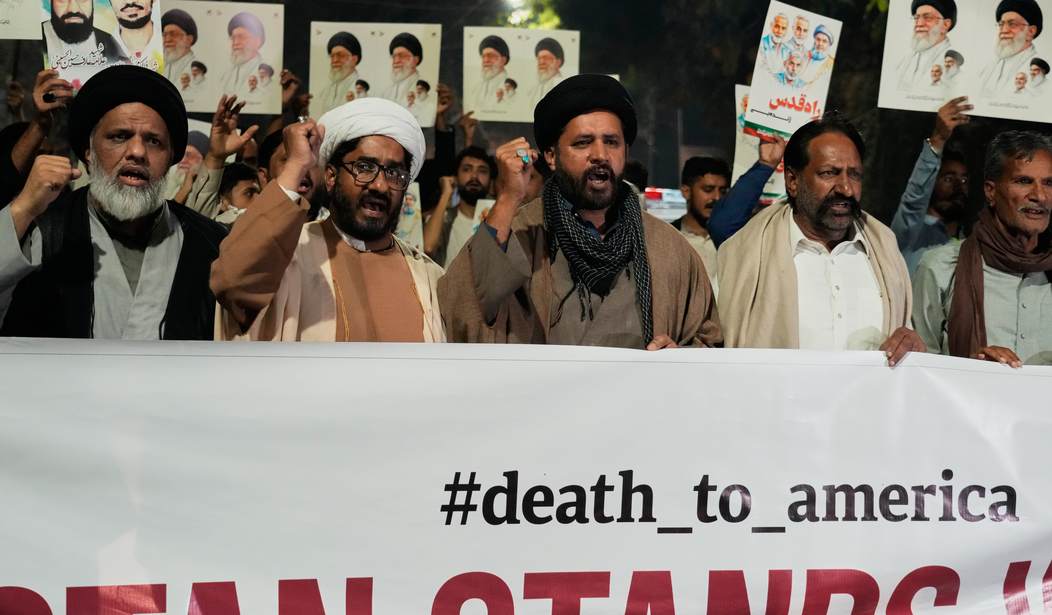
In the cleanest tell yet that Iran is on the ropes, a senior Iranian official just put a number on the table Tehran has never put there before. That official told Reuters on Sept. 22 that Iran can reopen the Strait of Hormuz within seven days if Washington eases military pressure and lifts the blockade on Iranian ports. Per that reporting, this marks the first time Tehran has attached a specific, dated performance window to reopening the strait rather than treating it as an open-ended bargaining chip. That's a meaningful shift. A regime negotiating from strength doesn't convert its leverage into a countdown clock — it converts it when the clock is running against it, not the other way around. Reuters doesn't name the "senior official," but it's a safe bet that it's either President Masoud Pezeshkian himself or someone standing close enough to him to speak for the office.
Of course, there's always the question of whether Iran actually follows through on its promises, and the standard response should be "they won't," since in practice, they never have.
That suspicion only deepens once you look at what other Iranian officials said in the same news cycle. CNBC's reporting notes that a separate senior Iranian government official told MS NOW, CNBC's Versant Media partner, that the Reuters and Kyodo reports were "not true." And according to yournews.com's writeup, Iran's semi-official Fars News Agency disputed the account, too. So this isn't a clean, confirmed data point. It's a single-sourced Reuters/Kyodo report, attributed to one unnamed official, that Iran's own state-adjacent media machine turned around and contradicted within the same day. CNBC itself states it "could not independently verify the reports."
That contradiction goes directly to a point I made back in April: Iran's civilian government under Pezeshkian and the Islamic Revolutionary Guard Corps aren't singing from the same hymnal, and this flip-flop looks a great deal like the result. It's reasonable to conclude Iran is fighting something close to an internal civil war right now, waged between the IRGC and whatever still passes for a civilian government in Tehran — one arm offering concessions to end a war it can't win, the other arm racing to deny it before Iranian state media has to explain the offer to its own people.
Let’s recall that Ali Khamenei was killed in a February 28 U.S.-Israeli strikeand his son Mojtaba Khamenei was installed as his successor. Mojtaba is now reportedly walled off from his own government by an IRGC security cordon. Gee, big shock.
The walk-back on the Hormuz offer itself is the more useful data point, because it measures Iran's shrinking ability to control its own message, let alone its own war. Even Iranian state media has lately taken on a tone bracing its audience for something difficult, a marked departure from its usual self-assured, defiant register. Pezeshkian's own framing — "we emerged with our heads held high," vowing to "firmly defend" Iran's positions — is the language of a leader managing domestic face-saving, not one negotiating from a position that needs no defending. That combination — tough public talk paired with real, dated concessions offered quietly through mediators — is the classic signature of a regime under genuine pressure, trying to manage two audiences at once: an international one it's handing specific offers to, and a domestic one it's still trying to sell a story of resilience. It calls to mind the rhetoric coming out of Berlin in the days after the Allied landing at Normandy — total confidence on the radio, total collapse on the map.
Interestingly, reports have surfaced, as yet unconfirmed, that Pezeshkian submitted an actual resignation letter back in May, arguing the elected government had been excluded from major decisions entirely. The regime reportedly denied this within hours, including through IRGC-affiliated media — the same pattern that just played out with the Hormuz offer this week. Clearly, the IRGC wants the illusion of a popularly elected government presented to the world. Accepting the resignation would risk triggering domestic unrest, which the IRGC can't afford from a global PR standpoint.
Recommended: What 'Star Trek' Taught Us About AI, Thirty Years Before We Needed the Lesson
Not everyone reads the power dynamic the same way. Iran analyst Ben Taleblu, quoted by Fox News, cautions against reading Pezeshkian's sidelining as a dramatic new break — his argument is that the president never held much real power to begin with, so this is an intensification of a long-standing structure, not a sudden coup. And a GIS Reports analysis lays out a genuinely fragmented decision-making body — Pezeshkian, Araghchi, Zolghadr, Ghalibaf, and a hardline chief justice all holding formal seats at the table, with the regime needing Pezeshkian and Araghchi kept visibly in the picture specifically because their public-facing legitimacy is worth something to a regime that still needs to claim popular consent. Clearly the IRGC holds the cards, and despite that, Pezeshkian is still pushing for a more moderate approach. He's still alive for one reason: The IRGC needs him for the illusion of legitimacy. At this point, I wouldn't bet on Pezeshkian surviving the eventual loss of power the IRGC appears headed toward. Someone will need to take the blame for that loss, and it won't be the men holding the guns.
Put plainly, the messaging coming out of Tehran this week is exactly what you'd expect from a regime managing weakness rather than strength — walking back a leak that looked too accommodating the moment it hit international wires, precisely because Pezeshkian's "heads held high" routine back home can't coexist with what amounts, in plain terms, to a public seven-day surrender clock.
Now, before some of you get this twisted, the offer from Pezeshkian's people came about a week before Trump's UN speech, not because of it. What brought it to the surface was the speech itself, and the Iranian delegation's walkout partway through Trump's remarks on the war. The speech didn't create the weakness. It just made it impossible for the Iranians to keep hiding it, which is perhaps even more useful.
Thought for the Day: Nixon saved his career by refusing to give back a dog nobody asked him to return — proof that sometimes the shrewdest defense is simply declining to negotiate over something that was never actually up for debate.
VIP members — The comments section is yours. Your voice matters.
Take care of yourselves today. Do me a favor, and if you like this content, spread it around. Social media and whatnot. Trust me, it helps. I'll see you tomorrow.
Editor's Note: The mainstream media continues to gaslight, spin, and lie about President Trump, his administration, and conservatives.
Help us continue to expose their left-wing bias by reading news you can trust. Join PJ Media VIP and use promo code FIGHT to receive 60% off your membership.
Join the Conversation
VIP members get the ability to comment on articles.