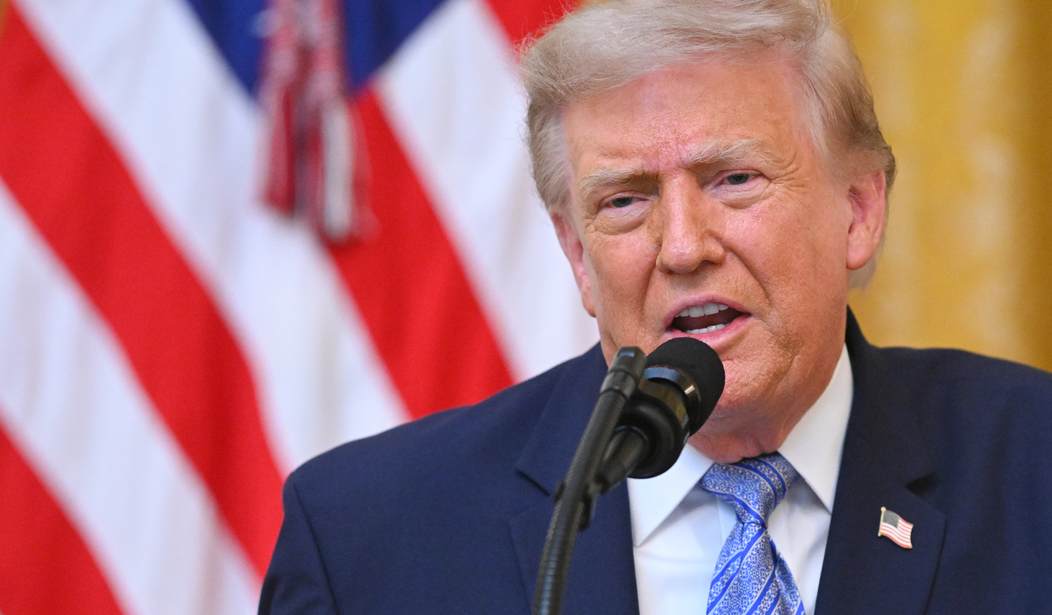

I get asked this question with some regularity: “What has Donald Trump actually accomplished as president?”
It is usually asked with the implication that the answer ought to be something along the lines of, “Well, he tweets a lot.”
(Sigh.) Fine.
Let's dispense with the television-panel version of the question and look at the record. Not promises. Not campaign slogans. Not what somebody on MS-NOW or Fox News says he might accomplish someday. What has actually been done? As of September 2026, the list is considerably longer than the question suggests. Because of the length of this list, I'm going to format this a bit differently, as you'll see. The real challenge for me was keeping this thing to around 2,000 words.
Economy and Taxes
Let's start with the one that tends to make Washington's tax-and-spend crowd particularly uncomfortable: Trump cut taxes.
On July 4, 2025, President Trump signed the One Big Beautiful Bill Act into law. Among other things, the legislation made permanent many of the individual provisions of the 2017 Tax Cuts and Jobs Act that otherwise were scheduled to expire. That includes the lower individual tax rates, larger standard deduction, and expanded child tax credit. It also made the 20% Section 199A deduction for pass-through businesses permanent. The bill also created several new deductions, including for qualified tip income, overtime compensation, and an additional $6,000 deduction for taxpayers 65 and older.
The law also temporarily raised the SALT deduction cap from $10,000 to $40,000, subject to income limitations, for 2025 through 2029.
And there's another part of the legislation that doesn't get nearly as much attention: It permanently restored 100% bonus depreciation for qualifying investments and permanently restored domestic research-and-development expensing. The Tax Foundation estimates the tax provisions could increase long-run GDP by about 1.2% and increase the capital stock by 0.7%.
That's not a campaign promise. That's a campaign promise that has been kept and turned into legislation.
And it is worth remembering that tax policy isn't merely about how much money Americans send to Washington. It also determines what businesses do with the money they don't send there.
Border and Immigration
Then there is immigration. Whatever one's politics, the numerical change at the southwest border has been difficult to deny. So the Democrats seldom get to the specifics of the thing.
The Trump administration's second-term immigration policy produced a dramatic reduction in illegal crossings compared with the Biden-era surge. The administration has also moved aggressively toward detention, removal, expedited processing, and enforcement rather than the release-and-process model that characterized much of the previous administration. And this is not merely about numbers on a spreadsheet.
The administration has attempted to change the underlying incentive structure: If crossing the border illegally means detention and removal rather than eventual release into the United States, the incentive to make the journey changes.
That is the theory behind the policy. And it works.
The administration has also expanded immigration enforcement well beyond the physical southwest border, including workplace enforcement, deportation operations, and efforts to restrict various forms of parole and temporary admission. The practical question is not whether everyone agrees with every element of that policy. Of course the loons are going to disagree with anything the man does, even if he proposes a policy they were pushing a couple years ago.
The practical question is whether federal immigration policy is producing results. It plainly, undeniably is.
Trade and American Industry
Trump has used tariffs as an instrument of economic policy to an extent not seen by a modern American president.
Agree with that strategy or disagree with it, it has changed the conversation from one in which American trade policy was largely treated as an exercise in maximizing cheap imports to one in which the United States is explicitly using market access as leverage in negotiations over manufacturing, supply chains, national security, and foreign industrial policy. The administration has also pushed domestic sourcing and supply-chain security aggressively. That means American jobs.
One example is a July 2026 executive order directing that critical materials and components for the American military be sourced domestically or from allied nations rather than leaving strategic supply chains exposed to foreign pressure.
That is a particularly important development in an era when China dominates significant portions of the world's processing capacity for critical minerals and other strategic materials.
Energy
Energy policy has undergone an equally dramatic reversal. The administration reopened 1.56 million acres of Alaska's Coastal Plain to oil and gas leasing, reversing the previous administration's more restrictive approach.
And nuclear power is back on the table in a serious way. In June 2026, the Department of Energy announced $17.5 billion in financing aimed at rebuilding the American nuclear supply chain and accelerating deployment of 10 large commercial nuclear reactors. The stated objective is to have ten new large reactors with completed designs under construction by 2030. That matters because energy policy eventually becomes economic policy.
You cannot build semiconductor plants, data centers, factories, steel mills, or artificial intelligence infrastructure with speeches and unicorn farts. At some point, somebody has to actually produce the electricity. Trump's answer has been to expand the available energy supply rather than restrict it.
Deregulation and the Administrative State
Trump has used executive authority extensively to attack what his administration considers unnecessary regulatory barriers.
The White House's executive order record shows actions addressing everything from federal contracting and housing construction to financial regulation, energy, agriculture, defense supply chains, critical materials, artificial intelligence, and federal lands. Whether every one of those orders survives judicial review or produces the promised economic effect is another question.
But the direction of policy is unmistakable. The administration has attempted to move the federal government from “How can we regulate this?” toward “Why are we regulating this in the first place?” That’s the question that always should have been asked and so seldom has been for the last 50 years. That's a rather significant change in governing philosophy.
The Judiciary
Presidents don't personally confirm judges. The Senate does that. But presidents nominate them, and Trump has continued to put his judicial philosophy into the federal courts through a steady stream of nominations.
The Senate Judiciary Committee's records show numerous circuit and district court confirmations during 2026, including Matthew Schwartz to the Second Circuit, Benjamin Flowers to the Sixth Circuit, and Daniel Traynor to the Eighth Circuit, among many district judges. And the pace has continued through the summer. The significance here isn't that one particular judge won a confirmation vote. It's that federal judges serve for life.
A president's economic policy can be reversed by the next president. A regulation can be repealed. A tax provision can be rewritten. A federal judge can remain on the bench for decades.
Recommended: The UN: A Band of Antisemites With Headquarters in New York City
Foreign Policy and the Middle East
This part of the record is considerably harder to summarize in a couple of bullet points. Trump's foreign policy has produced a series of diplomatic initiatives involving some of the world's most difficult conflicts.
The administration has rightly claimed a role in agreements or de-escalation efforts involving India and Pakistan, Rwanda and the Democratic Republic of Congo, Serbia and Kosovo, Armenia and Azerbaijan, Cambodia and Thailand, Egypt and Ethiopia, and Israel and Hamas.
That doesn't mean every conflict has been permanently solved. Diplomacy doesn't work that way. A ceasefire is not necessarily peace, and a memorandum is not necessarily a permanent settlement. But those distinctions don't erase the fact that Washington has been actively involved in attempting to settle conflicts that had resisted resolution for years.
Gaza
Gaza deserves its own heading. Trump's administration unveiled a 20-point plan for ending the Gaza conflict and moving beyond a ceasefire toward reconstruction and governance.
By January 2026, the administration announced that Phase Two was underway, including the formation of the National Committee for the Administration of Gaza and the establishment of a broader international framework for reconstruction and governance. The United Nations Security Council subsequently endorsed the framework in Resolution 2803. Again, reasonable people can debate whether the arrangement will ultimately work. But Trump takes the attitude that you miss every shot you don’t take. There is a substantial difference between saying, “Someone ought to figure out what happens after the shooting stops,” and actually putting a framework on the table for what happens next.
Iran
This one deserves more space than I am going to give it here because I've written about it extensively elsewhere. After the failure of negotiations and escalating military confrontation, the United States and Israel launched a major strike campaign against Iran, beginning on Feb. 28, 2026.
The conflict subsequently expanded dramatically, including fighting around the Strait of Hormuz and a U.S. naval blockade. By September, it remained unresolved, and military exchanges were continuing.
Whatever one's view of the policy, the important point for purposes of this list is simple: Iran is no longer dealing with an American administration that treats its nuclear program as an endless diplomatic seminar. The strategic consequences of that change are still unfolding. But there’s no more nuclear capability.
NATO and Defense
Trump continued his long-running demand that America's NATO allies spend substantially more on their own defense. NATO allies agreed in 2025 to a substantially higher defense-spending target, with the new framework calling for 5% of GDP by 2035, including spending on core defense and defense-related security requirements. The point is larger than any particular dollar figure.
For decades, American presidents complained that many European allies were not spending enough. Trump turned the complaint into a negotiating demand, and got real results. Whether one regards that as diplomacy, coercion, or simple burden-sharing, the spending commitments are now considerably larger than they were when he entered office.
The Military
The administration has pursued a broad rebuilding of the American defense industrial base. That includes efforts to expand domestic production of critical materials, strengthen the defense supply chain, accelerate weapons production, and rebuild industrial capacity.
The July 2026 executive order on defense supply chains explicitly directs the federal government to reduce dependence on potentially hostile foreign sources for materials and components needed to equip and sustain the U.S. military.
And that brings us back to something rather basic. A military is not simply men and women in uniform. It is factories. It is shipyards. It is machine tools. It is semiconductor fabrication. It is ammunition production. It is fuel. It is logistics. It is the ability to replace what gets used or destroyed. A country that cannot manufacture the tools of war becomes dependent upon, and eventually the subjects of, somebody who can.
And more
This isn't even an exhaustive list.
The administration has also pursued:
Federal workforce restructuring and changes to civil service policy.
Efforts to reduce federal contracting waste and increase accountability.
Changes to DEI policies throughout the federal government.
Expanded immigration enforcement.
Changes to federal lands and permitting policy.
Artificial intelligence and quantum computing initiatives.
Expanded domestic critical mineral and defense supply chain policies.
New efforts to accelerate housing construction by reducing federal regulatory barriers.
And the executive order machine hasn't exactly slowed down. The White House's official record shows new orders still being issued in September 2026, including actions involving veterans' benefits, defense production, and agricultural policy.
So, back to the original question: What has Donald Trump actually accomplished?
The answer is not that everything he has attempted has worked. It hasn't. Nor is it that every policy has been universally popular. It hasn't. Not that, with the jerking knee of the left, you'd expect that.
But if the question is whether there is an actual record of legislation, executive action, judicial appointments, border-policy changes, energy policy, trade policy, defense policy, and diplomatic initiatives, the answer is rather difficult to dispute.
There is a record. A very large one. And after all the shouting, screaming, cable-news panels, social-media wars, and endless political theater, that is probably the most useful way to judge a presidency.
Not by what the president says he accomplished. Not by what his enemies say he accomplished.
Rather, by what actually happened.
Only then do you get to legitimately argue about whether it was good, bad, effective, ineffective, constitutional, unconstitutional, wise, or foolish. But first, at least get the list right. Trump's detractors still can't manage that simple point.