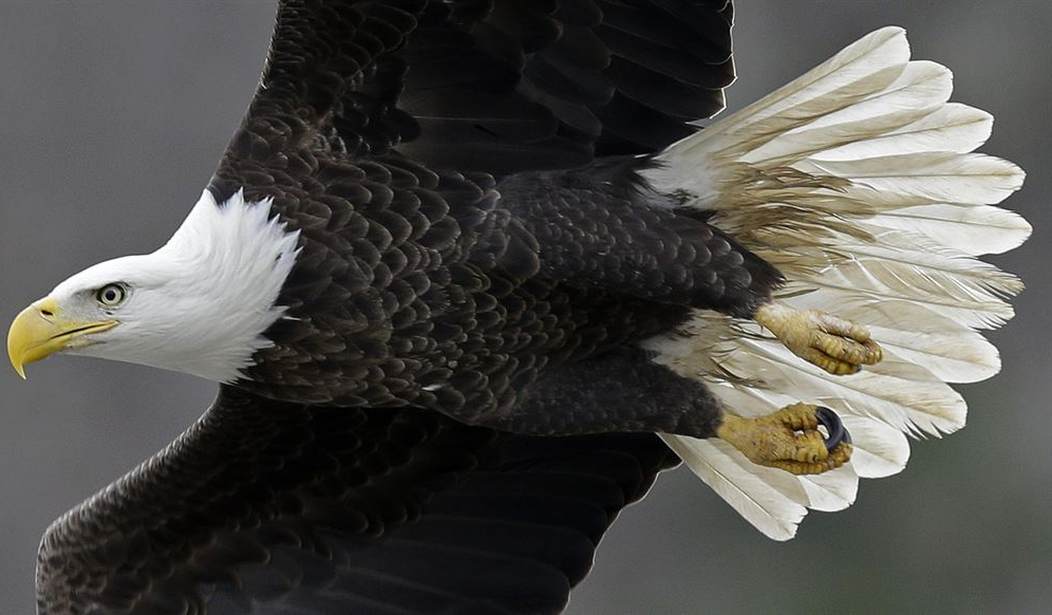

In May 1862, at Farmington, Miss., soldiers of the 8th Wisconsin Infantry took cover from Confederate artillery. Their most unusual companion had apparently learned the drill.
Old Abe, a bald eagle perched beside the regimental colors, hopped down. His handler returned him to his perch. He jumped down again. Finally, the soldier crouched beside him. When the men stood, Old Abe jumped back up, flapped his wings, and was ready to move.
It’s hard to imagine a stranger Civil War veteran. Old Abe carried no rifle and wore no uniform. Yet the young eagle accompanied Wisconsin soldiers through 37 battles and skirmishes and became one of the regiment’s most cherished members.
His story began in northern Wisconsin in 1861. Ogimaa Weigiizhig, also known as Chief Sky, a member of the Lac du Flambeau Ojibwe, took two eaglets from a nest. Only one survived. He traded the young bird to the McCann family near Jim Falls for a bushel of corn. When local volunteers prepared to join the Union Army, the family sold the eagle for $2.50.
From the Wisconsin Veterans Museum:
The exact method of the capture varies slightly among several sources. One account states that, after noticing a mature bald eagle hovering around a tree, “one of the Ojibwe men climbed the tree to the nest and while up there the old eagle charged on him and had to be shot.” Another explanation has the tree containing the nest being cut down by Ogimaa Weigiizhig, after he shot a mature eagle, presumed to be the mother of the two eaglets. Only Old Abe survived this extraction—his hatch mate perished soon after.
Ogimaa Weigiizhig later traded the surviving eaglet, for a bushel of corn, to Margaret McCann in the tiny community known as Jim Falls, Chippewa County. McCann’s husband, Daniel, had difficulty walking due to a childhood accident and wanted to contribute to the war effort in some way. Upon hearing of the formation of a militia company in the Chippewa Falls area, he decided to offer the young eagle as a mascot. The Chippewa Falls men refused the offer, but a company from Eau Claire agreed to purchase the eagle for their mascot.
On September 6, the soldiers departed Eau Claire by steamboat with their unlikely recruit. At Camp Randall in Madison, they named him Old Abe after President Abraham Lincoln. The Eau Claire volunteers became Company C of the 8th Wisconsin, and before long their entire regiment was known as the Eagle Regiment.
The soldiers carried Old Abe on a special perch decorated with the Stars and Stripes. During a performance of “Yankee Doodle” at Camp Randall, he grabbed a corner of a flag with his beak and beat his wings. The young men delighted in their mascot’s flag-waving performance.
Old Abe’s wartime experience was no parade. At Corinth in October 1862, a bullet severed the cord securing him to his perch. He flew about 50 feet before his handler, David McLain, caught him and hurried to safety. Later stories had the eagle soaring across enemy lines, but the brief escape was frightening enough.
During the Vicksburg campaign, another bullet stripped feathers from his neck and chest and wounded the webbing of a wing.
He survived.
In an 1864 memoir, Sgt. Maj. George Driggs wrote that his fellow soldiers grew so attached to Old Abe that they would spend their last cartridges rather than let the enemy capture him.
Back in camp, their feathered comrade could be a menace. He overturned water pails, stole food, chased insects, and amused himself with soldiers’ laundry. The men cared for him anyway. They had seen enough death to treasure a living creature who had endured the same dangers.
When Old Abe retired from the fighting in 1864, the regiment presented him to Wisconsin. He received a home at the State Capitol, where visitors came to see him. After a fire filled his quarters with smoke in 1881, he weakened and died on March 26 in the arms of his caretaker. His preserved remains were lost in the devastating Capitol fire of 1904.
From Wisconsin History:
At the end of the war, Old Abe was presented to the State of Wisconsin. For 15 years, he lived in the "Eagle Department" in the basement of the Capitol, attracting thousands of visitors. During this period, Old Abe also served as the star attraction at many fundraising events, earning thousands of dollars for politicians and charities.
Old Abe's long life ended March 26, 1881, when he died from smoke inhalation during a fire in the Capitol. His remains were stuffed and mounted, and for the next 20 years his body remained on display in the rotunda of the Capitol building.
After construction of the new State Historical Society building in 1901, Old Abe was briefly housed at that facility before being moved back to the Capitol in 1903. His remains were destroyed a few months later when the Capitol building burned down on February 26, 1904.
But his story kept traveling. The eagle on the famous 101st Airborne Division’s Screaming Eagle patch honors Old Abe. The Army adopted that design long after the Civil War, passing along a Wisconsin memory to another generation of soldiers.
I grew up in Altoona, right next door to Eau Claire. Today, Old Abe stands in Eau Claire’s Wilson Park, and students at Memorial High School proudly call themselves the Old Abes. Children still cheer a name first carried from their hometown into the terrible uncertainty of war.
More than 160 years later, the men who carried Old Abe are gone. Their eagle is gone. Yet in the Chippewa Valley, they haven’t entirely left us. Each time somebody says “Old Abe,” a small piece of their courage comes home.