


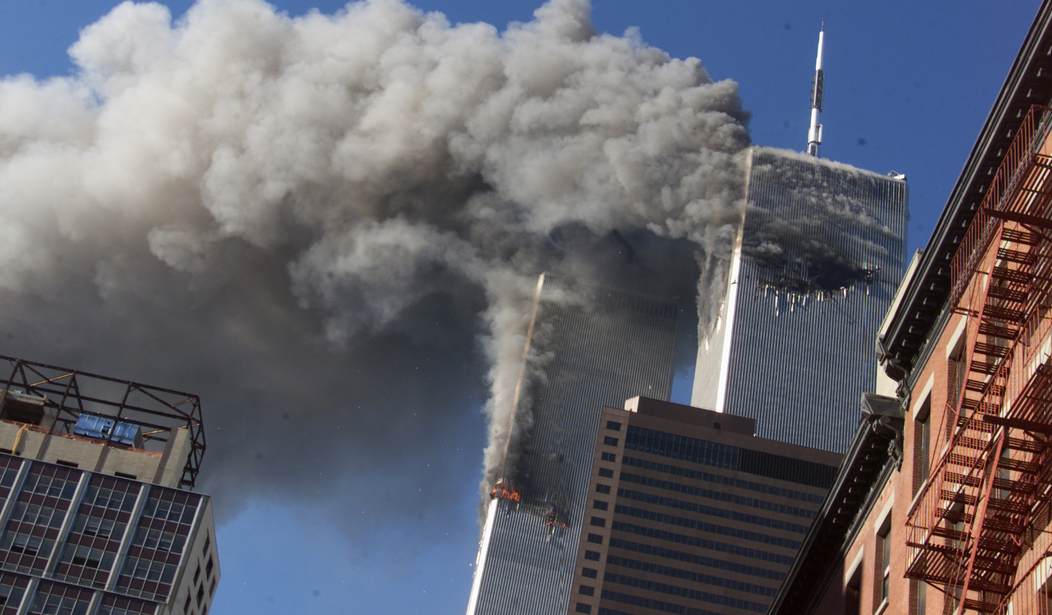
On Sept. 11, 2001, John Abruzzo was working on the 69th floor of the World Trade Center's North Tower when American Airlines Flight 11 struck.
Abruzzo was quadriplegic and used a power wheelchair. Everyone around him faced the same brutal fact: the only way out was down, and Abruzzo couldn't take the stairs.
From the 9/11 Memorial:
The World Trade Center fire warden and Port Authority of New York and New Jersey employee turned his concerns to the safety of his colleagues. Among them was John Abruzzo, a quadriplegic, who relied on a power wheelchair. Fabiano was joined by other coworkers on trying to rescue Abruzzo from the building on 9/11. They used an EVAC+CHAIR, an emergency evacuation chair. It’s designed with sled-like components, making it easier to descend stairs.
The chair was part of a security upgrade for people with disabilities after the 1993 World Trade Center bombing.
Fabiano and the coworkers lowered Abruzzo into the chair and escaped the building. Taking turns, they used the chair to carry Abruzzo down the stairwell.
They would run into firefighters on the 10th floor. The firefighters urged them to leave Abruzzo with them and they instructed them to continue their evacuation. But they refused. They didn’t want to abandon Abruzzo.
Reaching the lobby, they hauled Abruzzo in the chair, over debris and broken glass. They lifted him through a busted window and onto the sidewalk.
Soon after their escape, the building collapsed and the debris cloud chased them along West Street. They would encounter firemen who relieved them to carry Abruzzo’s chair. Abruzzo was later treated at the hospital for smoke inhalation.
Abruzzo took the EVAC+CHAIR home with him. In 2008, it was donated to the 9/11 Memorial Museum and is currently on display.
"It is an object that reminded us of the particular vulnerability of limited mobility-occupants within high-rise structures," Chief Curator Jan S. Ramirez said.
Ten Port Authority coworkers stayed. They were Michael Ambrosio, Peter Bitwinski, Phillip Caffrey, Richard Capriotti, Michael Curci, Michael Fabiano, Wilson Pacheco, Anthony Pecora, Gerald Simpkins, and Margaret Zoch.
They became known as the "Port Authority Ten."
They moved Abruzzo into a portable evacuation chair and began carrying him downward, taking turns as smoke filled the stairwells. About 50 floors into the descent, firefighters told them they could leave Abruzzo with them and save themselves.
They refused.
They kept going until they reached the lobby, carried him across debris and broken glass, and lifted him through a broken window.
They escaped only minutes before the tower collapsed.
From the 9/11 Memorial:
Detailing his evacuation from the North Tower's 69th floor on 9/11, John Abruzzo called the efforts of the colleagues who saved his life "unbelievable." With Disability Pride Month drawing to a close, we're sharing the story of his second escape from the World Trade Center.
Abruzzo is a quadriplegic who worked for the Port Authority as an associate accountant. On February 26, 1993, his evacuation took six hours - he was carried down 25 floors in his heavy electric wheelchair, finally transferring to a stretcher before making it out of the building.
More than seven years later on the morning of September 11th, Abruzzo arrived at work with his new powered wheelchair, customized to give him the most possible mobility. But the new chair was not what helped him this time.
The chair existed because America had already received a warning. During the 1993 World Trade Center bombing, Abruzzo's evacuation had taken six hours. Coworkers carried him 25 floors in his heavy electric wheelchair before moving him to a stretcher.
Afterward, the Port Authority bought evacuation chairs and improved emergency procedures. On 9/11, one of those chairs saved his life. The next morning, all ten coworkers reported to the Port Authority's provisional headquarters to help deal with the aftermath.
Twenty-five years later, their story deserves to sit beside the famous stories of firefighters charging upward. They were office workers; nobody swore them to an oath; nobody ordered them to stay. They simply looked at a man who couldn't escape without them and decided his life wouldn't become someone else's problem.
Twenty-seven floors below Abruzzo, Edward Beyea faced the same difficulty with a different ending. Beyea, 42, was quadriplegic and worked as a computer programmer. His friend and coworker Abraham Zelmanowitz, 55, stayed beside him while Beyea's aide, Irma Fuller, went downstairs to tell rescuers where they were.
FDNY Capt. William Burke eventually reached them. After the South Tower collapsed, Burke ordered his own firefighters to evacuate. He stayed with Beyea and Zelmanowitz and helped them descend from the 27th floor to the 21st. The three men never made it out. Burke was the only member of his firehouse killed that day.
An estimated 13,000 to 15,000 people escaped the Twin Towers. The evacuation study conducted afterward found preparation mattered, but so did people helping one another through the stairwells. Statistics tell us how many survived.
They can't fully explain why.
From the CDC:
On September 11, 2001, an estimated 13,000-15,000 persons successfully evacuated the two World Trade Center (WTC) towers. Because full-scale evacuations of such buildings are rare, little is known about how readily and rapidly these buildings can be evacuated and what factors serve as facilitators or barriers to the process (1). In 2002, the Mailman School of Public Health at Columbia University and CDC initiated The World Trade Center Evacuation Study, a multiyear qualitative and quantitative research study designed to assess factors that affected evacuation of the two WTC towers. This report summarizes qualitative data collected from Phase I of the study, which suggested that improved preparedness at the individual, organizational, and building environmental levels can facilitate rapid evacuation. Completion of Phase II of the study, together with other research efforts, should help workers, management, and local authorities develop and evaluate model emergency preparedness programs for high-rise occupancies.
Qualitative data for Phase I of the WTC study were collected from 56 participants during 2003, approximately 18 months after the events of September 11, 2001. Participants were self-selected into the qualitative study in response to a multimedia recruitment campaign; they consisted of 36 persons who were administered in-depth, semi-structured interviews and 20 who participated in five focus groups. The data collected helped guide development of a detailed study questionnaire for the quantitative Phase II* of the study.
The 56 participants ranged in age from 23 to 61 years; the mean and median age was 43 years. A total of 31 (55%) were male; 42 (75%) were white, seven (13%) were black, and one (2%) was Asian. Four (7%) identified themselves as of Hispanic ethnicity. A total of 37 (66%) of the participants were college graduates.
Interview scripts were designed to identify the factors that influenced both the decision-making process, as well as the actual evacuation-related behaviors. Transcripts of the taped responses were read and categorized by two reviewers, with coding themes verified by a third reviewer using a modified Q-sort methodology (2). Inter-rater reliability was high, with >95% concordance.
Individual factors. Participants cited four factors that affected their decision to begin evacuating: 1) perceived ability to walk down multiple flights of stairs (i.e., more than 80 for certain persons); 2) experience in evacuation of a WTC tower, including knowledge of stairwell locations and whether individual stairwells led to street level exits; 3) concern over leaving their work areas without the approval of executives or managers; and 4) information regarding what had occurred, what floors were involved, and how to respond. Direct evidence of the magnitude of the event (e.g., observing an aircraft strike a building, smelling fuel, or feeling a building move) caused some persons to leave immediately.
The qualitative data also suggested that, after a decision to evacuate was made, many persons stopped to attend to last-minute activities (e.g., making telephone calls, shutting down computers, or gathering up personal items). Deciding which route to take (e.g., stairs or elevators) might have delayed evacuation progress for others. Progress was reportedly slowed for some persons because of poor physical condition or inadequate footwear (e.g., high-heeled shoes or "flip-flops"). Some persons also delayed their progress to stop and assist others.
Abruzzo could. Years later, he tried to describe what those ten coworkers had done for him.
"Thanks? That's not enough for what they did."
As America marks 25 years since 9/11, we will again remember what 19 terrorists did to us; we should.
But another history was written inside those towers. It was written by people who could've kept moving toward daylight, looked back at someone who couldn't follow, and stayed.
Twenty-five years later, stories like these still deserve to be told because courage rarely announces itself in advance. It appears when somebody decides another person's life is worth the risk. Help PJ Media keep telling the stories worth remembering. Join VIP today and get 60% off with promo code FIGHT.






Join the conversation as a VIP Member