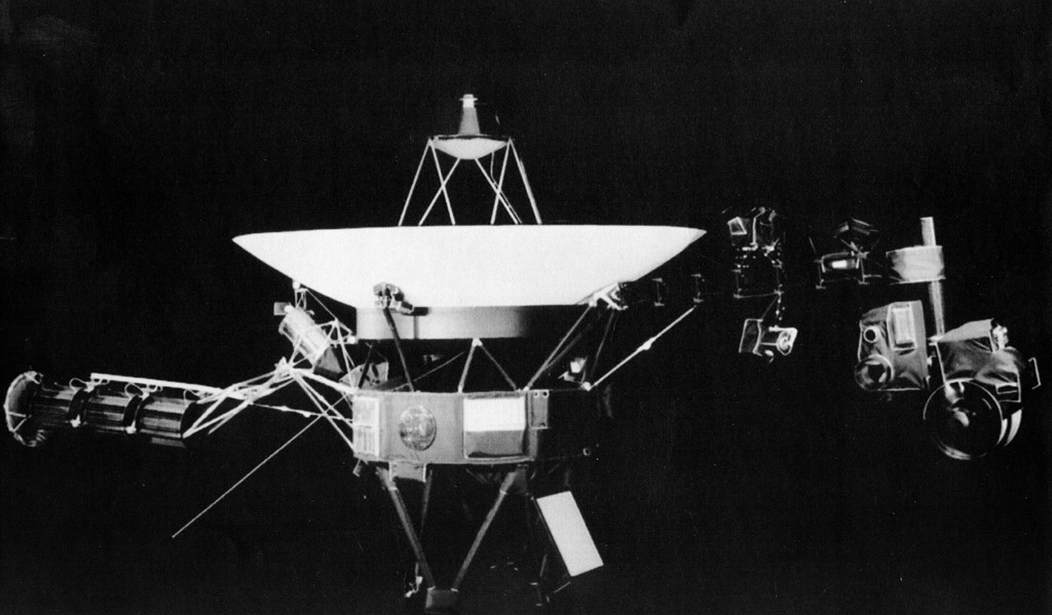
Voyager 2 was built to last five years. On Aug. 20, it turns 49, and engineers have just found a way to keep its final three science instruments operating for at least another year.
The fix sounds almost too modest for a spacecraft in interstellar space. Engineers at NASA's Jet Propulsion Laboratory turned off certain powered devices and substituted lower-power alternatives while keeping the probe warm enough to function.
They nicknamed the effort the "Big Bang."
Voyager 2's radioisotope generators lose about four watts of power each year, and the margin had become so thin that another science instrument was headed for shutdown before the end of 2026.
From Space.com:
To keep the probe running on this dwindling power supply, engineers recently reduced Voyager 2's power requirements by turning off a few non-science devices and using "lower-power alternatives" that are still effective enough to keep the spacecraft warm while it's so far from the sun, NASA officials said in a statement. "The spacecraft power margins have grown razor thin, requiring the team to conserve energy by shutting off non-essential devices and systems," NASA officials wrote of the mission, which is managed by the agency's Jet Propulsion Laboratory.
The drop in power is having a measurable science impact on both spacecraft — each has turned off two of their science instruments since 2024 alone. While some of these instruments were shut off after the spacecraft finished their historic planetary flybys decades ago, others were turned off due to power requirements.
Each spacecraft initially launched with 10 instruments, and Voyager 2 is now down to only three instruments. At first it looked as though Voyager 2 would have to shut down another of these instruments later this year, but luckily, the new power shifts will allow all three to operate "for at least another year," NASA said.
Voyager 1 will be tasked to do the same "Big Bang" power change "in the coming months." A signal to each spacecraft takes nearly 24 hours (or one light-day) to make a one-way journey, and officials noted Voyager 1 is further from Earth than its twin. (Voyager 2 is at about 142 astronomical units or sun-Earth distances, while Voyager 1 is nearing 171 AU.)
The two spacecraft initially launched to take advantage of a rare alignment between the outer solar system gas giant planets, which in order of distance from the sun are Jupiter, Saturn, Uranus and Neptune. Each Voyager spacecraft first flew past Jupiter and Saturn, taking unprecedented imagery of the planets and their moons.
Since 2024, dwindling power has forced the mission to shut down two science instruments on each Voyager probe. Voyager 2 still has three working instruments measuring cosmic rays, magnetic fields, and plasma waves. The team plans to make the same power-saving change on Voyager 1 in the coming months.
Forty-eight years is already wildly beyond the spacecraft's original assignment. Voyager 2 launched on Aug. 20, 1977, for what was designed as a five-year mission to study Jupiter and Saturn. Its primary radio receiver failed in April 1978, and the backup receiver has been doing the job ever since.
Then came Jupiter, Saturn followed, and engineers found a way to continue to Uranus and later Neptune. Voyager 2 remains the only spacecraft to ever visit those two planets. In 2018, it entered interstellar space, carrying its mission far beyond anything its builders could've promised in 1977.
There's something deeply American in the story. Voyager came from an era that had plenty of national problems, but the country still knew how to build for failure, leaving room for improvisation, and trusted skilled engineers to solve problems nobody could fully predict decades in advance.
Voyager's lesson is narrower and more useful than nostalgia. Durability comes from choices; redundancy has value; so does documentation and testing.
Another thing of significant value is preserving enough technical knowledge that, almost half a century later, a new generation can still understand an old machine well enough to coax another year from it.
The mission has also shown discipline; engineers have shut down systems as power faded instead of pretending every component could remain active forever.
From NASA:
Through the turn of the century, NASA's Jet Propulsion Laboratory (JPL) continued to receive ultraviolet and particle fields data. For example, on Jan. 12, 2001, an immense shock wave that had blasted out of the outer heliosphere on July 14, 2000, finally reached Voyager 2. During its six-month journey, the shock wave had plowed through the solar wind, sweeping up and accelerating charged particles. The spacecraft provided important information on high-energy shock-energized ions.
On Aug. 30, 2007, Voyager 2 passed the termination shock and then entered the heliosheath. By Nov. 5, 2017, the spacecraft was 116.167 AU (about 10.8 billion miles or about 17.378 billion kilometers) from Earth, moving at a velocity of 9.6 miles per second (15.4 kilometers per second) relative to the Sun, heading in the direction of the constellation Telescopium. At this velocity, it would take about 19,390 years to traverse a single light-year.
On July 8, 2019, Voyager 2 successfully fired up its trajectory correction maneuver thrusters and will be using them to control the pointing of the spacecraft for the foreseeable future. Voyager 2 last used those thrusters during its encounter with Neptune in 1989.
The spacecraft's aging attitude control thrusters have been experiencing degradation that required them to fire an increasing and untenable number of pulses to keep the spacecraft's antenna pointed at Earth. Voyager 1 had switched to its trajectory correction maneuver thrusters for the same reason in January 2018.
To ensure that both vintage robots continue to return the best scientific data possible from the frontiers of space, mission engineers are implementing a new plan to manage them. The plan involves making difficult choices, particularly about instruments and thrusters.
They kept the productive core alive, made trade-offs, and adjusted as conditions changed. Nearly 49 years after launch, Voyager 2 is still doing useful science because somebody kept asking what could be saved without sacrificing the mission.
More shutdowns will come. The physics guarantees an ending, and no clever engineering can repeal radioactive decay.
From NASA:
The Voyagers get their power from radioisotope thermoelectric generators, devices that convert heat from decaying plutonium into electricity. Due to the plutonium supply continually depleting, both probes lose about 4 watts of power each year. After almost a half-century since launch, the spacecraft power margins have grown razor thin, requiring the team to conserve energy by shutting off non-essential devices and systems.
Since 2024, the dwindling power supply has forced the mission to turn off two science instruments on each of the Voyager spacecraft (each spacecraft has 10 instruments; others had been turned off previously because they were only used for the mission’s planetary encounters). Without the Big Bang activity, the mission would have had to turn off another instrument on Voyager 2 before the end of 2026. The savings should provide power to keep its three instruments operating for at least an extra year.
The mission team plans to perform the same swap on Voyager 1, which is farther from Earth than Voyager 2, and to complete the effort in the coming months.
But there is a kind of dignity in refusing to waste a useful year simply because the machine is old.
The probe has survived presidents, recessions, wars, technological revolutions, and nearly five decades of arguments over what America can still accomplish.
Through it all, Voyager 2 kept moving outward.
Someday its transmitter will fall silent, and when it does, the mission won't look like a failure that lasted too long. It will look like one of those rare achievements that outgrew every reasonable expectation placed upon it.
For now, a spacecraft built in 1977 is still sending science home from interstellar space because America kept finding one more way to make it work. That may be the finest message Voyager 2 has sent us yet.