


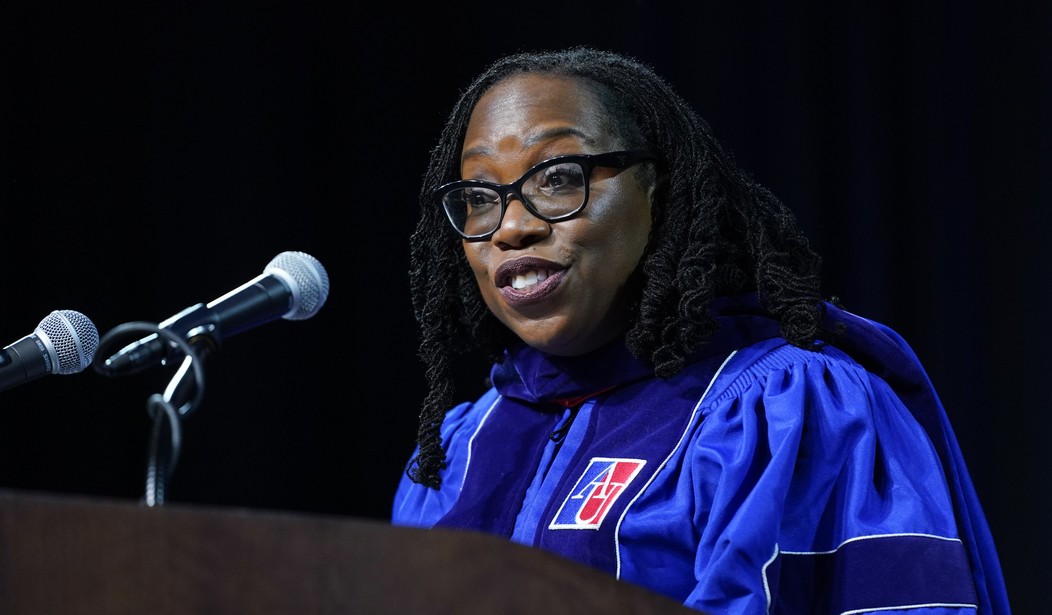
Associate Justice Ketanji Brown Jackson chose a remarkable place to explain judicial neutrality: a podcast hosted by former First Lady Michelle Obama and produced by the media company founded by Michelle and former President Barack Hussein Obama.
Jackson said judges must be "very, very mindful and scrupulous" about impartiality. She explained that invitations are screened to avoid ethical conflicts and even the appearance of bias.
During an appearance of more than an hour appearance on the podcast, Jackson, a Biden appointee to the Supreme Court, stressed the importance of being unbiased, saying, "You really have to be focused on that."
"There are lots of limits on what judges can do, and I try to be very, very mindful and scrupulous with respect to that because, as you say, our obligation is to be unbiased in our approach," said Jackson. "And so, you have to then navigate all the sources that could make for an appearance of partiality, which you want to avoid."
She added that "there are lots of things that I end up not accepting for that reason."
The former first lady asked Jackson about the practices she follows to remain unbiased.
"You also have to watch your exposure to things, so that there isn’t a bias," said Obama. "What does that mean for you in terms of reading the paper and listening to the news and how do get your information and what do you have to be careful about and how are you dealing with the potential conflicts so that you do stay above board?"
Her words sounded careful, while her surroundings told a different story.
A Supreme Court justice discussing neutrality on an Obama production is like a referee lecturing fans about fairness from inside one team's locker room.
The referee may swear the game will be called straight, but everyone watching still has reason to question why he picked that room.
The Court's code of conduct doesn't merely forbid direct political control. It tells justices to avoid impropriety and its appearance, promote confidence in judicial impartiality, and reject outside activities that reflect poorly on their neutrality.
Jackson signed the code with the other eight justices.
Her podcast visit may not violate a formal rule. The poorer judgment lies in selecting a partisan cultural setting while preaching caution about appearances.
Michelle Obama has every right to run a podcast, promote her views, and welcome guests.
Jackson carries a different burden because she holds life tenure on the nation's highest court.
The problem began before Jackson joined the Court. Former President Joe "Brain Cloud" Biden promised during the 2020 presidential campaign that his first Supreme Court selection would be a black woman.
He announced the race and sex requirements before choosing the nominee and deliberately restricted the pool before comparing candidates.
Calling the process merit-based alone requires forgetting his words, something the country has learned was a normal situation with Biden.
Jackson's performance since her 2022 confirmation has not quieted doubts about her judgment. In Trump v. CASA, Associate Justice Amy Coney Barrett wrote that Jackson's position conflicted with more than 200 years of precedent and "the Constitution itself."
Barrett added that Jackson condemned an imperial executive while embracing an imperial judiciary.
Associate Justice Samuel Alito delivered another rebuke in May. After Jackson accused the Court of letting principle give way to power in a Louisiana election case, Alito called the charge "groundless and utterly irresponsible."
The second reason offered by the dissent is that we should allow the 32-day period to run out in order to “avoid the appearance of partiality.” Post, at 3 (opinion of JACKSON, J.). But the dissent does not explain why its insistence on unthinking compliance with Rule 45.3’s default rule does not create the appearance of partiality (by running out the clock) on behalf of those who may find it politically advantageous to have the election occur under the unconstitutional map.
The dissent goes on to claim that our decision represents an unprincipled use of power. See post, at 4 (“And just like that, those principles give way to power”). That is a groundless and utterly irresponsible charge. What principle has the Court violated? The principle that Rule 45.3’s 32-day default period should never be shortened even when there is good reason to do so? The principle that we should never take any action that might unjustifiably be criticized as partisan?
He wrote that her rhetoric lacked restraint. Such criticism from colleagues reaches beyond ordinary disagreement over a close legal question.
Jackson has also leaned into the public spotlight through a memoir tour, entertainment appearances, and a magazine cover calling her "the people's champion."
Justice Ketanji Brown Jackson appeared on the cover of the most recent issue of Essence magazine, spurring critics to argue that she is seeking publicity in ways that are inappropriate for a member of the Supreme Court.
"Supreme Court Justices are not celebrities and should not be treated like celebrities," Andrew Fleischman, a Georgia trial and appeal lawyer, wrote of the cover.
The magazine’s cover features a picture of Jackson wearing a purple coat and smiling directly at the reader. Underneath Jackson’s photo is a caption that reads "the people’s champion."
Essence magazine describes itself as the "premiere lifestyle, fashion and beauty magazine for African-American women."
"As America celebrates its 250th birthday, ESSENCE is honored to unveil the first magazine cover of Supreme Court Justice Ketanji Brown Jackson’s historic career," Essence tweeted on the 4th of July, accompanied by a photo of the cover.
"As the first Black woman to serve on the nation’s highest court, there is no better moment to celebrate her extraordinary legacy. Ketanji Brown Jackson represents the American Dream and serves as a powerful voice for those simply seeking the God-given birthrights promised to every American," the tweet continued.
Supreme Court justices aren't elected champions; their duty is to the Constitution, statutes, precedent, and the cases properly before them.
No one needs to claim that a podcast appearance automatically decides Jackson's vote in a future case. Her standard focused on appearances. She said judges must avoid settings that could create an impression of partiality, then sat beneath the banner of one of America's most powerful Democratic families.
Jackson wants the country to trust her promise of impartiality. Trust grows when conduct supports the promise. On Michelle Obama's set, the picture defeated the words.
And that picture is a DEI hire for the most important court in America.
The people shaping our courts and government count on Americans forgetting what they said yesterday. PJ Media VIP helps keep the record straight. Join today and receive 60% off with promo code FIGHT.




Join the conversation as a VIP Member