







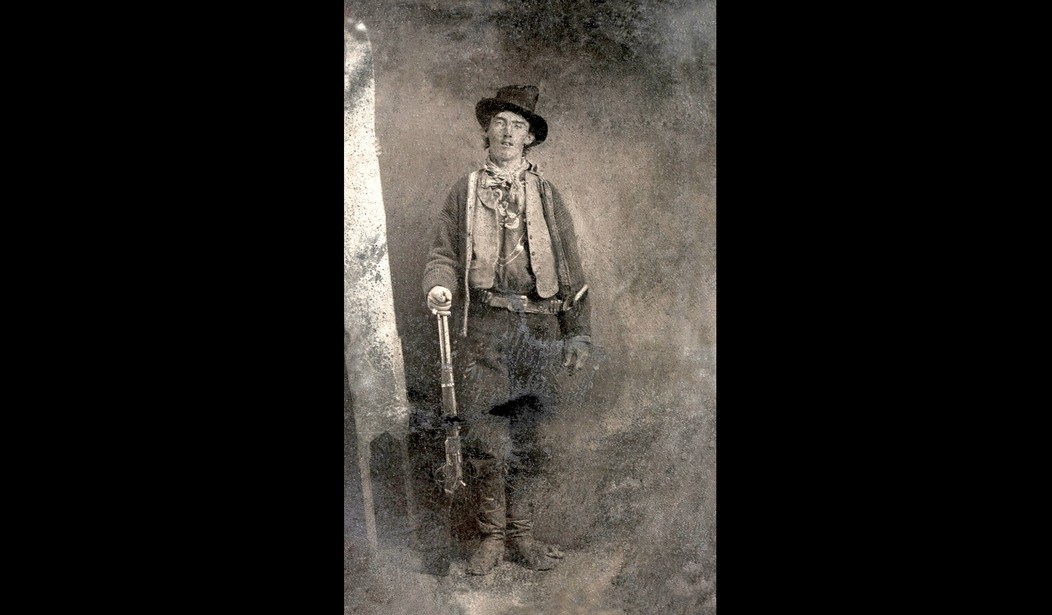
Over the weekend, I watched the movie Old Henry, and it brought me back to the movie Young Guns. That's a horrible segue, sorry, but I would rather not give away the aha! moment in Old Henry, in case somebody hasn't watched it.
Those connecting thoughts lead me to remember one of the more enjoyable conspiracy theories in history: did Pat Garrett really kill Billy the Kid that night 145 years ago?
At about 12:30 a.m. on July 14, 1881, a barefoot young outlaw stepped into Pete Maxwell's dark bedroom at Fort Sumner in New Mexico Territory, carrying a pistol and a butcher knife.
Lincoln County Sheriff Pat Garrett, sitting near Maxwell's bed, recognized the voice asking in Spanish who was there. Garrett fired twice, and Henry McCarty, better known as William Bonney and Billy the Kid, fell dead at 21.
Billy had already turned escape into a habit. He fled a Silver City jail as a teenager, slipped away from custody after bargaining with territorial Gov. Lew Wallace, and broke out of the Lincoln County courthouse on April 28, 1881, after killing deputies James Bell and Robert Olinger.
Garrett's bullet supposedly ended the final escape less than three months later.
His death lacked the grand showdown later movies would demand. Billy was hungry; Garrett was questioning Maxwell in darkness, and both men were armed.
Garrett later said he fired twice after Maxwell identified Billy's voice. One bullet struck the outlaw near the heart, ending a life built around violence in seconds. From History.com:
That night, Garrett wrote, he and two deputies, John W. Poe and Thomas McKinney, went to the ranch where Maxwell lived. A short distance from the property, Poe spotted an acquaintance who was camped out, and the lawmen dismounted and stopped to have coffee with him before heading on foot through an orchard to the house. Then they heard voices in Spanish—a language that Billy the Kid spoke as well as English and the Gaelic of his parents’ native country, Ireland.
The three men concealed themselves, as a man in a broad-brimmed hat, a dark vest, shirt and pants walked past them. Though they didn’t realize it, the man was Billy the Kid, who was headed for the house with the intention of carving for himself a piece of beef.
Leaving the two deputies on the porch, Garrett slipped into the darkened house and quickly found the room where Maxwell was in bed. Garrett began questioning him, and Maxwell admitted that the outlaw had been around, though he wasn’t sure where he was at the moment. Just then, a figure appeared in the door, carrying a gun and a butcher knife, and asked in Spanish who was there.
“Who is it, Pete?” Garrett whispered to Maxwell.
“That’s him,” Maxwell responded.
Billy the Kid realized that someone besides Maxwell was there in the darkness, and raised his pistol within a foot of Garrett’s chest. “Who’s that?” he asked, in Spanish.
Garrett quickly drew his revolver and fired two shots. The first shot hit Kid in the chest. “He never spoke,” Garrett recalled. “A struggle or two, a little strangling sound as he gasped for breath, and The Kid was with his many victims.”
When Garrett and the deputies examined Billy the Kid’s gun, they found that he had five cartridges and one shell in the chamber, with the hammer resting on it. If he hadn’t hesitated, Garrett might have been the one lying dead on the floor.
“It was the first time, during all his life of peril, that he ever lost his presence of mind, or failed to shoot first,” Garrett wrote.
The accepted account carries weaknesses. Garrett's 1882 book contained errors and exaggerations about Billy's earlier life. The room offered poor visibility, and later debate leaned heavily on Garrett's own account.
The original grave locations became harder to prove after a 1904 flood washed away cemetery markers. When three surviving pallbearers later tried to identify Billy's plot, they selected three different graves. From the Fort Sumner site:
Legendary outlaw Billy the Kid was killed by Sheriff Pat Garrett and buried in Fort Sumner. Billy the Kid, also known as Henry McCarty, Henry Antrim and William H. Bonney was a 19th century American frontier outlaw and gunman who participated in the Lincoln County War. According to legend, he killed 21 men.
McCarty (or Bonney, the name he used at the height of his notoriety) was 5 ft. 8 in. to 5 ft. 9 in. tall with blue eyes, a smooth complexion, and prominent front
teeth. He was said to be friendly and personable at times. Relatively unknown during most of his lifetime, Billy was catapulted into legend a few months before his death by New Mexico’s governor, Lew Wallace, who placed a price on his head.
Sheriff Pat Garrett shot and killed Billy the Kid July 14, 1881. Billy was buried the next day in Fort Sumner’s old military cemetery, between his fallen companions Tom O’Folliard and Charlie Bowdre. A single tombstone was later erected over the graves with a one word epitaph of “Pals” carved into it.
The tombstone has been stolen and recovered three times since it was set in place in the 1940s, and the entire gravesite is now enclosed within a steel cage. Following his execution by Lincoln County sheriff Pat Garrett, several biographies were written that depicted the Kid as either a vicious outlaw or a nineteenth-century Robin Hood.
Those gaps opened the door for survival stories, but the evidence still weighs heavily toward death. Garrett arrived with Jon Poe and Thomas McKinney; Fort Sumner residents viewed the body before burial; and Garrett wrote that a coroner's jury identified Billy and ruled the shooting justified.
The body was buried beside Tom O'Folliard and Charlie Bowdre, and no verified record places Billy alive after July 14, 1881.
Two later claimants kept the legend moving. John Miller, a farmer and horse trainer, died in 1937, with supporters pointing to his appearance, personal stories, and a pistol reportedly marked with 21 notches.
The notches prove little because the claim that Billy killed 21 men was itself a frontier legend rather than an established fact. This, of course, lends credence to the rule established in the movie The Man Who Shot Liberty Valance.
Ollie “Brushy Bill” Roberts made the louder claim. In 1950, he asked New Mexico Gov. Thomas Mabry for the pardon Billy believed Lew Wallace had promised in 1879. Roberts knew pieces of the Lincoln County story and carried old scars, but he produced no conclusive proof. Mabry rejected the request, and Roberts died later that year.
Modern DNA testing sounds like an answer, but the missing grave location blocks a clean comparison; researchers can't be certain which remains belong to Billy. Exhumation efforts involving his mother's grave also ran into legal and identification problems, leaving the physical evidence beyond reach.
Billy the Kid almost certainly died in Pete Maxwell's bedroom 145 years ago today. The survival theories remain because he died young, official records were thin, and his real life already included escapes that seemed impossible.
Garrett ended the man, but uncertainty kept Billy Bonney riding through American memory.
What do you think? Did Billy die in 1881, 1937, or 1950?
The stories Americans inherit are often more complicated than the versions taught in school. Support independent commentary that follows the evidence wherever it leads. Join PJ Media VIP today and save 60% with promo code FIGHT.


Join the Conversation
VIP members get the ability to comment on articles.