







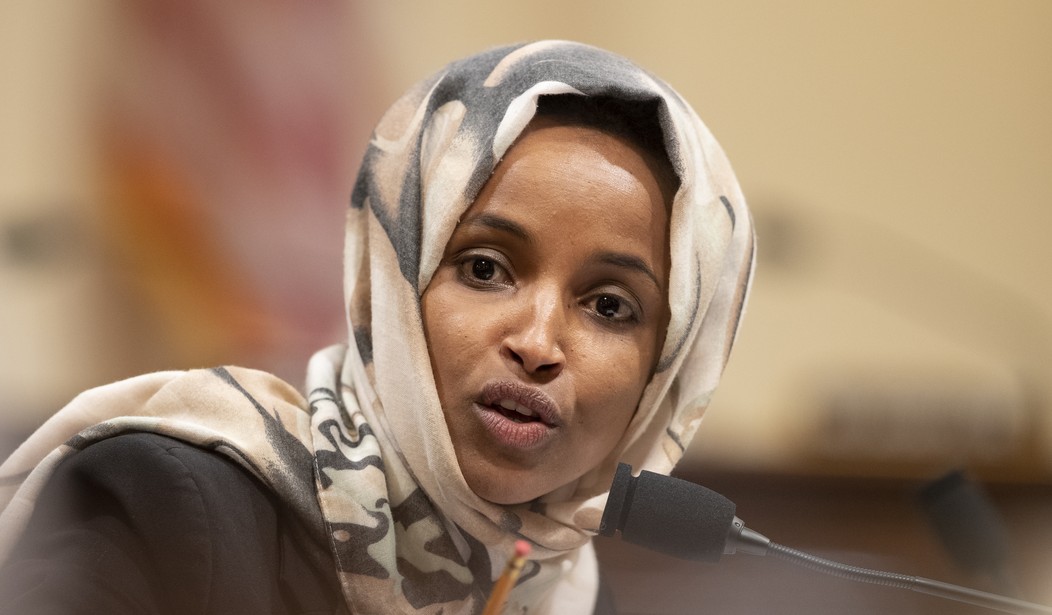
Rep. Ilhan Omar (D-Minn.) just gave President Donald Trump's national security team one more reason to keep its guard up.
Omar introduced a package of amendments to the FY2027 National Defense Authorization Act. One would repeal the Alien Enemies Act, while another says a foreign terrorist organization designation doesn't authorize military force against that group.
Omar's office sold the amendments as human rights measures, congressional oversight, and restraint in foreign policy.
Fine words hide hard consequences; her Amendment #1273 doesn't name al-Shabaab, Hamas, ISIS, or al-Qaeda. It would still directly speak to the legal and political fight over whether the commander in chief can use force against designated terrorist groups without waiting for Congress to bless each strike.
The hard part is motive; we can't prove Omar is trying to protect terrorists, but we should ask why she keeps choosing policies that would limit America's reach against the kind of groups that kill Americans and threaten our allies.
Somalian-born, fleeing a country in civil war, Omar's story is part of her public biography, and it also makes her repeated focus on U.S. power in East Africa harder to ignore.
Al-Shabaab isn't a distant academic example; it's a Somalia-based Sunni Islamic terrorist group that pledged loyalty to al-Qaeda in 2012. It seeks to overthrow Somalia's federal government, expel foreign forces, and build a fundamentalist Islamic state. From the Counterterrorism Guide:
Al-Shabaab targets US and other foreign military forces, including African Union Mission personnel, Somali Government and security forces, and civilian targets, such as hotels, shopping malls, universities, and busy intersections. The group has carried out mass-casualty attacks in Kenya, Somalia, and Uganda. Al-Shabaab’s complex attacks generally consist of an IED or VBIED detonation, followed by small-arms fire. The group also conducts ambushes, military-style assaults, kidnappings, mortar attacks, and assassinations in Mogadishu, such as an attempted assassination in March 2025 of Somali President Hassan Sheikh Mohamud.
TERRORIST GROUP DESIGNATION
The US State Department designated al-Shabaab as a foreign terrorist organization in March 2008. Many of the group’s senior leaders and officials—including explosives experts, operations plotters, and Kenya-based cell leaders—are Specially Designated Global Terrorists.
The National Counterterrorism Center says al-Shabaab has killed more U.S. citizens since 2014 than any other al-Qaeda affiliate, and the State Department designated it a foreign terrorist organization in 2008.
U.S. forces still strike al-Shabaab targets in Somalia. U.S. Africa Command announced another strike in coordination with Somalia's federal government after targeting al-Shabaab on July 5.
So when Omar moves to narrow what a foreign terrorist organization label can mean, the practical effect isn't theoretical. It reaches into places where American forces are still trying to keep terrorist networks from growing stronger.
President Trump has also used the Alien Enemies Act during his second term in connection with suspected Tren de Aragua members. The left argues the 1798 law gives presidents too much wartime power over detention and deportation.
What the left doesn't want acknowledged is that it gives the commander-in-chief a needed tool when foreign threats cross into American life through gangs, cartels, and hostile networks.
Omar wants the tool gone.
Omar's record fits a broader pattern; her NDAA package also includes repealing the War Reserve Stockpile Authority for Israel, which supports rapid military resupply in a region where Israel faces Hamas, Hezbollah, and other Iranian-backed threats.
Again, each piece gets wrapped in oversight language. The result still points in the same direction: less room for America and its allies to act, and more room for hostile actors to survive the first blow.
A country has a right to ask these questions without apology. When a member of Congress tries to weaken tools used against terrorist groups, voters are allowed to wonder who benefits. When that member has a long public history tied to Somalia, and one of the most dangerous terrorist groups in the world is based there, the question grows a sharper point.
Republicans shouldn't let Omar hide behind process; bring her amendments into the daylight, and make Democrats explain why they want to make it harder for President Trump to act against terrorist groups.
If they believe Congress should approve every use of force, let them defend that position to the families of troops, diplomats, and people who live with the consequences when America moves too slowly.
Support fearless conservative journalism. Join PJ Media VIP today and get 60% off with promo code FIGHT.
Join the Conversation
VIP members get the ability to comment on articles.