


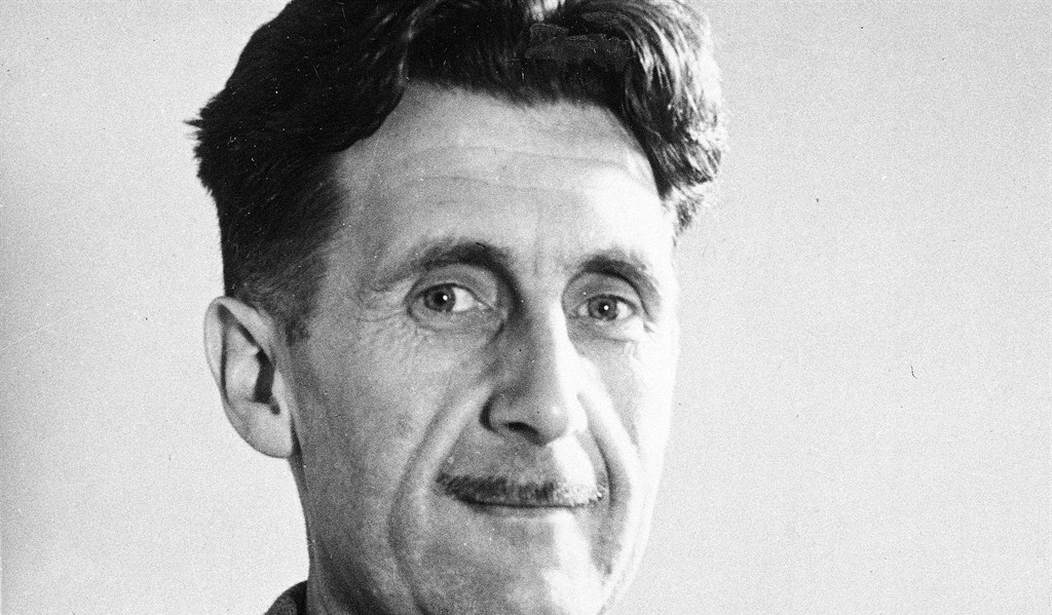
George Orwell's final novel reached readers on June 8, 1949, which makes today, Monday, the 77th anniversary of 1984. Orwell wrote much of the book while fighting advanced tuberculosis on the cold, lonely isle of Jura off Scotland.
He didn't write from comfort; he wrote from a body breaking down and a mind still sharp enough to see how modern power could crush the individual soul.
Orwell's real name was Eric Arthur Blair, but the world knows the pen name because the warning outlived the man. He had seen the Spanish Civil War up close, where fascists and communists both showed how fast noble words become weapons.
In his 1946 essay, "Why I Write," Orwell said his serious work after 1936 was written against totalitarianism and for democratic socialism as he understood it. Conservatives don't need to share his economics to respect the deeper point: Orwell hated systems that told people what they were allowed to see, say, remember, and believe.
What I have most wanted to do throughout the past ten years is to make political writing into an art. My starting point is always a feeling of partisanship, a sense of injustice. When I sit down to write a book, I do not say to myself, ‘I am going to produce a work of art’. I write it because there is some lie that I want to expose, some fact to which I want to draw attention, and my initial concern is to get a hearing. But I could not do the work of writing a book, or even a long magazine article, if it were not also an aesthetic experience. Anyone who cares to examine my work will see that even when it is downright propaganda it contains much that a full-time politician would consider irrelevant. I am not able, and do not want, completely to abandon the world view that I acquired in childhood. So long as I remain alive and well I shall continue to feel strongly about prose style, to love the surface of the earth, and to take a pleasure in solid objects and scraps of useless information. It is no use trying to suppress that side of myself. The job is to reconcile my ingrained likes and dislikes with the essentially public, non-individual activities that this age forces on all of us.
Postwar Europe helped shape the book's darkness. The Soviet Union tightened its grip over Eastern Europe; the atomic age had arrived; the Tehran Conference had shown how great powers could divide the world into zones of influence. History Extra provides a snapshot of the world that provided Orwell his material:
On 21 August 1936, a minor Bolshevik official named ES Holtzman told a Russian court that he had been involved in a Trotskyist plot against Stalin. Holtzman was a defendant in the first major show trial of the period known as the Great Purge, during which hundreds of thousands of Soviet citizens were consigned to prisons, labour camps and execution chambers. Holtzman testified that in 1932 he had travelled to Copenhagen to rendezvous with Trotsky’s son, Lev Sedov, at the Hotel Bristol. His evidence helped to convict himself and the other alleged plotters, all of whom were promptly shot.
A few days after the trial, however, a Danish newspaper pointed out the significant fact that the Hotel Bristol had been demolished in 1917. Evidence later emerged that Lev Sedov had been in Berlin on the day he was meant to have been in Copenhagen. Holtzmann’s ‘confession’ could not have been true.
The point of the trial was to prove the existence of an international Trotskyist conspiracy as a pretext for purging the Communist Party of anybody who might possibly challenge Stalin’s rule. The problem for Stalin’s secret police, the NKVD, was that not a shred of incriminating correspondence existed, so all the ‘evidence’ had to come in the form of forced and scripted confessions of face-to-face meetings. The Hotel Bristol error laid bare the fraudulence of these damning testimonies. “What the devil did you need a hotel for?” an embarrassed Stalin berated the NKVD officers who had fabricated the confession. “You ought to have said that they met at the railway station. The railway station is always there!” When the official book of the trial was translated into English, the passage about the hotel was deleted.
Orwell also wrestled with James Burnham's theory of a new managerial ruling class, one less interested in old crowns than in permanent control through bureaucracy, war, and organized fear.
Early readers knew they had been handed something grim and powerful. The first reviews described a frightening book, but also one built with force, speed, and moral anger. Literary Hub shared several reviews of Orwell's book. Here's what V.S. Pritchett, writing at The New Statesman, wrote on June 18, 1949:
“Nineteen Eighty-Four goes through the reader like an east wind, cracking the skin, opening the sores; hope has died in Mr Orwell’s wintry mind, and only pain is known. I do not think I have ever read a novel more frightening and depressing; and yet, such are the originality, the suspense, the speed of writing and withering indignation that it is impossible to put down. The faults of Orwell as a writer—monotony, nagging, the lonely schoolboy shambling down the one dispiriting track—are transformed now he rises to a large subject.
…
“These wars are mainly fought far from the great cities and their objects are to use up the excessive productiveness of the machine, and yet to get control of rare raw materials or cheap native labour. It also enables the new governing class, who are modelled on the Stalinists, to keep down the standard of living and nullify the intelligence of the masses whom they no longer pretend to have liberated. The collective oligarchy can operate securely only on a war footing. It is with this moral corruption of absolute power that Mr Orwell’s novel is concerned.
…
“In the homes of Party members a tele-screen is fitted, from which canned propaganda continually pours, and on which the pictures of Big Brother, the leader…Also by this device the Thought Police, on endless watch for Thought Crime, can observe the people night and day. What precisely Thought Crime is no one knows; but in general it is the tendency to conceive a private life secret from the State. A frown, a smile, a sigh may betray the citizen, who has forgotten, for the moment, the art of ‘reality control’ or, in Newspeak, the official language, ‘doublethink.’
…
“The duty of the satirist is to go one worse than reality; and it might be objected that Mr Orwell is too literal, that he is too oppressed by what he sees, to exceed it. In one or two incidents where he does exceed, notably in the torture scenes, he is merely melodramatic: he introduces those rather grotesque machines which used to appear in terror stories for boys. But mental terrorism is his real subject.
…
“For Mr Orwell, the most honest writer alive, hypocrisy is too dreadful for laughter: it feeds his despair.
Though the indignation of Nineteen Eighty-Four is singeing, the book does suffer from a division of purpose. Is it an account of present hysteria, is it a satire on propaganda, or a world that sees itself entirely in inhuman terms? Is Mr Orwell saying, not that there is no hope, but that there is no hope for man in the political conception of man?”
77 years later, conservatives look at 2026 America and hear the old alarm again. Big Brother doesn't need a telescreen on every wall when phones, apps, platforms, data brokers, and federal surveillance authorities already sit in the bloodstream of daily life.
Section 702 of the Foreign Intelligence Surveillance Act remains one of the sharpest fights in Washington because it allows warrantless surveillance aimed at foreigners overseas while raising concerns about Americans' private communications.
The temporary appointment of Bill Pulte as acting director of national intelligence by President Donald Trump has pushed the surveillance fight back into the center of politics.
Orwell understood the power of language before the age of content moderation and algorithmic reach, while Newspeak worked because it narrowed thought by narrowing words.
Today's version often arrives softer, dressed in institutional language about safety, equity, harm, and trust. Some of those words can carry good aims, but they also become dangerous when officials, schools, corporations, or platforms use them to punish plain speech and herd people toward approved conclusions.
Orwell's warning wasn't aimed only at one party, one country, or one century. He warned against the old human hunger to rule other minds. Conservatives in 2026 should read him with clear eyes, not as prophecy fulfilled in every detail, but as a hard lesson in how liberty fades when people grow tired, frightened, distracted, or too comfortable with power used against opponents.
Freedom needs witnesses—people willing to say what they see, remember what happened, and refuse the daily invitation to trade truth for peace and liberty for management. Orwell died less than a year after 1984 appeared. His body gave out, but his warning kept walking.
Seventy-seven years later, it still hasn't run out of road.
Want more columns that cut through the approved narrative and speak plainly? Join PJ Media VIP and use promo code FIGHT to get 60% off your subscription.




Join the conversation as a VIP Member