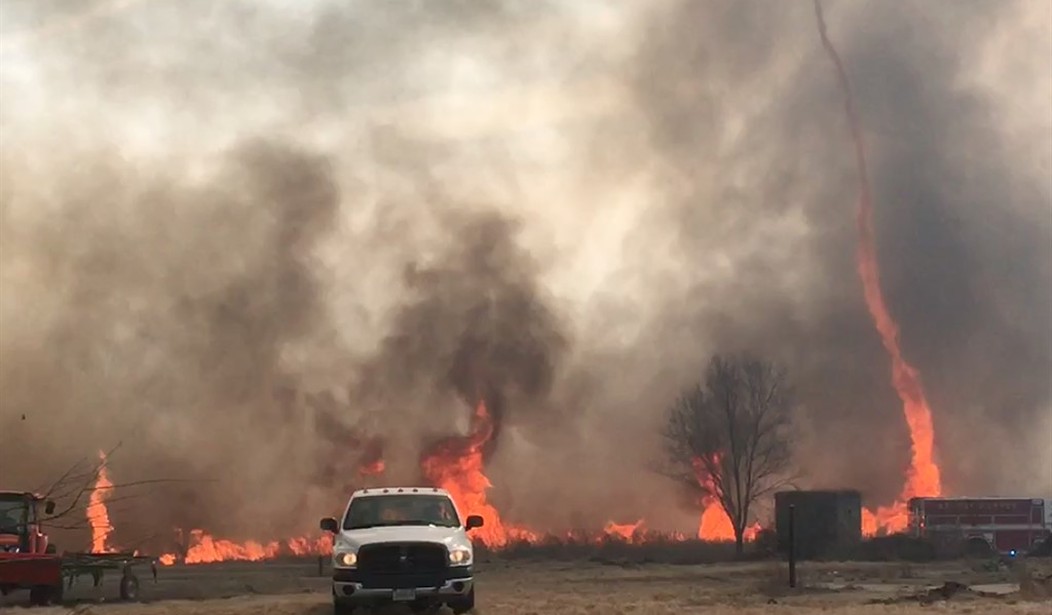

Scientists may have found one of the strangest tools yet for cleaning oil spills: a controlled fire tornado.
Elaine Oran, professor of aerospace engineering at Texas A&M University, leads a research effort that uses fire whirl to burn crude oil faster and cleaner than standard open-pool fires. Michael Gollner, mechanical engineering professor at the University of California, Berkeley, and member of the UC Berkeley Fire Research Lab, worked on the project with Oran. Qingsheng Wang, professor in the Artie McFerrin Department of Chemical Engineering at Texas A&M University, also contributed to the work.
The idea sounds wild until the numbers show up.
The results give cleanup crews a reason to pay attention. Fire whirls burned crude oil nearly twice as fast as standard pool fires. Some tests consumed up to 95% of the oil, and soot emissions dropped around 40%.
For me, the coolest part of this story is the bourbon cameo. From Prevention Web:
Some are looking to flaming twisters. It’s been more than a decade since Michael Gollner and his colleagues first watched a viral YouTube video of a fire tornado fueled by Jim Beam bourbon.
A warehouse in Kentucky had just been struck by lightning, funneling almost a million gallons of the flammable spirit into a nearby retention pond. As the flames whipped across the surface of the water, however, something in the atmospheric stars aligned: the flames coalesced into a towering fire whirl, more commonly known as a fire tornado. “We saw that and went, ‘Wow, that would be a neat application’” for cleaning up oil spills, said Gollner, a mechanical engineering professor at the University of California, Berkeley Fire Research Lab. “I wonder if we could do that on purpose.” They could, in fact. As Gollner and his collaborators recently reported in Fuel, fire whirls offer the potential to clean up oil spills more quickly and cleanly than existing methods.
Those are important factors to consider, because smoke and leftover residue often create a second environmental problem after the spill itself. Crews already fight oil with skimmers, dispersants, booms, and controlled burns. Each method helps, but none works perfectly. A hotter, cleaner burn could give responders another option before oil reaches birds, fish, wetlands, beaches, and coastal communities.
Oran described the work as the first serious attempt to use fire whirls for oil spill remediation. Her team saw a natural disaster behavior and asked whether engineers could bend it into a useful tool. From Texas A&M:
“This the first time anyone has conceived using fire whirls for oil spill remediation, and it’s really just the beginning,” said Dr. Oran, who is an aerospace engineer. “Our goal is to harness the chaotic nature of fire whirls as a powerful, precise restoration tool."
There are limits, though. In deeper pools of fuel, the fire caused the underlying water to boil, resulting in water vapor that extinguished the fire early, the team found. The impact of high or gusty wind conditions was not assessed, so for now, the findings have more relevance for calm conditions. And as a practical matter, the mechanics of inducing a vortex and creating a fire whirl on the water are not yet clear.
"The experimental setup, involving three walls to generate fire whirls, is not directly applicable to open ocean environments where large oil spills typically occur. Future research should explore applicable methods for inducing fire whirls in open water conditions, possibly through the use of mobile or deployable structures, or by leveraging natural atmospheric conditions fitting for fire whirl formation," the team concluded.
Wildlife crews fear fire whirls, because spinning flames can move fast, leap barriers, and intensify without warning. From Texas A&M:
Once ignited, it creates an ‘in-situ’ fire pool that stops the oil from spreading and poisoning marine ecosystems — but it comes at a heavy cost. Thick, black smoke billows into the sky, toxic soot enters the atmosphere and a layer of unburned sludge is left behind on the ocean’s surface.
Now, in a first-of-its-kind, large-scale experiment, researchers have developed a cleaner, faster solution to cleaning oil spills: massive fire whirls, or tornado-like flames that spin upward instead of spreading outward.
The result of this surprising twist? The spinning vortex acts like a natural turbocharger, sucking in oxygen and creating a flame that burns hotter, faster and far more efficiently than fire pools.
Even more striking, the fire whirl produced 40 percent less soot and consumed up to 95 percent of the fuel, leaving far fewer harmful particles and toxic residues behind.
The work, supported by the Bureau of Safety and Environmental Enforcement (BSEE), is led by Dr. Elaine Oran and Dr. Qingsheng Wang of Texas A&M University, and Dr. Michael Gollner of the University of California, Berkeley.
“This the first time anyone has conceived using fire whirls for oil spill remediation, and it’s really just the beginning,” said Oran, professor of aerospace engineering in the College of Engineering. “Our goal is to harness the chaotic nature of fire whirls as a powerful, precise restoration tool, to protect coastlines, marine ecosystems and the environment as a whole.”
Let me write that again: a controlled fire tornado. What could go wrong?
Researchers aim to control the same physics inside a designed structure. The concept takes a feared force and puts it under rules, walls, measurements, and safety limits.
The idea still has work ahead; a training field offers more control than open water. Real spills bring wind, waves, changing slick thickness, saltwater, bad weather, and moving currents. Engineers would need portable generators or barriers that ships could carry and deploy fast. The equipment would have to create the right airflow without letting the flame escape control. A tool that works beautifully on land still has to prove itself in the rough, messy world where spills actually happen.
Oil spills remain a stubborn threat because speed decides so much. Tanker accidents, pipeline failures, offshore drilling incidents, and ship collisions can push crude across open water before crews can contain it. Chemical dispersants break oil into smaller droplets, but they can raise new concerns. Skimmers need time and workable seas. Open burns can leave ugly smoke and tar-like residue. Fire whirls could shrink the cleanup window by burning more oil at the surface before the slick spreads into harder terrain.
The best part of the discovery may be its blunt practicality. Nobody needs a speech about innovation while oil drifts toward a shoreline. Crews need tools that work, and fire whirls could give them a faster burn, less soot, and a cleaner finish than older fire-based methods.
The research remains early, but the promise is real enough to deserve more testing. A controlled fire tornado may not sound like environmental protection at first hearing, but in the right hands, it may become one of the oddest cleanup tools ever aimed at poisoned seas.