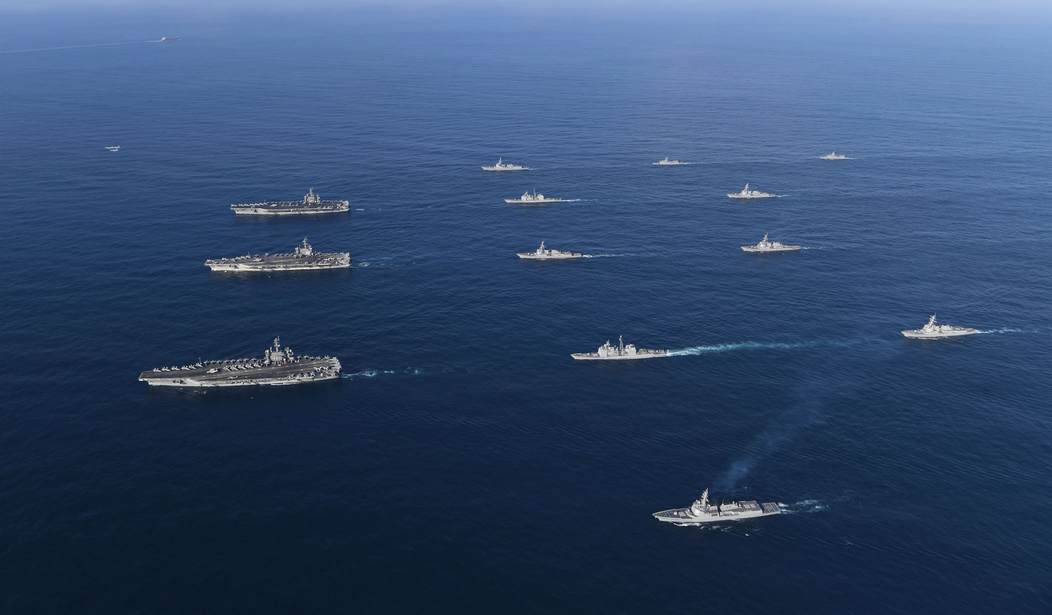

The USS Nimitz departed Naval Base Kitsap in Bremerton, Wash., yesterday, while sailors lined the flight deck and manned the rails as the carrier turned its final page. The ship headed east toward Norfolk, where decommissioning will take place later this year after over 50 years of service.
The warship, which entered service 51 years ago this coming May, has spent the majority of the past five decades as the “Pacific Northwest’s Carrier.” USS Nimitz completed her final global deployment in December.
“This ship and her crew could not be more thankful to the people of Washington State for their decades of hospitality, friendship and trust,” said Capt. Joseph Furco, commanding officer of USS Nimitz. “It is in no small part due to the support of our local community that Nimitz Sailors have been able to successfully train, fight and win, exemplifying the ship’s motto; Teamwork, a Tradition.”
The Navy plans a lengthy inactivation process once the ship arrives in Norfolk; nuclear-powered carriers require years of careful dismantling and recycling before the work is complete.
The USS Nimitz completed her final operational deployment in December 2025 after nine months at sea across the Pacific and the Middle East.
In June, the strike group set sail for the Middle East, where it operated alongside the Carl Vinson Carrier Strike Group. The Nimitz Carrier Strike Group arrived in the Middle East, hanging in the Arabian Sea, on the same day the U.S. struck three Iranian nuclear sites as part of Operation Midnight Hammer.
The Carl Vinson Carrier Strike Group left the Middle East in July.
In August, while still in U.S. Central Command, Nimitz made a port visit to Bahrain, the first time a U.S. aircraft carrier called on the country in five years.
After three months in the Middle East, the Nimitz Carrier Strike Group sailed through the Singapore Strait and back to the Indo-Pacific region where it stayed for the remainder of its deployment.
Crews conducted air operations and regional security missions during the deployment. The voyage marked the final operational patrol for the Navy's oldest active supercarrier.
Shipbuilders laid down the keel for the USS Nimitz on Jun. 22, 1968, at Newport News Shipbuilding in Virginia. Catherine Nimitz Lay, daughter of Fleet Admiral Chester W. Nimitz, christened the carrier on May 13, 1972. President Gerald R. Ford commissioned the ship into the United States Navy on May 3, 1975, at Naval Station Norfolk.
The carrier honored the World War II commander who led Allied naval forces across the Pacific and helped secure victory against Imperial Japan.
The Nimitz became the first ship in a new class of nuclear-powered supercarriers that reshaped American sea power. The ship stretches over 1,000 feet from bow to stern and displaces about 100,000 tons when fully loaded. Two nuclear reactors power the ship, enabling the carrier to operate for decades without refueling. The flight deck supports nearly 90 aircraft, allowing the vessel to deliver air power anywhere in the world.
Cold War tensions shaped the early years of USS Nimitz. The carrier deployed to the Mediterranean in 1976 during her first operational cruise. Additional deployments followed in 1977 and 1979 as the U.S. maintained naval strength in response to Soviet expansion.
In 1980, helicopters from USS Nimitz supported Operation Eagle Claw, the failed attempt to rescue American hostages held in Iran. Mechanical failures and harsh desert conditions forced the mission to end before reaching Tehran. The Nimitz remained on station for 144 consecutive days in the Indian Ocean during the crisis.
Later missions placed the carrier in several major conflicts and security operations. The USS Nimitz supported Operation Earnest Will during the Iran-Iraq War while protecting oil tankers in the Persian Gulf. Aircraft from the carrier flew combat missions during Operation Desert Storm in 1991 and later enforced no-fly zones over Iraq during Operation Southern Watch.
Modern deployments continued into the 21st century; USS Nimitz launched strike aircraft during Operations Enduring Freedom and Iraqi Freedom after 9/11. The carrier later supported humanitarian relief efforts following the devastating 2005 tsunami off the coast of Sumatra.
The ship also served as a testing ground for new aviation technology, hosting the first carrier landing of the F-35C Lightning II in 2014, marking a milestone for 5th-generation naval aviation.
Over five decades, USS Nimitz traveled millions of miles and carried thousands of sailors across every ocean. Generations of naval aviators launched from her deck, while thousands of maintainers, engineers, and sailors learned their craft aboard her steel city at sea. Each deployment reinforced American naval power and reassured allies worldwide.
Fleet Admiral Chester Nimitz signed the Japanese surrender aboard the USS Missouri in 1945. His name later traveled the oceans on a warship built to project American strength during a new era of global competition. That legacy now passes to the next generation of carriers, including the USS Gerald R. Ford and the ships that will follow.
The USS Nimitz now steams toward Norfolk for the final stage of her journey. Sailors in Bremerton watched the ship depart, knowing the Navy would move forward with newer vessels. History will remember the carrier that proved nuclear sea power could sustain American dominance across the oceans for half a century.