





Because we have no government armed with power capable of contending with human passions unbridled by morality and religion, avarice, ambition, revenge or gallantry, would break the strongest cords of our Constitution as a whale goes through a net. Our Constitution was made only for a moral and religious people. It is wholly inadequate to the government of any other. —John Adams
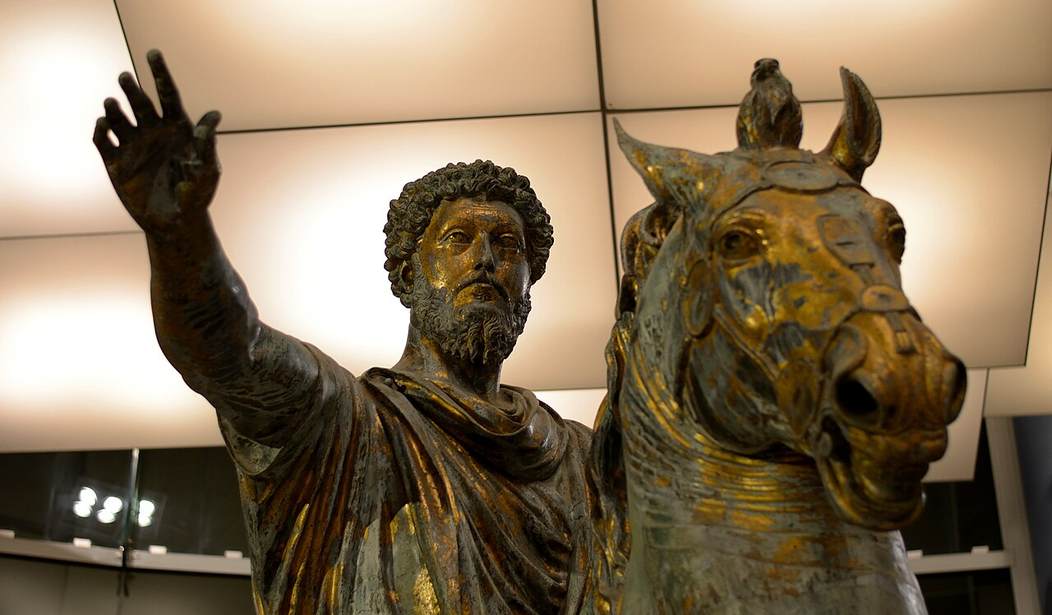
The meditations of Marcus Aurelius, the most succinct and powerful extant exposition of stoicism we have, were actually written as “notes to self” while the emperor was leading Roman legions against Germanic tribes. In them, we find that the key to happiness, or satisfaction with life, is deeper than the pursuit of shallow, transient pleasure, or the simple avoidance of pain. It lies in the pursuit of the four virtues: wisdom, justice, fortitude, and temperance. Wisdom is needed to discern what is just. Fortitude is required to persevere in the pursuit of justice, and temperance (moderation in all things) is required to be well-balanced in that pursuit.
Our rationality is a divine spark and the image of God within us, and rational animals, he wrote, “exist for one another.” Therefore, “he who acts unjustly acts impiously,” and “those who do not observe the movements of their own minds must of necessity be unhappy.” We are to “take pleasure in one thing, and rest in it, in passing from one social act to another, thinking of God.”
Marcus Aurelius was considered the last of the “good” emperors, and his son and successor, Commodus, could not have been more different (so different, in fact, some suspected a different father). Though raised in the traditions of stoicism, he completely abandoned them upon becoming emperor. “It’s all about me,” as we say today, could have been his motto. Blessed with the peace his father achieved on the frontiers, he squandered his rule by handing off authority to those who could pay the highest for such power. His time was spent with mistresses and in banquet halls, when he was not cosplaying ridiculously as a gladiator in fixed matches.
He was somewhat popular, but with the lower-class mobs in the street, which he could sic upon his opponents. He reversed the classic SPQR — Senatus Populusque Romanus (senate and people of Rome) — to Populus Senatusque Romanus. The poet Juvenal’s warning about Rome’s descent into values of nothing but panem et circences (bread and circuses) accelerated. His reign was filled with palace intrigue and assassination attempts. He was eventually poisoned by his mistress, and when that didn’t take, his fitness wrestler finished him off. It was said by Cassius Dio that Commodus had turned “the kingdom of gold to one of rust,” and his reign is considered the death of the Pax Romana.
Look around you today. Are we becoming a panem et circences society? Are virtue and justice sneered at? Has discussion descended from reasoning among our fellow rational creatures – our “image of god” touching theirs – to identity politics, clickbait, and emotional triggers?
My 1st-grade report card (1962-63) came printed with the following: “The school is working earnestly to help your child develop into a well-rounded citizen with many interests.”
Is that what our schools are doing today, or has citizenship gone by the wayside? How can good citizenship be instilled if a child is not taught to love and respect that which he is a citizen of?
In the introduction to my volume of the meditations of Marcus Aurelius, Pierre Bauman writes:
Here is a man who wanted for nothing – he had all the power, respect, and wealth anyone could ever had wanted at that time – and yet was at pains to remind himself over and over in private notes that true happiness has nothing to do with such things, but instead springs from a well-ordered mind. In our own times of frenzied materialist consumption, incessant electronic distractions, and political cacophony, we would do well to heed the message.
Amen, brother.



Join the Conversation
VIP members get the ability to comment on articles.