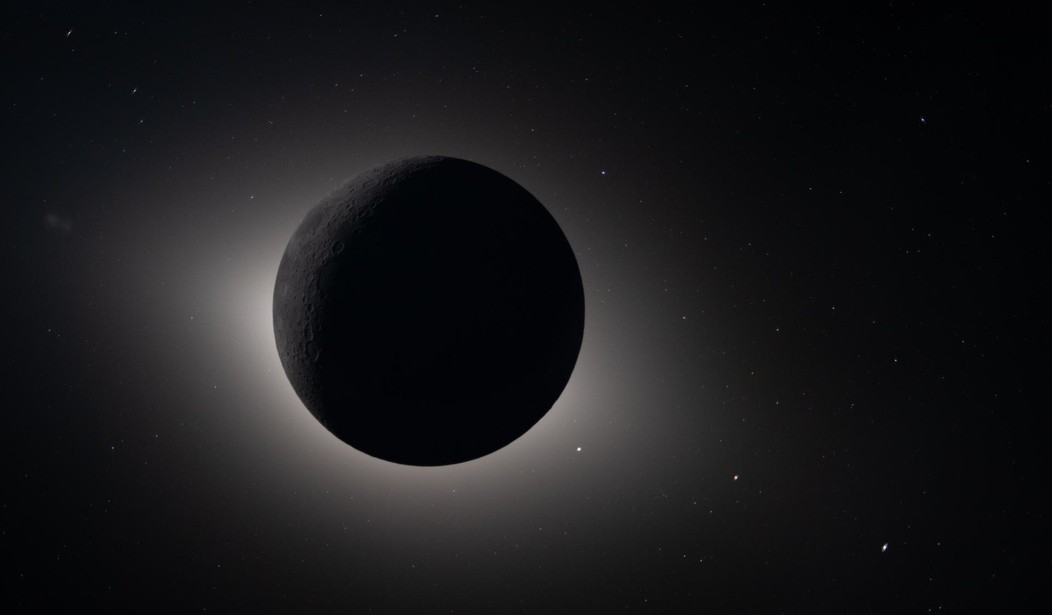

The Artemis II mission got a good bit of the space (heh heh) in last week's Sky Candy, and honestly, there was so much since then that I would have ended up completely dominating this week as well, so I got special permission to have a special edition for the end of the Artemis II mission. So, here's a special soundtrack.
If this makes you get teary-eyed, well, me too. Here's the whole soundtrack.
Here's the starting line.
I'm pleased to reveal my highest resolution photo of the complete SLS in flight, captured entirely using sound-activated triggers from cameras placed near the pad. Thanks to the technique used the image is ~300 megapixels!
— Andrew McCarthy (@AJamesMcCarthy) April 9, 2026
A ridiculously hard shot to get, but worth the effort. pic.twitter.com/ByPP7ybzRO
You may have heard about this kid's reaction. NASA bowdlerized it a bit, but you know what he said in place of "freaking."
That’s right, Hilt — we went to the freaking Moon! 🚀🌕
— NASA's Kennedy Space Center (@NASAKennedy) April 9, 2026
We were honored to welcome Hilt Boling and his family for a special tour of Kennedy Space Center following the successful Artemis II launch.
Hilt’s boundless enthusiasm reminds us why we go. Here’s to the next generation… pic.twitter.com/s6zYxpQCdI
The SLS is ready for its close-up.
@NASA has just released some EXTRAORDINARY tracking footage from Artemis II's launch just one week ago.
— Max Evans (@_MaxQ_) April 8, 2026
Mesmerizing exhaust flow interaction between all four RS-25's & twin SRB's. pic.twitter.com/Q49oZh5RrB
It really doesn't look like the globe in geography class.
Sunrise seen from space few minutes ago 🌍
— Science & Nature (@Sci_Nature0) April 7, 2026
Casting thousands of miles long shadows... pic.twitter.com/Kc3bCBIVgK
Now, this is an artist's rendition, but it was the best shot I found.
That moment when Artemis II got closer to the moon and the earth was 238K miles away. pic.twitter.com/qRigHgARjX
— Amazing Physics (@amazing_physics) April 7, 2026
The Artemis II crew identified and named two new craters. Carroll Crater is named after the late wife of astronaut Reid Wiseman.
Pleased to report right now "Carroll" is visible on the lunar limb. I captured a photo of it this morning as part of a super-high-resolution moon photo I'll be sharing tomorrow. Can you see it? pic.twitter.com/R6kwlkMLNE
— Andrew McCarthy (@AJamesMcCarthy) April 8, 2026
No human had ever before had this view of the far side of the Moon. You can expect a bunch of "well, akshully" replies because the Apollo Command Module pilots all went around the far side. But their average altitude was between 60 and 70 miles, while Artemis was between 4,000 and 6,000 miles.
The term “dark side of the Moon” is one of those persistent misnomers: nothing on the Moon is permanently dark.
— Erika (@ExploreCosmos_) April 7, 2026
The hemisphere we don’t see from Earth, the far side, receives sunlight just as regularly as the near side, with roughly two weeks of daylight followed by two weeks… pic.twitter.com/H9pE4FREp5
Even closer. The Mare Orientale is the bullseye feature just below center on the right.
A new "even closer" view of the Moon from #ArtemisII during its flyby on April 6, 2026. The view of the 183-mile-wide Mare Orientale is amazing! pic.twitter.com/LnG3Lb8kWf
— Jason Major (@JPMajor) April 6, 2026
Another first.
BREAKING: New never-before-seen view of the Moon’s Orientale Basin just released by the astronauts aboard Artemis II. This mission marks the first time in human history the entire basin has been seen with human eyes.
— Amazing Physics (@amazing_physics) April 8, 2026
The Orientale Basin is a massive 600-mile-wide impact crater… pic.twitter.com/cbwqhD3gyM
The Blue Marble.
This one really gets me. 📷❤️
— Erik Kuna 🚀 (@erikkuna) April 8, 2026
Not just because of the view, though obviously... come on. Earth hanging above the lunar surface is the kind of perspective that makes you stop for a second and just take it in.
But as a photographer, I love the composition here too. The balance,… pic.twitter.com/YdWtSOKfGR
EARTHSET.
— The White House (@WhiteHouse) April 7, 2026
April 6, 2026.
Humanity, from the other side. First photo from the far side of the Moon. Captured from Orion as Earth dips beyond the lunar horizon. Photo: NASA pic.twitter.com/ZEBTQA85TY
This is one of the greatest photos ever taken by a human…so far. pic.twitter.com/NbTwbrHVJw
— Jeremy (@ManaByte) April 7, 2026
Closer still.
🚨: La NASA diffuse le cliché de la LUNE le plus proche jamais réalisé par la mission ARTEMIS II.
— Neural Space (@NeuralSpace_) April 9, 2026
La RÉSOLUTION de cette image offre une visibilité et une NETTETÉ record de la surface. pic.twitter.com/reqR6Zcs9r
For a little while, NASA turned off the exterior lights to enable getting this shot.
Sky full of stars.
— NASA (@NASA) April 8, 2026
Following a successful lunar flyby, the Artemis II astronauts captured this breathtaking photo of our galaxy, the Milky Way, on April 7, 2026. pic.twitter.com/pzqcLZNB71
Now they're coming home. This is a fun visualization of the whole orbit.
Artemis Mission Route in 3D
— TheBrainMaze TBM (@thebrainmaze) April 7, 2026
- This animation visualizes the Artemis mission trajectory in a dynamic 3D perspective, showing how the spacecraft travels through the Earth–Moon system while all celestial bodies are in motion. Instead of a static path, the Sun, Earth, and Moon move… pic.twitter.com/efKniUbrTD
Around 8 p.m. Eastern Time (00:00Z), Artemis II will be returning to Earth at around 25,000 miles per hour, setting a new record previously held by Apollo 10, although only by a few hundred miles per hour.
Artemis II’s projected reentry path and timing
— Amazing Maps (@amazingmap) April 9, 2026
A tightly controlled return corridor across the Pacific, timed to the minute pic.twitter.com/zQJshfaaIV
It looks weird because it seems to make a sharp right west of Perth, Australia. That's actually an artifact of the Earth turning under the capsule as it approaches the Earth. I asked Grok to explain:
The sharp bend in the re-entry ground track west of Australia is not caused by the Orion spacecraft suddenly turning or maneuvering. Instead, it is a visual artifact created when plotting the capsule’s fast, nearly straight-line path through space onto a flat map of the rotating Earth.
Orion is returning from lunar distance on a free-return trajectory at roughly 25,000 mph (11 km/s). As it falls inward from hundreds of thousands of kilometers away, Earth continues spinning west-to-east beneath it. Far from Earth, the spacecraft’s high altitude makes the ground appear to move one way relative to its path; closer in, that relative motion shifts dramatically. The result is a kink or apparent reversal on the map — often near the point where the spacecraft’s velocity vector crosses the boundary between regions where Earth’s rotation seems to carry the ground “forward,” “stationary,” or “backward” relative to the incoming capsule.
In reality, Orion follows a smooth hyperbolic trajectory with no sharp turns. The bend disappears in a true 3D globe view and is a common feature on maps of high-speed lunar returns, including those from the Apollo era. The actual flight path stays safely over ocean before atmospheric entry southeast of Hawaii and splashdown off California.
The thing is that this is a hard re-entry with a heat shield that wasn't completely satisfactory for Artemis I I'll quote a discussion from X. (The original is in Japanese, so click through for the whole thing with the new translation feature.)
NASA Administrator Isaacman, who approved this decision, admitted as much himself in January 2026: "Long-term, this isn't the right way. And there's no Plan B."
Reentry can't be redone.From the moment it enters orbit, it's a one-shot gamble on whether the shield holds or not.
Even if this succeeds, the fundamental design issues will carry over to Artemis III.
NASA has already decided to introduce a revised shield for Artemis III.
In other words, the four returning tonight are astronauts plunging into the atmosphere with the "pre-revision design."
Homer Hickam, author of Rocket Boys: A Memoir, among others, put it this way.
Just a perhaps unnecessary reminder: The Artemis II crew, as successful as their mission has been, is involved in a dangerous enterprise with a spacecraft that has a heat shield that showed some unfortunate characteristics on Artemis I. If you are prayerful at all, please pray…
— Homer Hickam (@realhomerhickam) April 9, 2026
Hickam is quoting Heinlein's "Noisy" Rhysling.
We pray for one last landing
On the globe that gave us birth;
Let us rest our eyes on the fleecy skies
And the cool, green hills of Earth.