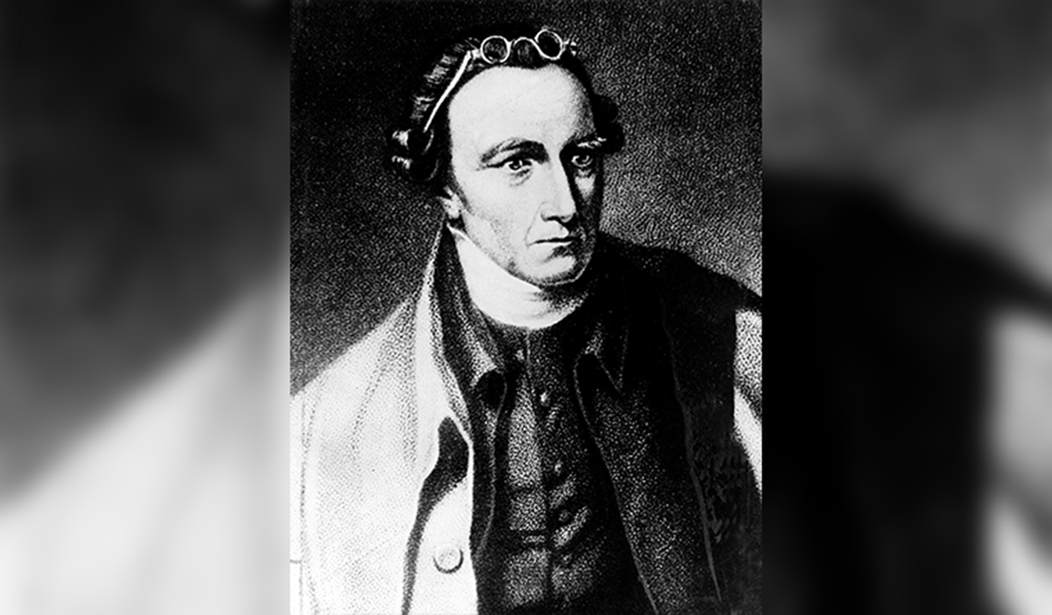

May 29 is the birth anniversary of a man who was among the most famous Revolutionaries in the Founding generation: Patrick Henry. His immortal words, "give me liberty or give me death," not only helped launch a Revolution but have been inspiring American patriots for two and a half centuries since. Yet Henry's parting warning to America is equally worthy of remembering.
This 250th anniversary year of America's existence is a particularly appropriate time for recalling the advice of our Founding Fathers. Indeed, many of the internal and external crises we face now are a result of too long ignoring their advice on such matters as mass migration, constitutional limits on government, welfare, party divides, public religious practice, and just taxation. Patrick Henry left behind at his death a brief but striking warning for Americans.
Historian Tara Ross explains that near his will, Patrick Henry left a sealed envelope. Within that envelope were his Resolutions against the Stamp Act, with which in 1765 he had ignited a firestorm of international controversy and domestic patriotism. On the back of this copy of his history-shaping resolves, Henry warned that only by practicing virtue and exercising wisdom could Americans determine whether their "independence will prove a Blessing or a Curse." He added, "Righteousness alone can exalt them as a Nation." His message was clear — without moral and political greatness, liberty would become license and the rule of law would break down. We've lived through crises caused by ignoring his warning, and we know now how true it was.
Patrick Henry was a fascinating man, complex and brilliant, most outstanding for his fiery passion, and yet able to maintain amicable ties with some of those against whom he'd fiercely argued. A lawyer, orator, and statesman, his political career included serving as the first governor of Virginia during the Revolution, founding the Virginia Committee of Correspondence, along with multiple terms in the Virginia House of Delegates, the Virginia Conventions, and the First and Second Continental Congresses. He was an early and fervent advocate for American independence and helped drive Virginia along that path, including by his most famous "Liberty or Death" speech.
Related: Stories of Heroism and an America 250 Reflection for Memorial Day
Like all men, even the best, Henry was sometimes very wrong, but he was also more able to admit he was wrong than most men, and that is a greatness in itself. Though a slaveowner, Henry confessed that slavery was unjust and ought not to exist in a Christian nation. An early and committed opponent of the U.S. Constitution, Henry yet later supported the union created by the constitutional system of government and helped push for a Bill of Rights.
And it was one of the Constitution's architects — George Washington — who convinced Henry to return to politics just before his death. Henry came a little more toward James Madison's way of thinking on the Constitution's necessity in his later years, but also persistently opposed the more atheistic and authoritarian tendencies of Madison's philosophy. In short, Henry might sometimes have altered his views or eschewed his former actions, but he really always aimed to be guided by religious moral principles and the promotion of liberty.
That is the spirit we perceive in his dying injunction to his fellow Americans, with which I will end:
Whether America's independence will prove a Blessing or a Curse, will depend on the Use our people make of the Blessings which a gracious God hath bestowed on us. If they are wise, they will be great and happy. If they are of a contrary Character, they will be miserable. Righteousness alone can exalt them as a Nation. Reader! whoever thou art, remember this, and in thy Sphere, practice Virtue thyself, and encourage it in others. P. HENRY