
America is now suffering from a crisis of depressed children, hopeless adults, and dysfunctional young people. Part of the reason for that crisis is a loss of just the sort of marvelous imagination expressed in such classic tales as “Peter Pan” and “Winnie-the-Pooh.”
When I was growing up, my siblings and I played constantly at being medieval royals or Revolutionary War soldiers. We dressed up as characters from our favorite Disney movies or novels, and acted out the adventures of Snow White, Frodo Baggins, Mr. Incredible, Laura Ingalls Wilder, and Mary Lennox. Even the way we internalized the very non-fictional Bible stories and lives of the saints was by dressing up as the Blessed Virgin Mary or Moses or St. George and acting out their biographies. We wrote fairy tales, put on plays, and memorized poems. It is a sad fact that such a childhood is becoming increasingly rare, and I think with very serious consequences for our culture and the future of our art and literature. Perhaps the reason we have so many remakes and prequels and sequels is because our imaginations cannot reach the original and unforgettable heights of previous eras’ creators.
Among the stories my mother read to us and my parents showed to us on film growing up were Peter Pan and Winnie-the-Pooh. They have long been popular — what child has not dreamed of flying up to the stars or having his toys come alive? I think in the case of these two stories, however, they are more than amusing bedtime stories. They really do speak to the importance of imagination, not only during the formative years of childhood, but into adulthood. As C.S. Lewis put it, “I am almost inclined to set it up as a canon that a children’s story which is enjoyed only by children is a bad children’s story.”
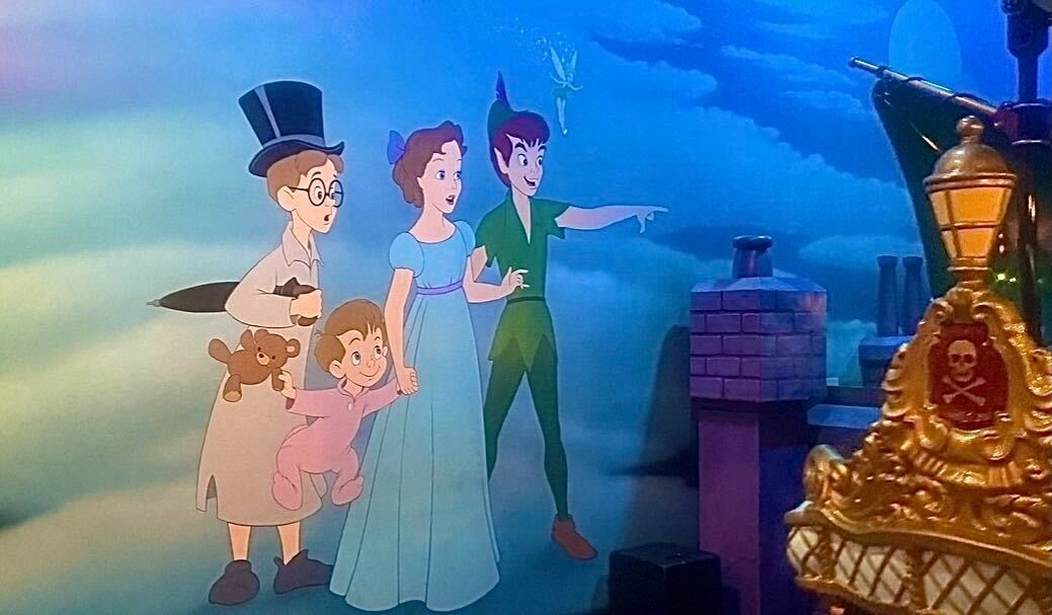
I recently read the original “Peter Pan” play by J.M. Barrie and re-watched Walt Disney’s animated film version of the same. I personally find the Disney movie a good deal more appealing, partly because Peter Pan himself is much more charming and less heartless in the film, and partly because there is a great deal less violence (the original play has at least two wholesale and gruesome massacres). That said, both versions of “Peter Pan” highlight the importance of imagination not only in a child’s life, but in an adult’s life.Indeed, the Walt Disney version illustrates just the point I wish to make, a point that many moderns deride or overlook. Having had a series of wonderful adventures in Neverland, Wendy and her brothers decide that, much as they love the magical land – and much as Wendy loves Peter – they are ready to return to London and grow up. The impetus of their return is their longing for their mother; one of the great themes of the movie is the importance of motherhood. But in the ending scene, it is Wendy’s father George Darling who takes center stage.
Earlier in the movie, he precipitated a climax by mocking Wendy’s fanciful stories and his sons’ pretend games, and by sneering at the very existence of Peter Pan. Yet in the last scene, he is stunned to see the pirate ship which Peter Pan is skillfully flying past the moon. For the first time in the movie, a real smile overspreads Mr. Darling’s face. “You know, I have the strangest feeling that I have seen that ship before, a long time ago, when I was very young,” he sighs happily, and he stands watching the ship fly away while embracing his beaming wife and daughter.
When he had forgotten the fairy tales of his childhood, and demanded his family reject all imagination in favor of hyper-rationalistic materialism, Mr. Darling was irritable, unhappy, and constantly upsetting or arguing with one of his family members. But when he finally acknowledges the joy that magic brought to his childhood, and shares that joy with his children and wife, suddenly Mr. Darling becomes a satisfied man. His life and soul are complete. He can simultaneously be the reasonable businessman, the instructive father, and the imaginative playfellow. Between memories of the past and shared delight in the present, he is fully himself.
Related: Winnie-the-Pooh and WWI: 100 Years of a Veteran’s Creation for His Son
Like the fictional Mr. Darling, the real-life A.A. Milne – author of the Winnie-the-Pooh stories – used imagination to connect with his child. Returning from the horrors of World War I physically and psychologically scarred, Milne sometimes struggled to explain to his little boy Christopher Robin why he was afraid of bees or jumped as if shot at a popped balloon. To help explain the behaviors related to his PTSD at a child’s level, and to connect more deeply with his son, Milne invented stories surrounding the stuffed bear he had bought Christopher Robin and others of the boy’s playthings. One hundred years later, Pooh and Eeyore and the rest are still helping adults and children alike form shared memories and discover the wonder of an ordinary world transformed by imagination. The charm of the Hundred-Acre Wood is nearly as strong for many adults as for children. C.S. Lewis was quite right.The incomparable G.K. Chesterton was a great advocate for adults believing in Santa Claus and fairies. His belief was that when once adults become too disdainful of fantasy and magic, they will eventually begin to deny miracles. Indeed, I have found in confirmation of Chesterton’s theory that most of the people I know who began by laughing at Santa Claus and ridiculing wizardry now mock the parting of the Red Sea and Christ’s resurrection of Lazarus. One does not, of course, need to believe in pixies to have faith in God, but when a man once gets used to despising the marvelous, he will eventually challenge the miraculous. God gave us imagination for a reason, and to suppress that divinely-created part of our minds is unhealthy.
Do we not look around the modern world and see too many reasons to fear we have corrupted the healthy imagination of childhood? How many parents now think themselves virtuous for telling starry-eyed tots that no Santa Claus will come down the chimney? How many adults deliberately expose little kids to completely age-inappropriate content, especially sexual content? Do most parents tell or read their children bedtime stories as Milne did, and do those same parents encourage their children to put aside the video games and iPhones to play at being pirates or soldiers or elves in the backyard?
The result of all this repression and derision at imagination is that it bursts forth in unhealthy ways. American young people are increasingly irreligious, yet also increasingly obsessed with perverted and morbid fantasies and horror fictions. The teenager who believes in no God investigates Wiccan witchery or binges on demonic TV shows. The kid whose parents told him there is no such thing as flying reindeer believes the preposterous nonsense that he can alter his sex. If we will not encourage healthy and beautiful imaginative exercises, we will see youth exercise their imaginations in very disturbing and destructive ways.