Chronicling the ongoing intersectional struggle to liberate women — inclusively defined as the legacy kind and the transgenders — from The Patriarchy™, one microaggression at a time.
Sacha Baron Cohen’s ‘midlife post-divorce body is repellent to most women,’ claims legacy media columnist
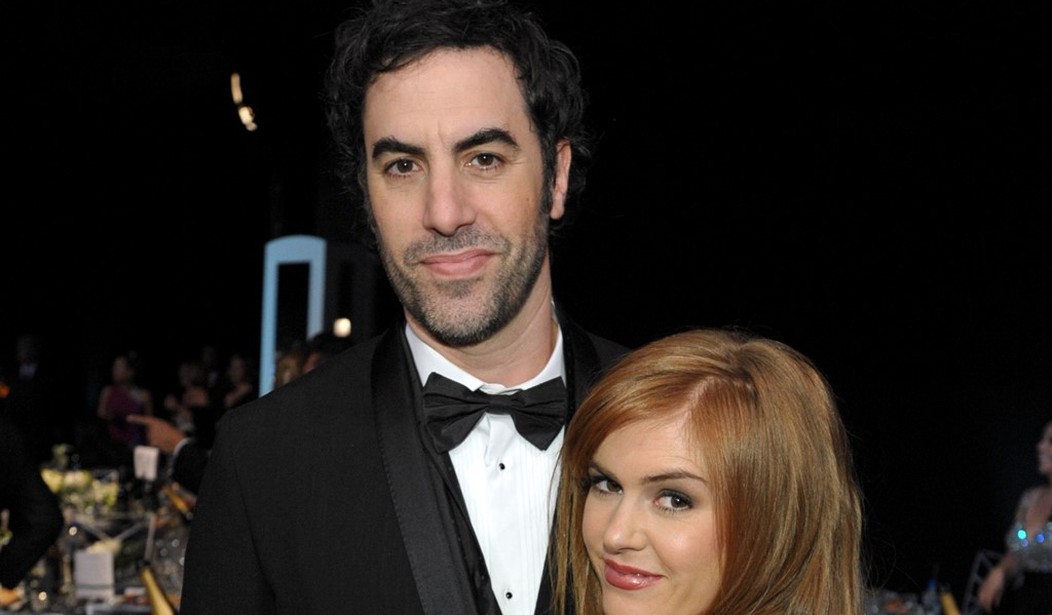
Sacha Baron Cohen, the visionary genius behind Borat and Bruno, apparently got divorced sometime recently and also got in shape at more or less the same time, two occurrences which may or may not be coincidental.
Related: 'HuffPost Personal' Cancer: A Tragic Tale of One Husband's Total Emasculation
Whatever the reason for Cohen’s physical transformation or his divorce, I don’t really care on either count.
At all.
But some frumpy shrew called Judith Woods over at The Telegraph does care, enough to write a provocative, feminist-coded op-ed titled “Sacha Baron Cohen doesn’t realise his midlife post-divorce body is repellent to most women.”
Via The Telegraph (emphasis added):
No, of course it wasn’t. It was this: I get the 53-year-old actor and comedy writer is now officially divorced from his wife, Isla Fisher, 49, but I’m not sure the revenge body thing is really working…
I can’t see why a Celine Homme polo shirt and Tom Ford linens wouldn’t have done the trick for Baron Cohen. He’s a dad with two daughters and a son, and therefore absolutely entitled – some would say obliged – to rock a dad bod…
Now that the privately educated Cambridge graduate has joined the Hollywood elite, he happily admits he brought in a crack team for his ripped glow-up, which he describes as “a midlife crisis”…
These days, muscle mass equals star power. On screen, at any rate. In Men’s Fitness, Baron Cohen has found the perfect body-conscious audience for his great reveal, but I’m not sure how many women will find his pumped-up pecs a thing of beauty.
As a seasoned Social Justice™ documentarian, the whole essay comes off an awful lot like an exercise in “body-shaming,” which is otherwise frowned upon in intersectional feminist subculture.
Related: 12-Foot Statue of Obese Black Woman Appears in Times Square
Here’s a handy side-by-side comparison of Cohen and the author of this ditty, Judith, which may or may not explain, either fully or in part, her odd obsession with Sacha Baron Cohen’s physique.
Judith Woods got bad jeans. pic.twitter.com/kN1gh304ka
— Lahiru Mihiripenna (@lahirumihiri) July 31, 2025
What, one wonders, in addition to why the newspaper decided this was worth publishing, might have been the impetus for this screed?
Did Judith Wood’s husband have a midlife crisis, get in shape, ditch her, and find some hot new 20-something?
Who knows?
In any case, this appears to be yet another episode in the longstanding feminist tradition of reimagining personal psychological issues as political ones, thereby making them everyone’s problem.
Imagine, if you will, the outrage if some guy — let’s call him “Jared Woodson” in this hypothetical — wrote an article for legacy media titled “Female Celebrity X Is Looking Really Hideous These Days: Sagging Here, There, Everywhere! Repellant!”
Naturally, feminists, a category of ideologue to which Judith surely belongs by her own characterization, would deride such an article as an expression of the oppressive “male gaze” and call for his head, which they’d probably get.
Via Body Positive Alliance (emphasis added):
Since I was a little girl, I have been acutely conscious of how men perceive me. Until recently, I didn’t know where this awareness originated or why I wanted to be noticed. But, as I got older and began to feel attracted to men, I focused on looking desirable to them. I often wondered if I measured up to what they wanted to see.
I now attribute this mindset to the male gaze, a concept introduced in 1975 by Laura Mulvey in an essay titled “Visual Pleasure and Narrative Cinema.” The male gaze, by definition, is the objectification of women from the perspective of a heterosexual, cisgender man.
As I now call it, my internalized male gaze is especially identifiable to me when men catcall me. I feel utterly disgusted when it occurs, yet at the same time, there is a part of me that feels validated by the recognition from those who call out to me.
I often sit with the issue of feeling valued by this objectifying treatment. However, I now realize that the desire to appeal to men doesn’t stem from my attraction to men but from societal pressures that I was previously unaware of.
That being said, this profoundly ingrained self-perception isn’t exclusive to heterosexual, cisgender women. High school junior Ruby, who is a lesbian, believes that the male gaze can create a standard of attraction that non-heterosexual and heterosexual women alike feel they must conform to.
“I know that I’m not attracted to men, but sometimes I will feel like I am because of the male gaze and because of how internalized it is,” Ruby said. “That’s what’s expected of you. You expect your body to feel that desire even though it doesn’t. It’s confusing.”
The male gaze is internal and is also perpetuated in magazines, television, movies, and other forms of media. In this regard, the male gaze centers female existence around mens’ desires. Films such as The Wolf of Wall Street and The DUFF cater to this patriarchal idea.
“Perpetuated in magazines, television, movies, and other forms of media”!
Not that these people having double standards is some kind of revelation.
Anyway, let’s end on a lighter note — with Borat effortlessly laying waste to a band of frumpy shrews in the mold of Judith Woods.