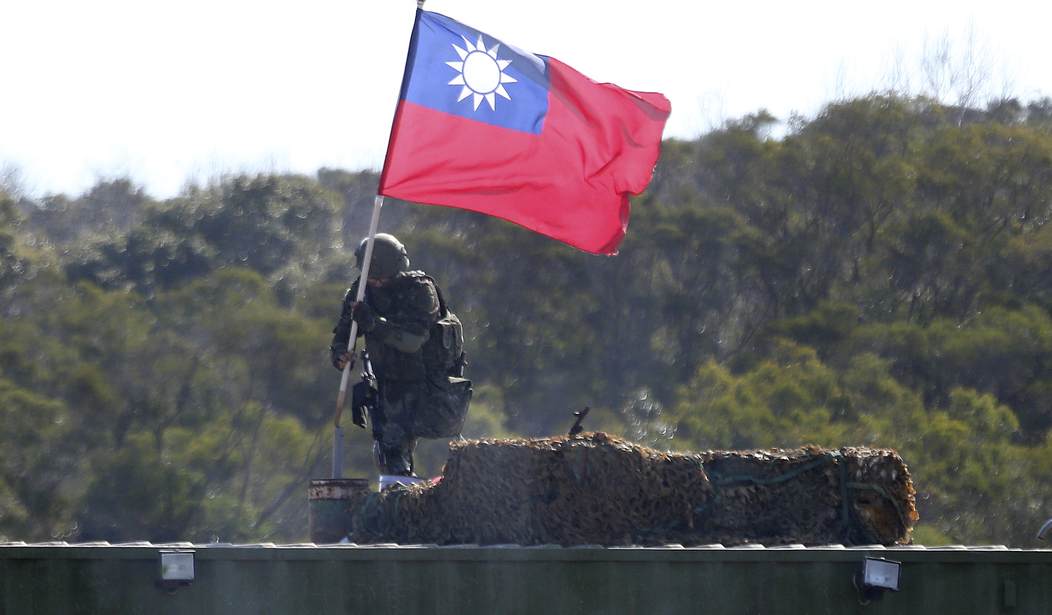
Since the partition in 1949, when the nationalist Kuomintang fled to the island, the CCP has eyed Taiwan, which it perceives as its rightful territory.
For equally as long, Taiwan has served as a de facto American military base, keeping the Chinese hemmed into the mainland and limited in their ability to project power into the Pacific.
For its part, Washington has long considered Taiwan a vital strategic asset.
For many decades, the diplomatic posture was one of “strategic ambiguity” — until Biden blew the lid off that and his overworked handlers and media lackeys were forced to spend the entire next news cycle trying to walk it back.
Related: Columbia U Video Promotes Hillary Clinton's New Foreign Policy Course
AOC, more recently, in what was supposed to be her big foreign policy debut ahead of her 2028 presidential run, entirely by accident, stumbled into reaffirming strategic ambiguity on Taiwan — not because she understands the policy but because she’s so out of her depth, like a deer in headlights, that her rambling, nonsensical rehearsal of jumbled talking points had the effect of affirming strategic ambiguity.
DEI diva AOC reveals at big foreign policy debut that she knows nothing about foreign policy pic.twitter.com/I3SrDOQLCw
— Ben Bartee (@BenBartee) March 17, 2026
All of which is to say: the Chinese invasion of Taiwan has seemed inevitable to foreign policymakers for many years — not a question of if but when.
When, it seems, might be soon.
Via Politico, March 15 (emphasis added):
Taiwan saw a surge of Chinese military planes near the island, its defense ministry said Sunday, after a sharp drop in flights over the past two weeks had sparked discussions among observers.
The ministry detected 26 Chinese military aircraft around the island on Saturday, with 16 of them entering its northern, central and southwestern Air Defense Identification Zone. Seven naval ships were spotted around the island, it reported.
There are numerous reasons, one could speculate, why the time might seem ripe for a Taiwan incursion.
For one thing, the United States military, which has provided the “security” umbrella to allies like Japan, South Korea, and Taiwan, is a bit preoccupied in other regions of the world.
Recently, reports indicate that various forms of U.S. weaponry have been relocated to the Middle East, leaving allies in the Orient uncertain about the ability of the United States to mount a defense in the region against Chinese aggression.
Via Reuters (emphasis added):
South Korea can deter any threats from North Korea even if Washington redeploys weapons stationed in the country, President Lee Jae Myung said on Tuesday, after reports that U.S. missile defence systems were being sent to the Middle East.
Reports on shifting key U.S. military assets have sparked concern in Asia about the potential gaps in regional defences if Washington diverts ships and missiles used to deter military flexing by China and North Korea to other theatres.
"It appears that there is controversy recently over U.S. Forces in Korea shipping some weapons, such as artillery batteries and air-defence weapons, out of the country," Lee said in a cabinet meeting, noting that while Seoul had expressed opposition, it was not in a position to make demands.
Lee said the removal of some U.S. weapons from the country "does not hinder deterrence strategy towards North Korea," noting South Korea's defence spending and conventional capabilities far exceeded those of North Korea.
South Korea hosts a major U.S. military presence in combined defence against nuclear-armed North Korea, with about 28,500 troops and surface-to-air defence systems...
South Korean Foreign Minister Cho Hyun said on Friday that U.S. and South Korean militaries were discussing the possible redeployment of some U.S. Patriot missile defence systems to the conflict in the Middle East.
South Korean media reported some missile batteries had been shipped out of Osan Air Base and were likely to be redeployed to U.S. bases in Saudi Arabia and the United Arab Emirates, though South Korean authorities have not confirmed these reports.
For another, American allies, particularly Japan, amidst a rise in nationalist sentiment, are in the process of beefing up their respective militaries in order to compensate for the uncertainty they feel about U.S. security guarantees. Striking while they’re relatively weak, before they have the chance to amplify their defenses, might seem to make sense to Beijing war planners.
Related: The Sun Never Sets on the British Empire
The final factor that China might be considering is American tech firms’ current overwhelming reliance on Taiwanese semiconductors. While the U.S. is in the process of weaning itself off of Asian semiconductors in favor of domestic production, it’s still a work in progress.
If China were able to grab that production capacity in Taiwan overnight, it would confer immense leverage in whatever trade or military negotiations in the future.