Archiving the “strange death of Europe,” as Douglas Murray put it, and the West more broadly, at the hands of the neoliberal technocracy.
‘First Black Briton’ skeletal remains: Not black at all but actually British, according to new DNA sequencing
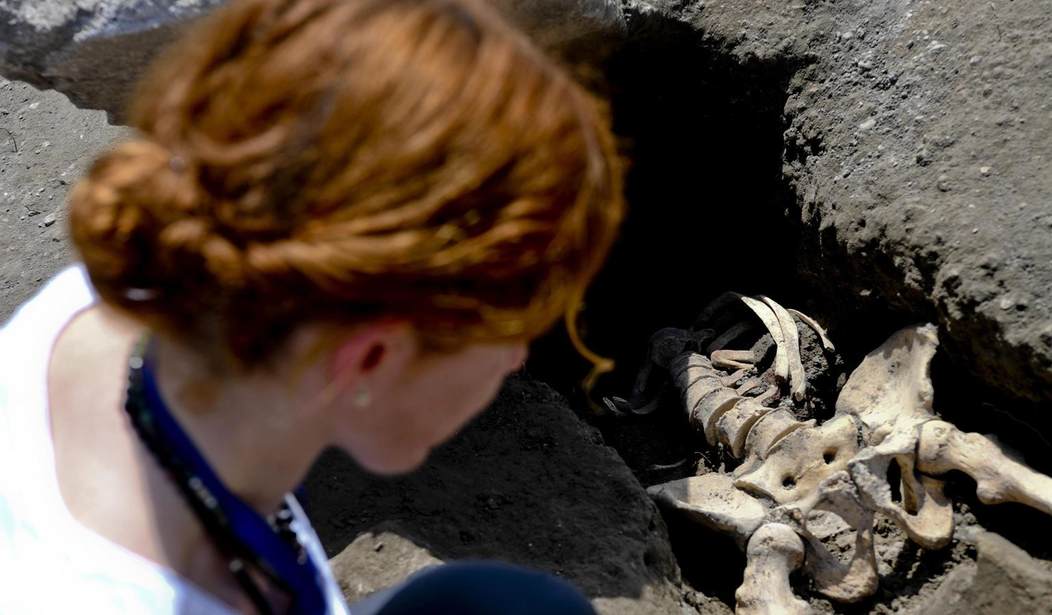
The sordid “Beachy Head Woman” affair began in 2012, when DEI hustlers first posited that the skeletal remains of a female discovered in East Essex, estimated to have died in the heyday of the Roman empire, was actually sub-Saharan African, a theory promulgated in the service of proving that that the British Isles had always been inhabited by blacks dating back millennia and therefore justifying the replacement of the native white population with African migrants.
Related: British PM: We Censor Anti-Migrant Protests ‘For the Children’
You can imagine how giddy the proponents of replacement migration in state media were to wield their potent new rhetorical weapon.
And wield it they did.
The BBC even went so far as to feature a “reconstructed” Beachy Head Woman face with brown skin, black eyes, and curly black hair.
After the first Beachy Head woman story of her being sub-Saharan African fell apart, the myth was amended in 2017 to an origin story pointing to the island of Cyprus in the Mediterranean — still not British but not as wildly implausible as the sub-Saharan version.
After years of subjecting the British public to the fable of the “First Black Briton,” lo and behold, it turns out that Beachy Head Woman was actually — and this is a truly shocking development — British, meaning she had white skin and blue eyes.
Via Phys.org (emphasis added):
The identity of a Roman-era individual found in southern England has finally been resolved after scientists at the Natural History Museum were able to sequence high quality DNA from her skeletal remains.
Once theorized to have origins in sub-Saharan Africa or possibly the Mediterranean, the first comprehensive scientific study to be carried out on the Beachy Head Woman has revealed that her origins were in fact much closer to home.
The Roman-era individual was brought to light in 2012 when her remains were uncovered in the collections of Eastbourne Town Hall. Details on the box she was found within suggested that the skeleton had been found at the nearby headland, Beachy Head, in the 1950s but no details of an excavation have yet to be recovered.
The Beachy Head Woman's story became more intriguing when initial morphometric analysis suggested she originated from sub-Saharan Africa; this result informed a display at the Eastbourne Museum and captured media attention. Then in 2017, unpublished DNA work suggested she was more likely to have come from the Mediterranean rather than Africa, possibly Cyprus. However, this finding was based upon limited DNA data, insufficient for robust conclusions, leaving many questions about the Beachy Head Woman unanswered.
One might be tempted to give the scientists who took the British on such a long ride the benefit of the doubt.
But ask yourself this: how many times have Western archeologists ventured deep into the Congo, discovered human remains, and then claimed with the assistance of Western media that they were actually white people from thousands of years ago, with the unsubtle insinuation that African actually rightfully belongs to white people?
Related: New Hollywood Hate Flick: White People ‘The Most Dangerous Animal on the Planet’
Just like with COVID — where the errors of The Science™ always cut in the direction of exaggerating the risks of COVID while overplaying the “safety” and “efficacy’ of the “vaccines” — isn’t it weird how the “errors” only ever seem to go one way?