





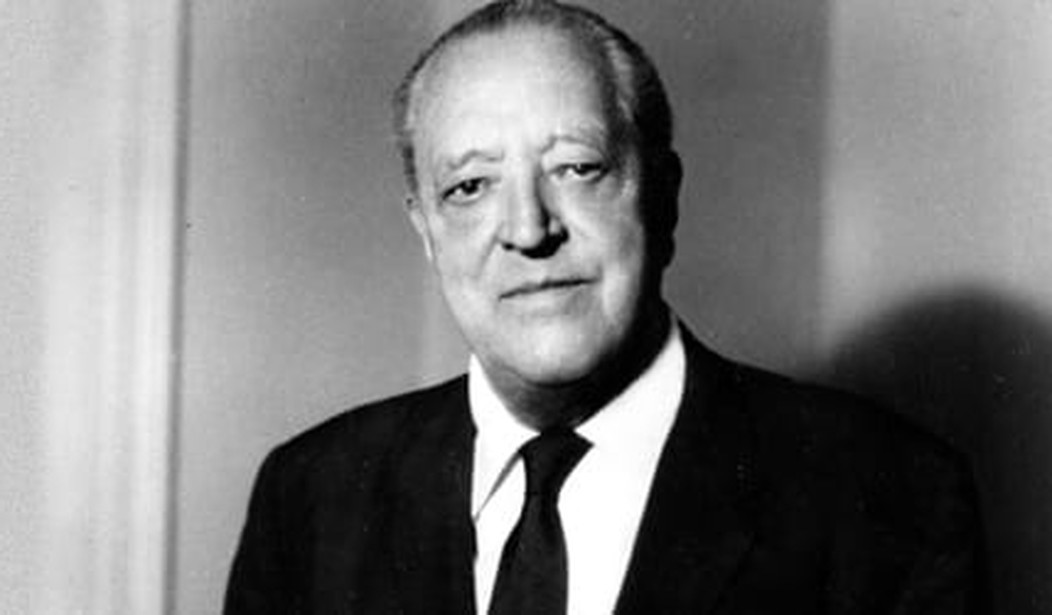
Television’s Mad Men would have you believe that America was a monolithic bastion of Puritanism, untrammeled by European or socialist influences (despite the rise of Woodrow Wilson and FDR!) until the Beatles touched down at JFK Airport in 1964. The reality though, as Allen Bloom memorably wrote in The Closing of the American Mind, was that almost immediately upon the US winning World War II, America began to slowly — often unwittingly — become an unofficial enclave of Germany’s Weimar Republic.
Take architecture. As Tom Wolfe noted in From Bauhaus to Our House, his classic debunking of modernism’s excesses, because America’s intellectuals tend to think of themselves as an artistic colony in thrall to Europe, when the leaders of the Weimar-era German Bauhaus of the 1920s were evicted by the Nazis, they were welcomed by Depression-era American universities as “The White Gods! Come from the skies at last!”
[Walter Gropius, the founder of the Bahaus] was made head of the school of architecture at Harvard, and Breuer joined him there. Moholy-Nagy opened the New Bauhaus, which evolved into the Chicago Institute of Design. Albers opened a rural Bauhaus in the hills of North Carolina, at Black Mountain College. [Ludwig Mies van der Rohe, its last director, when the Nazis shuttered its doors in 1933] was installed as dean of architecture at the Armour Institute in Chicago. And not just dean; master builder also. He was given a campus to create, twenty-one buildings in all, as the Armour Institute merged with the Lewis Institute to form the Illinois Institute of Technology. Twenty-one large buildings, in the middle of the Depression, at a time when building had come almost to a halt in the United States— for an architect who had completed only seventeen buildings in his career—
O white gods.
Mies van der Rohe (1886-1969) is the titular subject of the newly published biography by architectural historian Franz Schulze and architect Edward Windhorst (who studied his craft under a protégé of Mies). They’ve collaborated on an extensively — very extensively — revised version of the biography of Mies that Schulze first published in 1986, the centennial of Mies’s birth.

Mies van der Rohe’s 1929 Barcelona Pavilion, May 2000. Photo © Ed Driscoll.
While he was America’s most influential postwar modern architect and teacher, Mies never quite become a household name on the same order as Frank Lloyd Wright. (Despite a prominent Life magazine feature in 1957.) But he’s been the subject of numerous biographies and book-length profiles, beginning with his prominent role in The International Style, the pioneering Museum of Modern Art exhibition by Philip Johnson and Henry Russell Hitchcock, which first put modern architecture on the map in America, back in 1932.
Even as Mies was associated with several prominent buildings deserving of respect after World War II, perhaps his greatest accomplishment was to singlehandedly invent the language of postwar American architecture. We take tall steel and glass office buildings and apartments for granted, but it was Mies who created their look, beginning with 1951′s Farnsworth House (which would also provide the inspiration for Philip Johnson’s own Glass House) and from that same year, the 860-880 Lake Shore Drive apartment complex.

The Adam Building, a 1928 project (not built) by Mies for a department store in downtown Berlin. Scanned from the 1986 edition of Mies van der Rohe: A Critical Biography.
Mies didn’t arrive at this language overnight – he began formulating it as early as his 1921 Friedrichstrasse Office Building project (his charcoal and conte crayon sketches were perhaps the very first modern designs for tall office buildings) — in an era when a bankrupt Germany was still literally crawling out of the rubble of World War I. And his much lesser-known 1928 commercial designs, such as the Adam Building, which was a proposal for a department store for Berlin, and a similar design for a bank/department store in Stuttgart, further point the way to his post-World War II American architecture.

Unbuilt Stuttgart bank and department store project, 1928. Scanned from the 1986 edition of Mies van der Rohe: A Critical Biography.
These buildings also expose one the paradoxes of modern architecture: While the external I-Beam didn’t make its appearance on a Mies-designed building until after World War II, Mies arrived at his basic building forms, and all of his furniture designs, by the end of the 1920s – and yet this “modern” architecture and design is still very much with us today. (At the start of the year, when I prepped for writing a review of the DVD edition of HBO’s Boardwalk Empire series set in Atlantic City in the Roaring Twenties, I watched several hours of the show in a marathon session lasting deep into the night. When I turned the DVD player off, I was thrilled to return to the 21st century – only to stare at all of the Mies-designed furniture in my kitchen and living room and realize in a sense, I was still stuck in 1920s!
Unfortunately, while illustrations of the Adam Building and Stuttgart Bank/Department Store were included in the original 1986 edition of Schulze’s book, they’re missing from this revised edition. Which is too bad, as they’re not readily found in Google’s image archives. There are several key additions in this new edition, however. Perhaps the most intriguing is the transcript of the court hearing from 1952, when Dr. Edith Farnsworth sued Mies after construction costs for her titular house on the banks of the Fox River in Plano, Illinois, went over budget. As Schulze and Windhorst note, the relationship was cordial (some have argued quite very cordial), until 1951, when Farnsworth soured on the design of the house once it was completed, and the relationship between client and architect irrevocably soured as a result. On the other hand, as Mies told the court in 1952, “I was famous before. She is now famous throughout the world.” But neither parties acquitted themselves all too well during this period, as the transcript found by Schulze and Windhorst highlights.
Another way that this biography differs from Schulze’s 1986 predecessor is an emphasis near the end of the book on the projects built under the name of The Office of Mies van der Rohe, but largely designed by Mies’s associate architects. For the most part, these were competently done, but frequently lacked the sense of Schinkel-inspired proportion that Mies brought to the best of the buildings he personally designed.
But then, as Schulze and Windhorst write, while Mies saw himself as the most systematized and rational of architects, his sense of space, proportion and massing, the keys to his best works, were concepts almost impossible to teach:
Mies was a system builder in an age suspicious of systems, and part of his genius was his skill in reconciling opposing positions. His system was not a set of rules but a method for seeking and finding an architecture in harmony with modern times. It was his will, firm and final, that convinced the world of the 1950s that he was a man of reason. Yet without the simple excellence of his architecture, even his will and the charisma that radiated from it would not have been enough to win the acclaim he garnered. It became conventional wisdom to acknowledge that Mies’s architecture, because it was reasonable and systematic, was therefore the most teachable. The stillborn design in the Miesian manner that transformed the American cityscape in the 1950s and 1960s suggests otherwise.
And then there were the architects who didn’t work in Mies’s office, but borrowed his language extensively, such as Philip Johnson and Gordon Bunshaft of Skidmore, Owings and Merrill. SOM in particular would build far more Miesian buildings than Mies himself — which Mies himself didn’t mind at all, as he told an interviewer in 1960, “Sometimes people say how do you feel if somebody copies you and so on. I say that is not a problem to me. I think that is the reason we are working, that we find something everybody can use. We hope only that he uses it right.” But the public and the American urban landscape didn’t necessarily benefit, as Schulze and Windhorst’s comment on the acres of stillborn Miesian buildings in postwar America highlights.
But that same reductionist impulse wasn’t just confined to modern architecture. It would impact graphic design as well by the mid-1960s, as the classic moment in the 2007 documentary Helvetica illustrates:
Note that for both Mies and designer Michael Bierut, featured in the above clip, this was a benefit of modern design, not a drawback. However, one enormous drawback to Mies’s language – and the language of modernism in general — was its lack of emotionalism. As the recurring leitmotif in Tom Wolfe’s From Bauhaus to Our House went, expressions of grandeur would be responded to with an upturned nose and the droll socialist reply, “how very bourgeois” by most postwar modernist architects.
The way Americans lived made the rest of mankind stare with envy or disgust but always with awe. In short, this has been America’s period of full-blooded, go-to-hell, belly-rubbing wahoo-yahoo youthful rampage— and what architecture has she to show for it? An architecture whose tenets prohibit every manifestation of exuberance, power, empire, grandeur, or even high spirits and playfulness, as the height of bad taste.
We brace for a barbaric yawp over the roofs of the world— and hear a cough at a concert. In short, the reigning architectural style in this, the very Babylon of capitalism, became worker housing. Worker housing, as developed by a handful of architects, inside the compounds, amid the rubble of Europe in the early 1920s, was now pitched up high and wide, in the form of Ivy League art-gallery annexes, museums for art patrons, apartments for the rich, corporate headquarters, city halls, country estates. It was made to serve every purpose, in fact, except housing for workers.
When Mies had the opportunity to first build in America, beginning on his own IIT campus during and after World War II, the results looked rather factory-like to the layman. Wolfe described Mies’s open-planned S.R. Crown Hall, his showplace school of architecture on his IIT campus, as looking like an LA car wash. This is somewhat unfair on one level, as the stylized “Googie” architecture of L.A. in the 1950s and ’60s was an attempt to add additional curb appeal to Miesian architecture. On the other hand, when Wolfe writes, “The compound style, with its nonbourgeois taboos, had so reduced the options of the true believer that every building, the beach house no less than the skyscraper, was bound to have the same general look,” he’s certainly onto one of the key disadvantages of Miesian architecture — and modern architecture in general.
As Schulze and Windhorst note, once Mies had developed his postwar architecture language and details (extensively cataloged and illustrated in the oversized 1974 book Mies van der Rohe at Work, written by Peter Carter, who studied and later worked with Mies), he tended to reuse it ad infinitem. As we previously noted, Schulze and Windhorst describe Mies as a systems builder who frequently questioned new architectural designs. Mies’s famous quip that “architecture is not a cocktail” – not something for which you mix up a fresh batch of ingredients every weekend – seemed a direct rejoinder to Frank Lloyd Wright, whose forms and styles seemed endlessly inventive.

Neue Nationalgalerie, Berlin. Photo by andersphoto / Shutterstock.com.
At one point, Schulze and Windhorst write, “After the completion of the Farnsworth House and its scaling up for [the 860 Lakeshore Drive apartment complex], Mies was essentially finished creating. He had successfully adapted his European vocabulary to the new materials and methods of fabrication available to him in the United States.”
This seems a bit harsh, particularly as it dismisses the care and innovation that Mies put into his landmark Seagram building, and the amount of effort that he put into his less successful, yet still epochal final building, the Neue Nationalgalerie in Berlin. This building had a circuitous birth — it began in 1957 as a showplace office headquarters commissioned by Jose M. Bosch, then the president of the Bacardi Corporation for their offices in Santiago, Cuba (after reading Mies’s Life magazine profile and seeing the photos of the building Mies had designed for the rival Seagram Corporation on Park Ave). Castro’s revolution scotched that building. But Mies, in the last decade of his life, was so enamored of the enormous structure he had designed, an engineering marvel free of internal columns he would dust it off — and scale it up to even larger proportions — when commissioned to design a museum for Schweinfurt, Germany in the early 1960s. The column-free building was a concept that married engineering and spatial deign that obsessed Mies throughout the 1950s, particularly when his gargantuan Chicago Convention Hall project of the early to mid-1950s was never built. While he was working on the Schweinfurt museum, the city of Berlin contacted Mies about creating a museum in the city where he had first made his reputation four decades earlier and he would request (and be granted) permission to conclude the Schweinfurt project, only to scale it up even further for the museum in Berlin.
Mies’s final building would end up being one of his most controversial. Great architects often cap their career with unwieldy museums (see also, the Guggenheim, one of Frank Lloyd Wright’s last buildings). But with the Neue Nationalgalerie, here was a building where the form and the function never quite meshed. While the enormous one-room structure echoes, on a much larger scale, some of the spatial concepts Mies had pioneered four decades earlier in his Weimar-era Barcelona Pavilion, as Schulze and Windhorst note, it functioned poorly in its intended role as a museum. Even Mies admitted it, as the authors note:
The great room is a mostly inflexible, inhospitable arena for the display of any but the largest objects. In the inaugural exhibition, Piet Mondrian’s paintings were hung on large white panels suspended from the ceiling. In ensemble the panels themselves were an impressive study in weightlessness, but the paintings were drowned in the ocean of surrounding space. Mies barely bothered to rationalize his solution. “It is such a large hall,” he declared, “that of course it means great difficulties for the exhibiting of art. I am fully aware of that. But it has such potential that I simply cannot take those difficulties into account.” These words are a measure of the intensity, not to say the willfulness, of Mies’s belief that the structurally objective clear span was the ultimate expression of the epoch.
Incidentally, we’d be remiss without mentioning a few words on Mies’s politics and worldview. While Schulze and Windhorst spend plenty of time with Mies in the hothouse Weimar era of the 1920s, when Mies’ politics shift from a dalliance with Communism (he designed a tribute to murdered Spartacist leaders Rosa Luxemburg and Karl Liebknecht in 1926) to the socialism of the Bauhaus (and Weimar in general) to a dalliance with National Socialism, the authors, not surprisingly, fail to notice that this progression isn’t as dramatic as it first seems, or that Philip Johnson, Mies’s chief early American benefactor would, if anything, become infinitely more enamored with post-Weimar socialist Germany than Mies ever would.
And speaking of the Weimar era, a key revision to this edition of Mies’s biography is the removal of any reference to Oswald Spengler, the Weimar-era German historian who wrote the legendary The Decline of the West in 1918, (and whose name inspired the nom de blog of PJM’s own David Goldman) and followed it was a second volume in 1922. In his 1986 edition, Schulze believed that Spengler’s works formed much of the seminal influence upon Mies’s Weimar-era worldview:
The proximity of several of Mies’s best-known statements to Spenglerian concepts and even locutions is so noteworthy that, together with the evidence of the two well-worn volumes in his library, we are led to believe that the melancholy historian-philosopher was on Mies’s mind [during the early 1920s].
A year after the publication of the second volume of The Decline of the West, Mies wrote: “Architecture is the will of an epoch translated into space”; “Not yesterday, not tomorrow, only today can be given form”; and “Create form out of the nature of our tasks with the methods of our time. This is our task.” As late as 1930 he added: “The new era is a fact; it exists, irrespective of our ‘yes’ or ‘no.’” And in 1964: “My definition of civilization is an order in the material realm; and culture is the order in the spiritual realm-or rather the harmonious expression of order in the spiritual realm…We speak of the Roman Civilization and the Greek Culture; and this is how I see it.”
The reference in this last, late statement to “civilization” and “culture” is traceable certainly to Spengler, though it is more the cold- blooded tone of Mies’s earlier remarks that rings with the sentiments of The Decline of the West, even as it points to his ultimate differences with de Stijl and the constructivists.
In contrast, searching on “Spengler” in the Kindle edition of the 2012 biography of Mies brings up no listing. Indeed, in the new edition, Schulze and Windhorst now claim that historical philosophy played little role in Mies’s designs:
Historians and critics alike sometimes make broad claims about the genesis of works of art. In the case of Mies, scholars with excellent credentials have contended that he designed some of his buildings with the intention of expressing, in built form, a philosophical position, and that his buildings are architectural translations, from word into form, of his thinking, as derived, for example, from that of Romano Guardini.
It is tempting, especially in the case of Mies, who read and quoted philosophy his entire life, to evoke a causal connection between what he read and what he designed. But there is no evidence that the philosophy of Guardini or Rudolf Schwarz or anyone else was the source or the starting point of the design of any of Mies’s works; nor is there reason to believe that Mies designed by anything other than his own formal intentions “to solve architectural problems,” as he always described his work, unless they were derived to some degree from the acknowledged influences of other architects, like Schinkel or Paul or Behrens or Wright. This applies also to Saint Thomas Aquinas and Saint Augustine, two other philosophers frequently cited in discussions of presumed influence on Mies’s architecture.
Joseph Fujikawa, who knew him professionally as well as anyone, offered this view of Mies’s interest in philosophy: “He did quote . . . philosophers and I’m sure, even though he didn’t personally say so, he made a real effort to read as much as he could of their works. My general impression is that he was trying to confirm ideas which he himself had. I think the things he believed in, he found these historical figures who said the same thing. I think it reinforced his own convictions. . . . He read philosophy primarily for that reason.”
Whatever their inspiration, MIes’ architecture and furniture designs continue to further inspire both laymen and architects to this very day, decades after Mies himself passed away. To understand them better — and thus the visual language of the world we inhabit, Mies van der Rohe: A Critical Biography is highly recommended.





The Barcelona Pavillion was a real work of art. But outside of that, I’ve never been impressed by Mies. His work, broken down, is rectangular structural expressionism. It’s functional, it’s cost effective, and steel and glass are long lasting, low maintenance materials for exterior surfaces, so it’s popular. And he was hugely influential, so that makes him important.
But that doesn’t mean his architecture, outside of a few art pieces, was very good. Mies was among a group known as the Internationalist Architects, a group whose work transcended cultural boundaries. An 80 story rectilinear skyscraper was the same in Berlin or Paris or Chicago. In all those places it’s equally dehumanizing in scale and lacking any redeeming aesthetic quality.
Compare the work of any really talented architect, like F.L. Wright or Santiago Calatrava, to the work of Mies van der Rohe. There is no comparison.
Yes, well said — particularly the dehumanizing part. Far too often, his work is frigid, sterile and ugly.
As for the review:
Mies never quite become a household name on the same order as Frank Lloyd Wright.
…maybe because FLW was a much better architect?
Many of us have learned to look for the approved academic view, and then flee the other way. Fortunately, the Bauhaus influence is now history and we survived. This book will never be on my reading list.
You’re right – I think the “International Style” took off simply because it came to be seen as the cheapest possible way to put up a big building. You’ve seen one, you’ve seen ‘em all. Boring!
So this guy was responsible for mid-century ugly and you think that is a good thing. Pretty much no architects have created anything worth keeping since the 1930s. Those who built in the US from 1945-1990 deserve particular derision. Sadly, some try to preserve the ugly as historic. Our children’s children will then be able to see the ugly for themselves and wonder what was in the drugs so many partook of.
I lived down the street from 860-880 Lake Shore Drive for 20 years. They are hard buildings to live in. An all glass exterior on one story hideaway on a remote ten acre site allows one to commune with nature. An all glass exterior on two 26 story highrises placed on an urban lot with hundred of neighbors’ apartments stacked up on three sides is akin to trying to live inside one of huge aquariums you might find in a Vegas casino. To preserve the unity of the exterior residents are restricted as to their options to shield themselves from the prying eyes of neighbors. I swear that except for units facing the lake most of those white shades seemed to stayed closed for the entire time I lived there.
Nor was Meis’ design long on creature comforts for what is now a very pricy co-op. The heating is via radiant floors with supplemental heating along the exterior because all that vintage 1950 glass simply bleeds cold into a room during a Chicago winter. There is no central air, but again because of the need to have a pristine exterior the residents have to get written approval in advance on all air conditioning installations. Then there is the small problem of fresh air circulation. The only part of those floor to ceiling windows that open are the panels right down on the deck. That is fine if your preferences is for a cold draft across your toes and ankles but problematical if one wants to park a sectional on an exterior wall.
What you criticize is not the style it is the technology. I am sure Mies would use central air-conditioning/exchange and insulated glass today. With his floor heating system he was half a century ahead of his time. How to you protect yourself from the prying eyes of neighbors in buildings raised long after Mies built his? Are you saying that solid walls are prettier than curtains?
For your information, the north side of 860 Lake Shore Drive faces the south side of 880 and they were built at the same time. Nor were all the adjacent buildings in 1949 low rises. The Lakeshore Club is 18 stories tall and was built in the 1920s. Check out Google Earth. It’s massive north facade is maybe 60-70 feet from the south side of 860. That strongly suggests the architect wanted the occupants to feel they had no real privacy.
Then there is the issue of designing a building that is appropriate for the climate, especially one in an exposed location on the shore of an inland sea where the potential annual temperature range is 130 degrees Fahrenheit. If the technology of the day cannot adequately provide for the comfort of occupants it is incumbent upon the architect to alter his design so materials that do allow for such comfort can be used. That’s the reason all the other high rises built in Streeterville until the development of thermopane glass and central air conditioning where brick over steel frame construction with a Chicago window in the living/dining room and regular double hung windows in the other rooms. That includes he building I lived in which was built almost a decade after 860-880. Those exterior walls could be properly insulated given the technology of the era in which they were built. Meis’s building cannot be. Those windows were of the proper design, size and location to provide adequate air flow on a hot, humid day. A docent at the Chicago Architecture Foundation once told me the only reason the puny, ill placed windows at 860-880 open at all is the Chicago building code requires windows in residences open for natural ventilation. Meis didn’t like that, but he had to change the specs or that so called masterpiece would never have been built.
The problem with separating style and “technology” in the case of van der Rohe is that he was part and parcel of the whole Bauhaus celebration of material and technological possibility over simple, squalid matters like comfort, use, and practicality. They trumpeted “function!” to the wondering world, but had no discernable interest in simple functionality. They built comically inefficient “machines for living”, machines within which one could not so much “live in”, as “manfully endure”.
The Bauhaus architects were grotesque, academic frauds at best, and fascist, sadistic monsters at worst.
Is there anything more dysfunctional than explicit functionality? Mies certainly helped answer that one.
FWIW: When I lived in Chicago in the late 60s, there was a story about that Van Der Rohe himself lived in an old apartment building across the street from 860-880, and that when asked why he didn’t live in the building he had designed, he responded that he would rather look at them.
I heard that the buildings had no garbage chutes, so that the denizens had to leave their trash in bags outside their doors to be picked up. Now that’s disgusting.
You can look at a Mies sky-scraper today and it looks like it was built yesterday-timeless.
No other “modern” architect has ever accomplished that. Even the Guggenheim-museum or “Falling Water” look old fashioned today. The reason why some people find Mies buildings “ugly” is because his extreme minimalistic style transcends the taste of the peasant.
If you want to spend time in a beautifully proportioned building with inadequate HVAC go right ahead, but don’t tell me what a great architect the designer was. A great architect provides both beauty and utility for the occupants whether the style be Minimalist or Rococo. Meis frankly never give a damn about the needs of the occupants and no amount of appreciation for his fine sense of proportion offsets that mortal failing as an architect.
Your reference to peasants makes you sound a lot like the snooty late Walter Netsch and his lefty politician wife when the State of Illinois demolished parts of his design for the University of Illinois at Chicago campus. His walkways were falling apart and thank God his wife didn’t have enough clout to get them restored. A friend was in charge of the demolition and told me those two were incredibly nasty about the peasants not understanding Netsch’s brilliance. This peasant thinks that when an architect calls a feature “user friendly” it is not a good sign of his competence when actual users avoid those very features. It seems what he saw as comforting enclosure the users saw as a place where a mugger might lurk.
You are right, we (a particular school of architects) don’t believe in the democratization of “beauty” or “needs” or “architecture” and don’t give damn about the (amateur) opinions of the occupants/clients. You know the saying “a camel is a horse designed by a committee” Is this arrogance? Maybe, but calling me a lefty I find offensive.
“You are right, we (a particular school of architects) don’t believe in the democratization of “beauty” or “needs” or “architecture” and don’t give damn about the (amateur) opinions of the occupants/clients.”
Which is to say, you excuse yourself from quality design work because it demands talent and creativity and math and engineering knowledge and it’s actually very difficult to do correctly. So you crank out a mammoth steel and glass box, and because it’s completely lacking in aesthetic quality you call it extremely minimalist, which is writing yourself another excuse for your lack of talent and effort.
And when the rest of the world doesn’t see your genius, you dismiss them as uneducated peasants. It’s all rather pathetic and transparent, a lot like a Mies van der Rohe design!
It’s architecture for people who hate people.
Timeless? Horse manure always comes out looking pretty much the same too, no matter what year is is being produced.
For comparison, here’s Wright’s idea of how to approach a skyscraper, the Price Tower:
http://www.greatbuildings.com/buildings/Price_Tower.html
Functional, beautiful, humanly scaled and inviting. It’s a work of both art and engineering. As I said, there’s no comparison between Mies and a really talented and creative architect.
Ah, yes, the Seagram Building. Where Mies, that apostle of “functionalism”, put wide-flange beams made of bronze on the outside to “reveal the structure” of the steel skeleton within. At the same time that he was decrying any “ornamentation” as “bourgeois” and “dishonest”.
The actual structural function of the bronze beams? Other than pigeon roosts, none.
Mies, like Gropius and the rest of the Baahaus Boys, was fundamentally a theorist determined to prove that he, and only he, had a personal hotline to the “soul” of “true architecture”.
And like most such would-be High Priests Of What Is Right, half the time he didn’t know what he was talking about, and the other half of the time he was busy contradicting himself. As with the bronze beams.
Still, it could have been worse. He could have been Le Corbusier, who thought his Voisin Plan high-rises to replace Paris would be not only better than Paris as it existed, they’d be invulnerable to air attack, too;
http://aftercorbu.com/2007/08/12/plan-voisin/
Corbu assumed that the enemy would only be dropping gas bombs, incendiaries, and fragmentation (anti-personnel). I guess the SC1800 “Satan” high-capacity HE bomb was something he didn’t anticipate*.
I’m not an enthusiast of Paris, but I don’t think this would have been an improvement. “Cabrini Green on steroids” would be more like it.
Which pretty much sums up “Modern Architecture” as a whole.
cheers
eon
(*BTW, German factory building constructed on “Bauhaus” lines did not react at all well to the attentions of the 8th Air Force and RAF Bomber Command. In fact, they tended to come apart rather abruptly when the thousand-pounders arrived through the roof.)
“German factory building constructed on “Bauhaus” lines……”
WHAT is your point?????
Structural survivability. “Modern architecture” structures with “glass box facade over steel skeleton” designs have a very poor track record of surviving;
Earthquakes
Floods
Aerial bombing
Hurricanes
Tornadoes
and/or just about anything else the surrounding environment throws at them. With generally deleterious effects on the contents- including people.
In Germany, older factory complexes, such as the Daimler-Benz plant and the ball-bearing factories at Dusseldorf, that were built on traditional concrete/stone structure lines took repeated “visits” from Allied bomber formations to render them non-operational. Newer factories built on “Bauhaus” lines during the Weimar period, such as the BASF plant outside of Munich, were rendered useless after at most one or two goings-over.
By comparison, British factories built on “traditional” lines in Birmingham and elsewhere survived repeated hammering by Luftwaffe bombers for five years. Granted, the “shadow factory” policy of dispersing production helped, but final assembly for most things from rifles to Lancaster bombers had to go on in some central area. Those were primary targets for the German Air Force, and they survived; damaged, but repairable.
Central London survived the attentions of 2,420 V-1 “buzz bombs” and 518 V-2 ballistic missiles, each loaded with a ton of high explosive, from August 1944 to April 1945. This was in addition to the bombs delivered by German bombers, plus fighters doing low-level “sneak raids” at night. Again, “old-fashioned” structures. Badly damaged, but repairable, and more importantly more likely to offer some protection for people unlucky enough not to be in the Underground when the “mail” arrived. (The parallels with modern-day warfare with missiles and rockets, as in Gaza, are pretty obvious.)
Even Japan’s industries survived through most of the war, being starved out of resources by the U.S. Navy’s submarines rather than destroyed by bombing. (Contrary to popular belief, the U.S. Army Air Force had a sustained bombing campaign against Japan from 1943 on, based in China and the Aleutians. It’s the reason that the entire B-29 production went to the Pacific theater instead of England.) Again, concrete and stone structures, with or without steel skeletons and/or reinforcements.
If all a structure needed to be a viable concern was “looking good” by the standards of some self-appointed guru, Disneyland would be a good model for the real world. But there’s more to it than looks.
Compare and contrast; the July 28, 1945 impact of a B-25 Mitchell on the Empire State Building, and the Pentagon vs. WTC on 9/11.
The ESB and Pentagon are not “Bauhaus”-type structures. The WTC towers absolutely were.
If it can’t survive, it’s not viable.
clear ether
eon
Does not the Enola Gay delivering its mail render the importance of building survivability vs. bomb thesis moot?
You may have noticed that no nuclear weapons have been used in warfare since then. Hamas isn’t hitting Israel with fission weapons.
Saying that “A-bombs render structure survivability a non-issue” is rather like saying that “police officers shouldn’t bother wearing bullet-resistant vests because they won’t stop rifle bullets”. The correct answer to that, as those of us who have been there know, is “the average perp has a pistol or sawed-off shotgun, not a rifle”. Vests work perfectly well against those, as they were designed to.
Assess the threat environment; design to meet the most likely threat.
How hard is that?
clear ether
eon
the dumbest posting so far! 90% of American home-owners live in wood-frame buildings….
True, but we weren’t discussing individual-family homes, we were discussing large, commercial buildings. Which are, or at least should be, designed with the idea of being able to remain standing when subjected to the attentions of the forces of nature, or obstreperous “neighbors”.
At least long enough for emergency services to arrive, the occupants to be evacuated, and (hopefully) be repairable afterward. “Modern architecture” structures tend to fail all three criteria. The sort of homes 90% of people live in is irrelevant to the discussion, and indeed to the column itself.
Try to stay on topic, please.
clear ether
eon
Count me in as another citizen left unimpressed by the leavings of Mies and the American Mieslings … all I think of when I look at one of their buildings is “Mid-20th century Brutal Modern.” And once I read Wolf’s “From Bauhaus to Our House” I realized why I had always viscerally disliked the modern, mid-20th century style.
what do you like? Palladio?
OK, superior non-peasant one, I’ll bite: In what sense does preference for Palladio over Mies mark one as irredeemably vulgar, “peasant”, etc – and is that what architectural preference is for you – yet another hijacked vehicle for you to employ in your of self-stroking vanity?
As a completely architecturally uneducated user and inhabitant of public spaces (as are the majority of such inhabitants, for whom, presumably, such architecture has been built, my personal experience of Padillo-style architecture is, as Ed infers, much more resonant with, and encouraging of, human dreams and ambitions than is my experience with Miesian architecture.
The former, it seems to me, takes very much from nature, where forms repeat but interact in surprising ways with other repeating forms (some of which “rationally” might appear quite purposeless) to produce a synergistic life-giving whole that is greater than its component parts – again, more like the logic of a living organism than the Miesian celebration of the dead machine.
Too, one has the experience when being in a Padillo-inspired building that a number of different interesting and often romantic human experiences might be had in different parts of the structure – even parts only removed from each other by as little as a few feet. In the Miesian skyscraper, one feels (and, it turns out, is proved justified in feeling) that the experiences one might have within are extremely limited and uniform – making them perfect expressions of the often soul-deadening bureaucracies within.
It seems to me that what one has here is the difference between the admittedly sometimes silly but ultimately human drive for a variety of open-ended personal experiences, versus the “no questions asked” fetishism of impersonality that, again, Ed draws connection to in the Helvetica clip.
So: there is the completely uneducated peasant view. Now it’s your turn: Why and in what sense do your own preferences make you better than me?
You asked for it!
You seem to be proud to describe yourself as “uneducated peasant”, this is vanity-of the worst kind.
What makes me better is not my “preference” it is talent, education, knowledge, social class, exposure to thousand years of European culture and architecture and a deep understanding of the evolution of architecture and its different function at different times in history. Only a corrupt architect gives his client what he wants, leaving him exactly where he is and what he is, instead of edifying and elevating him.
Most of what you write is romantic nonsense and with your vocabulary (e.g. encouraging human dreams and ambitions, produce a synergistic life-giving whole, the logic of a living organism, romantic human experiences, soul-deadening, fetishism of impersonality…) you would never make it past my secretary, but she would give you the name of a good psycho-therapist.
Our “tastes” are, mostly, the result of socialization and are class-specific and this is where you are found wanting.
You like Thomas Kinkade, I like Mark Rothko, you like George Liberace and I like Miles Davis, I live in the present and you seem to be stuck in the past, enjoying mass-produced “Art Nouveau” or “Arts and Crafts” antiques. That makes me better, and better qualified. We are not equals. I could go on….but why?
My. Such conceit. You’d go over well at MOMA, I’m sure.
You obviously haven’t read Wolfe’s book, or you’d see that you are (by your own admission) precisely the sort of “compound architect” he spends most of it poking fun at. “Engaging in architecture” as opposed to “mere ‘building’”.
You think you are superior. I suspect you are confusing conceit with actual qualifications. (Hint; being “European”, and somehow “more cultured” is no index of ability.)
And by the way, there’s an old saying in commerce. It goes,
Just out of curiosity, how many major buildings have you done?
(The retirement home for Mom, and drawings for classes in architecture school, don’t count.)
cheers
eon
Your post makes one sympathetic to Ivan the Terrible’s way with architects; though these days, of course, they ought to be blinded BEFORE they can be about their vandalism.
Come clean, fred – you’re a right-wing type playing moby, right? I refuse to believe that anyone could be so stereotypically straw-villainous as you portray yourself. You sound like a character out of some undertalented objectivist fanboy’s Ayn Rand fanfic.
What do I like – practically anything pre-mid-20th century, but my personal favorite is Arts and Crafts style, especially Greene & Greene.
http://en.wikipedia.org/wiki/Greene_and_Greene
Pallsdio? Absolutely. Art Nouveau, as well. I even like Art Deco, which was probably the last human architectural style Western civilization has seen–i.e., the last building style to exist before being rebarbative and displeasing the eye became de rigeur for an architect. The only question is whether it’s the last we shall ever see.
it was Americans who invented modern architecture when Sullivan realized that building anything from the general down to the particular is based on ideas. He taught Wright this, who in turn taught my old boss John Lautner how to practice this way. All of these men, not related by birth, and not associated by some stupid divine right were able to develop their own architecture by having ideas…By shear will power, talent and hard work. This is how they passed down the magic and it continues today through me. I know how difficult it is to be original but I have learned to work like they did, by thouroughly studying the problem then using intense concentration coupled with years of experience the beautiful answer is realized in the mind.
Mies was brilliant but his reservoir for creation was never fully developed, hense, the repetition….German worker housing ad infinitum. And easy to copy!
One day, a long time ago in Berlin, The architect Peter Behrens brought into his studio Frank Lloyd Wright’s recently published Wasmuth Portfolio. Around a drawing table stood Behrens and his apprentices: LeCorbusier, Walter Gropius and Mies. The magnitude of Wright’s thinking brought the office to a standstill and the architecture of the world was to be different from then on. Save, for one small problem, they didn’t fully understand the full import of form forever follows function. They all tried but their work has never met the depth of the American architect’s previously mentioned.
Why anyone would spend time poring over works and thought processes of Mies amazes me. His fame is based on — being the “father” of sterility of American commercial and institutional art for over half a century. What a great claim to fame!
One of the core precepts that guide a true architect is that his creations should bring delight, to both occupant and viewer.There is no delight or pleasure to be found in contemplating the structures drafted by Mies or his apers unless you are obsessive over dimentional ratios and the placement of adjacent rectangular forms, Mies was totally lacking artistry or spatial imagination. He never moved beyond being a T-square master. A walk through Taliesan West with all of Wright’s trapezoidal doors and other absurd delights makes it clear that, when it comes to architectural recognition, he deserves the accolades while Mies is worthy of no more than an admissive shrug.
The curse of Mies undeserved celebrity is that it was so simplistic that it was easy for a lousy architect or or even an engineer to knock off a “modern” building design. The module was the standard 4×8 and few could tell the difference between a service station and a Phillip Johnson home or a Mies apartment from the Ferndale Junior High School. It is not surprising to learn that he was a doctrinaire Socialist: his work epitomizes the cold, frigid, spirit-killing sterility of statism. Read a book bout him? A biography of Michael Jackson would be as edifying and a lot more pleasurable.
Great post, Mr. Driscoll. PJ Media ought to do more such serious culture pieces. It would give the site a better status as well as make it more interesting. As to Mies, he was the architect-as-artist and designed buildings of great beauty that had technical flaws. So what else is new? It’s not his fault that most modern buildings are ugly. He didn’t design them.
I should add that the ugly modern buildings NOT designed by Mies have many technical flaws as well. Probably more, individually, and certainly collectively.
The “sterility” of modern architecture cannot be blamed on an architect who did not design most of the buildings. It can be blamed on 1.) the architects who did design those buildings, 2.) the schools that educated them, and 3.) the developers, builders, and governments that were unwilling to pay for good architecture and simply took the cheapest, most profitable way to build.
Prior to modern architecture (essentially prior to WW1), there was always a tradition of building that provided forms that even uninspired architects could use and come up with attractive, un-oppressive buildings, even under normal economic constraints. Our old cities were full of these, though they have been gradually torn down, at first in great multitudes by the “urban renewal” spasms since WW2.
Who is to blame for not coming up with a new building tradition that can produce good buildings and humane physical environments under the circumstances of modern economics, materials and techniques? Masterpieces can be found here and there, but not a healthy vernacular tradition. I nominate the architecture schools, as the ones to blame.
Those old pre-WWI architectural styles have their own practicality issues which the modern era have not been kind to, as well. I live in a small town – ~6000 or so – with a downtown full of classic old Victorian buildings. They burn down with sickening regularity. The landlords collapse those old high ceilings down to something livable with cheap suspended ceilings, until after generations of landlords overlaying each other’s work, there’s a layercake of suspended ceilings which make perfect firetraps the moment something shorts out. There’s buildings with too few stairwells, so that the second and third floors are again, deadly in case of disaster. I saw a bank building where the firewall doors had been blocked open by retrofitted sprinkler lines, totally defeating the purpose of the attempted fireproofing. Many of the old Folk Gothic homes have attics full of hair-raising ancient electric wiring knocked into the buildings long afterwards and looking like they should have incinerated them decades ago with electrical fires.
What you are describing are maintenance and engineering problems, not aesthetics.
It would have been nice to find out why the authors of the reviewed biography decided to remove their 1986 claims of Spengler influence. Why was it memory-holed? Was it just undocumented speculation which somebody with actual citations destroyed in some review of the earlier edition?
Wright: celebratory and aspiring.
Mies: stultifying and statist.
Oh yes, and Gehry: looks like the carpet bombing has recommenced.
A fair measure of how our culture has progressed over the last 125 years or so.
http://iamyouasheisme.files.wordpress.com/2008/10/maakies_mies.png
I have a hunch the perfect Miesian building — both form and function working harmoniously — is the Barcelona Pavilion. It’s a space designed to be briefly visited but not lived within, a stage set where Notable People can strike graceful poses before moving on.
To actually live in these things, three preconditions are necessary. Build them as one-family houses, small in scale. Two, use architects born and raised in the US, who understand local materials techniques. And finally, build in California where climate is your friend.
If you want to see liveable Bauhaus, check out the Case Study Houses (http://en.wikipedia.org/wiki/Case_Study_Houses), in particular those by Koenig, Ellwood, and Soriano. (Eames was too idiosyncratic.) And on a vernacular level, check out the Eichler homes (http://en.wikipedia.org/wiki/Joseph_Eichler)
That first paragraph was brilliant.
Most of those Case Study Houses are appalling, looking like warehouses and overgrown sheds both inside and out. The #4 from Ralph Rapson is particularly horrible, if only for the scaldingly disrespectful cartoons that accompany the design sketches.
#9 from Eames and Saarinen is at least interesting, not for the whole – the exterior is just another ugly shed sitting in a grove – but the interior has that gorgeous, stylish Eero Saarinen sense of jet-set, space-age cool. Hard to say how comfortable it might be, but at least in the middle of a grove in southern California, the big exhibitionistic acres of glass are mostly hidden from the glaring sun and the neighbors’ prying eyes.
#10 – plywood interiors? Really?
The kitchen in #16 seems pre-lit for the plottings of some villianous evil – maybe the wife in a late Noir getting ready to feed her children to her cheating husband before burning the place down around his screaming ears?
I see #17 is listed as “remodeled beyond recognition”, a common problem with these sorts of living-misfires. Actually, now that I look at it – was #17 used for that episode of Mad Men set in Los Angeles?
Every single one of these houses have fireplaces. What’s the point of a fireplace in southern California? Does it ever get cold enough to warrant a fire?
Looking at all of these… the denizens of the Eisenhower-Kennedy Space Age look to have projected themselves into the airless sterility of vacuum long before a man actually set foot on the Moon.
Mr, Driscoll’ s piece is about Mies work, what influenced him and the influence he had on other architects, teachers and on the broad society of America.Regardless of the merit of his personal accomplishments, and the wide adoption of his “system”, his influence was malignant and lasting. Most of the attention he received was based on the unprecedented scale of the use of glass and steel. One has to question the greatness of an architect who, after he has seen the completion of a vast structure in which art was to be displayed and on which he was fixated on clear spans, says, ” Oh! I didn’t realize it was going to be so big,” Duh.
Architecture is an art but it is also always a business, constrained by budget, with realization in the hands of engineers and contractors over whom the designer rarely has control. Responsibility for Structural failure cannot fairly placed on the architect. Mies seas far less frequently accused of faulty design than FLW who never completed a project without egregious flaws and frequently wound up in court. MMost architects of standing make use of the most advanced materials and technology but have an affinity with traditional materials and incorporate thrm in their creations where they see them as appropriate. It is always more costy. Another reason Meis gained more disciples than Wright. Bottom line: the most celebrated architects today avoid any association with Meis but often tip their hat to FLW.