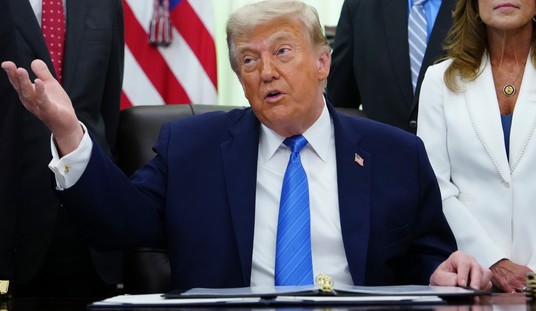
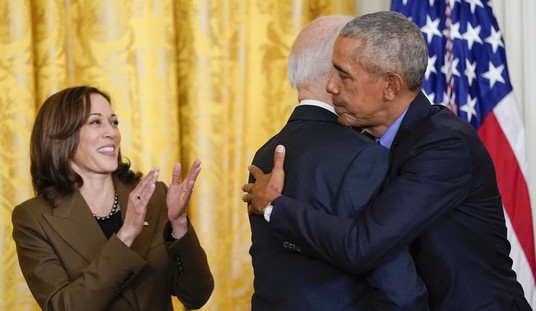
While Time magazine is always more than willing to help President Obama, perhaps the real benefit of their Photoshopping an approving President Reagan next to Obama is that it allows the rest of us to contrast the personalities and worldviews of the two men.
In the Washington Examiner, Ed Meese writes, “Reagan was always underestimated by his friends and by his opponents:”
He actually believed that was an advantage. Many political opponents thought he would be an easy mark. But his overwhelming victories in the four elections he won revealed the folly of such suppositions.
AdvertisementReagan was friendly to all that he dealt with. He had no “secret persona” for those close to him. He was the same man whether talking to top staff members in the Oval Office or when addressing 10,000 people at a political rally. His integrity and sincerity were obvious — one reason he was so genuinely admired by the American people.
It was also a tremendous source of strength for those of us who worked for him. At every stage of his political career, we were confident he would fully support us if we did the right thing. In the first Cabinet meeting after his inauguration, he stated that what he wanted to hear from us was the truth and what was right to do for the American people. Politics, he insisted, should never color our advice.
With that principled approach to the presidency, he won the confidence and approval of the American people. His leadership and his optimism concerning our nation’s future remain hallmarks of his time in office.
Contrast a man who “had no ‘secret persona’ for those close to him,” with this rather Machiavellian passage:
“I am new enough on the national political scene that I serve as a blank screen on which people of vastly different political stripes project their own views. As such, I am bound to disappoint some, if not all, of them. Which perhaps indicates a second, more intimate theme to this book–namely, how I, or anybody in public office, can avoid the pitfalls of fame, the hunger to please, the fear of loss, and thereby retain that kernel of truth, that singular voice within each of us that reminds us of our deepest commitments.”
At least with the Gipper, one never had any doubts as to what those deepest commitments were, what their desired outcome was, and what drove them.
Related: In 2007, Noemie Emery reminded us of what Time magazine thought of Reagan while he was in office. On the eve of Reagan’s centennial, Kerry Picket of the Washington Times adds, “We remember what liberals said and what they really think about Ronald Reagan.”


Well, if you are looking for the “deepest convictions” of little lenin, than you certainly should ignore what he says when he speaks to the country at large, because every word of that newspeak is a lie of one sort or another.
But there isn’t any doubt about what he really believes. Every acquaintance in his entire life has been a radical dedicated to tearing down the USA. How could he possibly be any different than them. If all you ever hear is one thing, over and over and over and over, by the time your personailty is shaped, you are that thing. You can’t be anything else.
Perhaps if there was a consistent pattern of actions to indicate otherwise, one could say that people do change.
But this guy hasn’t changed and he won’t. It’s who he is. Everything that appears to be against hard-core America-destroying radicalism is pure subterfuge.
Reagan was perpetually underestimated, Obama is consistently over-estimated. Just one more way that they are mirror images of each other.
The difference couldn’t be more obvious to observers.
Remember just this line from Reagen: “Government is not the solution, government is the problem”. Now tell me how he and Obama can be considered anything but polar opposites. TIME’s cover won’t succeed in giving BHO any respectability, It rather further diminishes him (were that possible) by the comparison.