






Egypt’s fate, I think, will not be settled by the June 16-17 presidential election (second round). It has already been set by the parliamentary election which has given a large majority to the Islamists as well as the ability to write the constitution. If Ahmad Shafiq defeats the Brotherhood candidate, Muhammad al-Mursi, parliament will simply make a strong prime minister (appointed by the Muslim Brotherhood) and a weak president.
But, of course, a victory for Shafiq would be significant, indicating that a lot of those who voted for Islamists in the parliamentary voting — as many as one-third of them, about 25 percent of the total population — are not eager for a Sharia state. That could be added to another 25 percent (40 percent of them Christians) who are anti-Islamist.
Shafiq, a former general and prime minister, is widely seen as a man of the old regime. Think of it this way. Suppose President Husni Mubarak had died or been disabled prior to 2011, or that the establishment had revolted and gotten rid of Mubarak on its own and chosen a successor. Shafiq might have become the new president and there would never have been a “revolution” in Tahrir Square.
So there you have it. One candidate wants basic continuity with more freedom; the other, al-Mursi, wants an Islamist state, Sharia law, and jihad. That’s a pretty clear choice.
The campaign is marked by the Brotherhood’s outspoken extremism and Shafiq’s relative moderation. It did not have to be that way. The Brotherhood could have continued to feign moderation, but perhaps its explicit radicalism is an attempt to capture the Salafist vote.
Shafiq also could have played the radical demagogue making big promises but he isn’t doing so. His strategy is apparently to play on Egyptians’ fear of radical change and instability, the idea that crime and anarchy are out of control and massive violence along with economic collapse are on the horizon. Shafiq, then, is the candidate of stability.
Let’s take a typical Shafiq stump speech. It includes the following points:
–Refusing to demagogue on the Palestine issue. “Choose a country with Cairo as its capital, not in Palestine….Some people want Palestine to be our capital. The Palestinian cause is in our hearts but our capital will remain Cairo and from our capital we will strive to help Palestine become an independent state with East Jerusalem as its capital.”
That statement took guts for several reasons. He gives an alternative view of the issue, saying that the Brotherhood would sacrifice Egyptian interests, getting the country into war with Israel. While the Brotherhood—and even the U.S.-favored but defeated “moderate Islamist” candidate challenged Israel’s right to exist, Shafiq openly advocates a two-state solution without any tricks. Notice he said “East Jerusalem” and not, as Arab politicians often do, “Jerusalem.”
–Avoid adventurous actions that might get Egypt into war. “Choose me as I defend Egyptian security; defending Sinai which others will let slip from our hands….Defend the Suez Canal, which others want to give to foreigners.” Why would Egypt lose the Sinai or the Suez Canal? Because if it got into a war with Israel and was defeated, there could be a repeat of the situation that prevailed from 1967 and for many years afterward in which Israel was controlling all or part of Sinai and the Canal couldn’t function normally.
–Don’t be bloodthirsty. He accepted the life sentence for Mubarak and a former interior minister (not a death sentence) and six security officials being found innocent. Egypt should not be eager to throw people into prison but move toward democracy: “The days of political imprisonment are gone. Rest assured your sons and daughters are safe enough to express their opinions, even if their’s oppose mine.”
–Real Muslim-Christian peace in Egypt. “The Brotherhood accuses our Coptic brothers of treason and tries to stop them from practicing their given right to vote. How do you expect them to believe you when you speak kindly to them in press conferences and threaten them in their homes and stores?”
–Economic stability. “I am sure that as soon as I am elected all international investments that are halted now will return. Housing investments, agricultural investments, industrial investments and tourism will return to as they were, and better,” An Egypt run by the Brotherhood is not likely to attract foreign investment or put the emphasis on economic progress.
The idea that total control of the government by the Brotherhood will moderate that group could not be more foolish. We have already seen over the last year how successes make the Islamists more extreme and intolerant.
Meanwhile, the liberal reformers become even more irrelevant as they condemn both sides or, in some cases, might even prefer the “pro-revolution” Brotherhood against the hated “military and establishment-backed” Shafiq. That seems to be the view of Western governments, media, and “experts,” too, even though they are gradually becoming more frightened of the Islamists.
Now, as cracked as this seems, the left-wing party, al-Nour, has endorsed the Brotherhood candidate for president! [Here’s the tweet in Arabic.] Why? Because they agree on hating America, Israel, the army, and the old regime. By the way, al-Nour’s leadership was among the “Facebook kids” who began the revolution in January 2011. They were allied with the Brotherhood then, too.
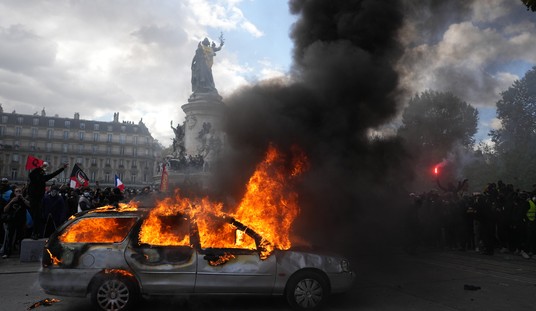
Of course, even if Shafiq wins, the Islamist-dominated parliament will really rule the country. Moreover, as we saw with violent attacks and arson at four of Shafiq’s election offices, there will be lots of violence from Salafists and possibly Brotherhood people. Christians, women who exercise certain rights and secularists will be attacked and at times killed.
The only way out would be a Shafiq-army alliance, giving the president — who has no political party and no organized base of support in parliament — some muscle. Following a period of massive violence, chaos, and economic catastrophe, that might eventually lead Egypt back to the kind of military regime that governed between 1952 and 2011, albeit with far more personal freedom and (possibly fixed) elections. Like it or not, that may well be the best possible option.
But first we have to see who is going to be Egypt’s president.

Join the Conversation
VIP members get the ability to comment on articles.